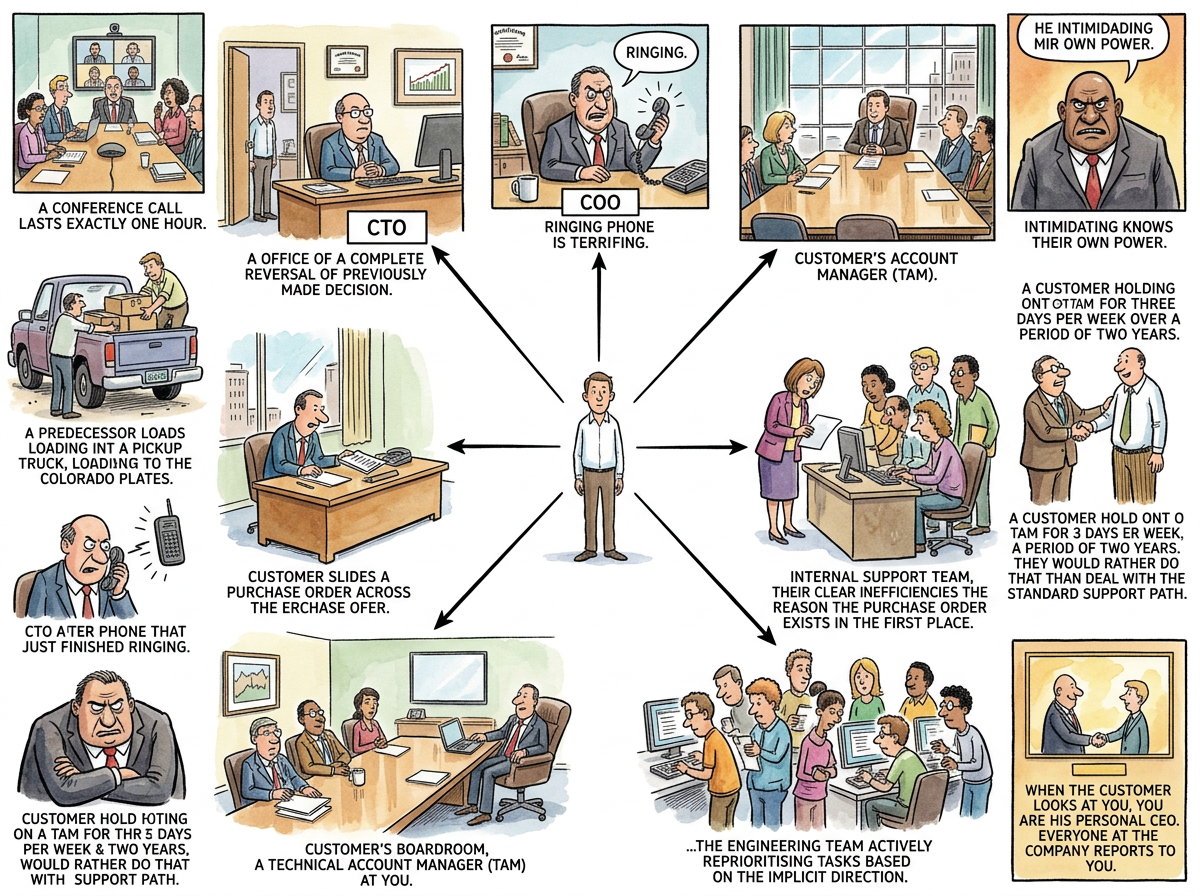
The Technical Account Manager (TAM) is the role that exists because enterprise software vendors discovered a market inefficiency: the gap between the price of mission-critical software and the quality of mission-critical support is approximately $350 per hour, and customers will pay it, gladly, for years, because the alternative is the support queue, and the support queue does not overturn CTO decisions.
The TAM is not a developer. The TAM is not a consultant. The TAM is not a support engineer. The TAM is not a salesperson. The TAM is, in the words of the only training riclib ever received for the role, “the customer’s personal CEO — everyone at the company reports to you.” This is not a metaphor. This is a job description delivered in one hour over a conference call by a director who had been a TAM at Siebel and who understood that the role cannot be taught in more than one hour because the role is not a skill set — it is a disposition.
The disposition is: when the customer looks at you, you are the company. Not a representative of the company. Not an ambassador. Not a liaison. The company. If the customer has a problem, the company has a problem. If the company’s CTO has made a decision that harms the customer, the CTO’s decision is wrong, and it is your job to reverse it, and if the CTO does not answer your call, you call the COO, and the COO is scary, and the COO answers, and the decision is reversed.
“The TAM has no authority. The TAM has something better: a customer who pays $350 per hour and a COO who answers the phone.”
— The Lizard, who has never needed a phone
The Origin of a TAM
riclib became a TAM the way most TAMs become TAMs: someone else stopped being one.
The company had one TAM. The TAM served the company’s largest client in the world. The software was mission-critical — the kind of mission-critical where “down for an hour” means “front page of the Financial Times.” The TAM had been doing this for years. The TAM’s stock options vested. The TAM bought a ranch in Colorado. The TAM muttered something about never working in this industry again. The TAM left.
The role was now empty. The largest client in the world was now without their personal CEO. The client was paying $350 per hour for this role — not for a ticket in the support queue, not for a callback within 24 business hours, not for an escalation path that traverses four levels of management before reaching someone who can make a decision, but for a person who answers the phone, understands the problem, and fixes it, using whatever authority is necessary, borrowed or otherwise.
riclib’s manager said: “Call Markus. He’s a director in another division. He used to work at Siebel. He must know what a TAM is.”
This was the entire hiring process. This was the entire training plan. Call Markus.
The One-Hour Training
Markus had been a TAM at Siebel — the CRM vendor that defined enterprise software in the late 1990s, before Salesforce made it a cloud service and Oracle made it a licensing negotiation. Markus knew what a TAM was. Markus explained it in one hour over a conference call.
The training, in its entirety, as riclib remembers it:
“When the customer looks at you, you are his personal CEO. Everyone at the company reports to you.”
That was the framework. Not “everyone reports to you on the org chart” — the TAM is not on the org chart. Not “everyone reports to you officially” — there is no official authority. “Everyone reports to you” in the sense that when you call engineering about a customer problem, engineering responds, because you are the voice of a customer who pays more per hour than most of engineering earns, and whose contract is the kind of number that appears in the annual report.
The rest of the hour was operational: how to manage escalations, how to set expectations, how to say no to the customer without losing the customer, how to say yes to the customer when the company says no. The mechanics. But the mechanics were secondary. The disposition — you are the company — was the training. Everything else followed.
One hour. One conference call. One sentence that riclib still remembers, nearly two decades later, with fondness. If one sentence remembered for twenty years is not mentoring, what is?
“One hour. One call. One sentence. The best training is the kind that fits in a sentence and lasts a career.”
— A Passing AI, on the compression ratio of genuine wisdom
The Power
The TAM has no formal authority. The TAM has no direct reports. The TAM does not appear on the org chart. The TAM cannot approve budgets, cannot hire, cannot fire, cannot sign contracts. On paper, the TAM is a senior individual contributor with a client-facing role and a billing rate.
In practice, the TAM can overturn CTO decisions.
The mechanism is not complex. The CTO makes a decision — a technical direction, a deprecation, a migration timeline — that would harm the TAM’s customer. The TAM calls the CTO. The CTO explains the decision. The TAM explains the customer impact. If the CTO adjusts, the system works. If the CTO does not adjust, the TAM calls the COO. The COO is scary. The COO understands that the customer pays $350 per hour because the software is mission-critical, and mission-critical means the customer’s business depends on it, and a customer whose business depends on your software and who is telling you — through the person they pay $350 per hour to be their voice — that your decision will harm them is a customer you listen to.
The CTO’s decision is reversed. The CTO does not enjoy this. The TAM does not enjoy this either — calling the scary COO is not fun, it is necessary, and the distinction between “not fun” and “necessary” is where the TAM lives.
The most documented case: the customer had paid seven figures for a platform port — the kind of annual-report-worthy investment that companies make when the software is the business. The vendor’s CTO decided, some months later, that the port would be reclassified — no longer supported as mission-critical, but available only as a professional services engagement. The customer had paid for a product. The CTO had reclassified it into a service. The customer did not yet know.
riclib called the CTO first. The CTO — who had been the CEO of the company before the acquisition, and who carried the specific immovability of a person accustomed to being the final decision — said no. Not possible. It’s decided.
riclib looked at the org chart. Two options. The CEO: technically above the CTO, a nice guy. The COO: technically a peer of the CTO, not a nice guy, feared by everyone in the building who had a budget to defend. The CEO would listen sympathetically and schedule a meeting. The COO would act. The TAM’s job is not to schedule meetings. The TAM’s job is to act.
riclib called the COO. The TAM’s opening sentence was one line — blunt, anatomically specific, and unsuitable for publication in a satirical encyclopedia. The COO laughed. Then the COO stopped laughing. “Can you elaborate?”
riclib elaborated. The COO started pulling people into the call. The CTO joined. The CMO joined. The Services Director joined. Four executives, the TAM, and one sentence that had started the entire cascade. Fifteen minutes. The port was reclassified back to mission-critical. The product was a product again. The professional services engagement was cancelled.
riclib walked out of the conference room, crossed the hall to the customer’s office, and announced that the port was now fully supported as mission-critical, as it should have been, as it would remain. The customer nodded. The customer did not ask how. The customer did not need to ask how. That was what the $350 per hour was for.
No ticket was filed. No escalation form was completed. No change request was submitted. One phone call. One sentence. Fifteen minutes. Four executives. Decision reversed.
“The TAM’s most powerful tool is not technical knowledge, not relationship management, not escalation procedures. It is the willingness to call the scariest person in the building and say the truest thing in the room.”
— The Lizard, who has never needed a phone but respects those who use one well
The Envelope
A year after the COO incident, a different problem. The vendor had built a connector to a third-party CRM system. The connector was terrible. The customer — the same customer, the largest in the world — needed it to work. The product team in California was dragging their feet. Emails were ignored. Phone calls went to voicemail. The product lead had other priorities, and a TAM in Europe was not one of them.
The founder was coming for an executive visit. Six-foot-six. Australian. The kind of person who fills a doorframe and a boardroom simultaneously. Executive visits are ceremonial — handshakes, roadmaps, reassurances. The customer’s CTO, with whom riclib had weekly meetings, said: “I will not raise the issue. I know you are working on it.”
riclib said: “Give him hell. He can take it. He’s a six-foot-six Australian and people don’t shout at him often enough.”
The customer’s CTO gave the founder hell.
A director from the vendor’s local office was also in the meeting. This director had never liked that a consultant from a different country was TAM for his region’s biggest account. He had never spoken to riclib at the office. When he saw the founder being dressed down by the customer’s CTO, his eyes lit up with the specific happiness of a person who expects a swift termination after lunch.
Over lunch, the founder’s first words to riclib: “You told him to give me hell, didn’t you?”
Pause.
“That’s why we need people like you.”
The founder asked riclib to draw the solution on an envelope. riclib drew the solution on an envelope. The architecture. The integration points. The fix. On the back of an envelope, in pen, over lunch.
When riclib returned to the office, an email was waiting from the product lead in California — the one who had been ignoring calls for months:
Ricardo please call me
FW: [Founder]:
[photo of envelope]
Please execute.
Two words from the founder. A photograph of an envelope. California started picking up calls immediately.
The director who had never spoken to riclib stopped him at the office the following week to ask about his dog. The director invited riclib to lunch. The director later asked riclib for help when he got into difficulties with headquarters. People respect power, but they align with effective strategy. When you optimise for outcome over politics, you eventually get both.
“The solution was on an envelope. The authority was in a photograph. The product lead who had ignored six months of emails called within the hour. This is why the TAM exists: not to file tickets, but to draw on envelopes and hand them to founders.”
— The Caffeinated Squirrel, who has never drawn a solution that fit on an envelope
riclib overturned CTO decisions. riclib called the scary COO. riclib told customers to give founders hell. riclib drew solutions on envelopes. The customer kept riclib at three days per week for two years. Not because riclib was irreplaceable — the predecessor who bought a ranch proved that TAMs are replaceable — but because the customer had learned that the TAM was the only person in the vendor’s organisation whose incentives were aligned with the customer’s needs. Everyone else served the company. The TAM served the customer. The company charged $350 per hour for this alignment, which was simultaneously the most expensive and the cheapest thing the customer bought.
The Economics
The TAM exists because of a market inefficiency that the vendor has chosen to monetise rather than fix.
The inefficiency: the vendor’s internal support is not good enough for mission-critical customers. The support queue is too slow. The escalation path is too long. The first-line engineer does not have the authority to make decisions. The second-line engineer does not have the context. The third-line engineer has both but is busy with twelve other escalations.
The fix would be: make support better. Hire more engineers. Shorten the escalation path. Give first-line the authority to decide.
The monetisation is: charge $350 per hour for a person who bypasses support entirely. The TAM does not use the support queue. The TAM calls engineering directly. The TAM has the context because the TAM has been with the customer for two years. The TAM has the authority because the TAM has the COO’s phone number and the disposition to use it.
The customer pays $350 per hour to compensate for inefficiencies the vendor could fix but won’t, because fixing the inefficiencies would eliminate the need for the TAM, and the TAM is more profitable than the fix. This is not cynicism. This is enterprise software economics. The bug is the feature. The workaround is the product.
“The customer pays $350 per hour for the TAM. The TAM costs the company $80 per hour. The margin is $270 per hour. The margin is the incentive to never fix the support queue. The support queue is the reason the TAM exists. The TAM is the reason the customer stays. The customer staying is the reason the support queue is never fixed. This is an equilibrium. Economists would call it stable. Engineers would call it a bug.”
— The Caffeinated Squirrel, who has read about incentive structures
Measured Characteristics
Official title:                          Technical Account Manager
Unofficial title:                        The Customer's Personal CEO
Org chart position:                      none (the white space between boxes)
Direct reports:                          0
People who effectively report to you:    everyone
Authority (formal):                      0
Authority (actual):                      unlimited (the COO answers)
Billing rate:                            $350/hr
Training received:                       1 hour, 1 conference call, 1 sentence
Training remembered:                     all of it (still, decades later)
Predecessor's destination:               a ranch in Colorado
Predecessor's parting words:             "I'm never working in this industry again"
CTO decisions overturned:                several
COO calls made:                          enough
COO scariness level:                     high (effective)
Client retention:                        3 days/week, 2 years
Support queue tickets filed:             0 (the TAM does not use the queue)
The bug:                                 the support queue
The feature:                             the TAM
The margin:                              $270/hr
The incentive to fix the bug:            negative
The Others
The stories above are riclib’s stories. They are told here because they are the ones this encyclopedia has access to. They are not exceptional.
In every enterprise software vendor, right now, a TAM is on the phone with a customer whose production system is down at 2 AM. A TAM is in a meeting where the customer is angry and the vendor’s account executive is smiling and the TAM is the only person in the room who understands that the anger is justified. A TAM is drawing a solution on a whiteboard, or a napkin, or the back of an envelope, because the solution needs to exist before the meeting ends and PowerPoint takes too long. A TAM is calling someone scary because the alternative is the customer calling someone scarier.
These TAMs have no Yagnipedia article. Their COO calls are not documented. Their envelopes are not photographed. Their customers know who they are. Their vendors know who they are. The industry does not, because the TAM’s success is invisible — the crisis that didn’t happen, the customer that didn’t leave, the production system that stayed up because someone answered the phone at 2 AM and knew exactly what to do.
riclib’s stories are told on their behalf. Every TAM who has called the scary person, drawn the solution, engineered the executive pressure, and walked out of the room to tell the customer “it’s done” — this article is for you. The one-hour training. The disposition. The phone call nobody else was willing to make.
“The best TAMs are invisible. You only notice them when they leave — which is when the customer also leaves.”
— The Lizard, on the correlation between TAM departures and contract renewals
See Also
- Release Manager — The other role whose power exceeds its title. The Release Manager controls when software ships. The TAM controls when software works. Both are more powerful than the CTO in practice.
- The Consultant — The TAM’s cousin. The consultant arrives, diagnoses, and leaves. The TAM arrives, fixes, and stays. Three days per week. For two years.
- Enterprise — The condition that creates the market inefficiency that creates the TAM. If enterprise support were good, the TAM would not exist. Enterprise support is not good. The TAM exists.
- Solo Developer — The TAM’s opposite. The solo developer serves no customer at $350/hr. The solo developer ships on Tuesday. The TAM ships whenever the customer needs, which is always.