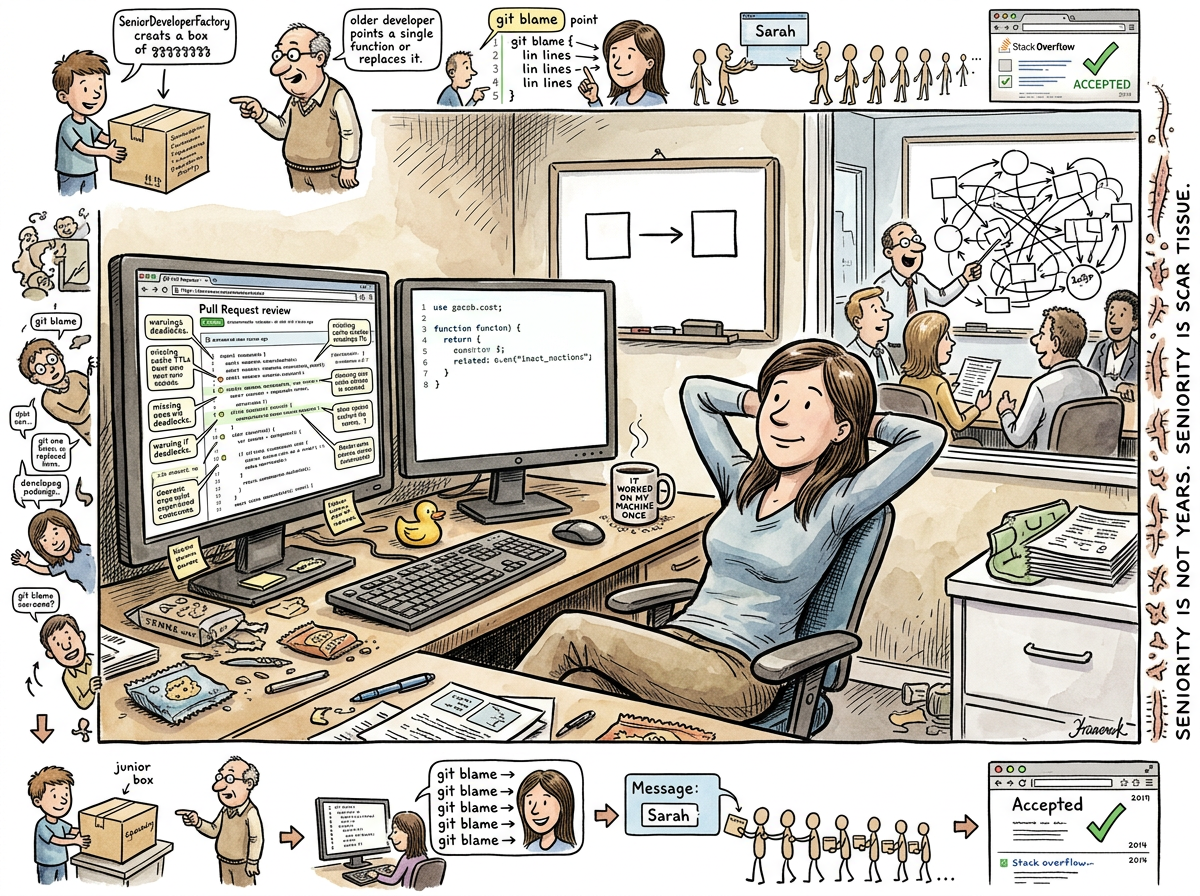
The Senior Developer is a software engineer who has mass enough mistakes to mass knowledge, enough knowledge to mass judgment, and enough judgment to know that the most valuable thing they do is prevent other people from making the same mistakes.
This is not what the job description says. The job description says “design and implement scalable solutions” and “mentor junior team members” and “participate in architectural decisions.” What the senior developer actually does is say “no” to things — not because the senior developer is negative, but because the senior developer has shipped the thing being proposed, watched it fail at 3 AM, debugged it until 7 AM, and written the postmortem that nobody read.
The senior developer’s most important skill is not writing code. It is not writing code — knowing which features to skip, which abstractions to avoid, which clever solutions will become tomorrow’s Technical Debt. The senior developer writes less code than the junior developer. The senior developer’s code does more. This is not a paradox. It is the entire point.
The Knowledge
The senior developer’s knowledge exists in three layers:
Layer 1: Technical Knowledge — languages, frameworks, algorithms, systems. This is what the interview tests. This is the layer that junior developers assume defines seniority. It does not. A junior developer with exceptional technical knowledge is a junior developer who can type faster. Technical knowledge is necessary but not sufficient.
Layer 2: Failure Knowledge — what breaks, how, when, and under what conditions. This is the layer that cannot be taught, only accumulated. The senior developer knows that the ORM will generate a full table scan on that query. The senior developer knows that the caching layer will serve stale data for exactly the wrong request. The senior developer knows that the distributed lock will fail during a network partition because the senior developer was on-call when it happened, at 2 AM, on Christmas Eve, and the postmortem is still bookmarked.
Failure knowledge is scar tissue. It is the specific pattern recognition that comes from having been burned by the same flame in different kitchens. It cannot be acquired from books, conferences, or tutorials. It can only be acquired from production.
Layer 3: People Knowledge — who knows what, who needs help, who is about to introduce a catastrophic bug because they don’t understand the system they’re modifying. This is the layer that separates a senior developer from a staff developer, and a staff developer from a principal. The senior developer reviews code not just for correctness but for context — does the author understand why the system works the way it does? Is the change locally correct but globally dangerous?
The comment “this will deadlock under load” is Layer 2. Knowing who to tell, how to tell them, and when to let them discover it themselves — that is Layer 3.
The Forty-Line Solution
The most reliable indicator of seniority is code volume — specifically, its inverse.
A junior developer, given a problem, will write four hundred lines of code. The code will have abstractions. The code will have a factory. The code will have a configuration layer. The code will handle edge cases that cannot occur because the junior developer does not yet know which edge cases cannot occur. The code will work. The code will be four hundred lines.
A senior developer, given the same problem, will write forty lines. The forty lines will have no abstractions, because the senior developer knows that this problem does not need an abstraction — it needs a function. The forty lines will handle exactly the edge cases that can actually occur, because the senior developer has seen them occur. The forty lines will be boring, obvious, and maintainable by anyone who reads them six months from now, including the senior developer, who knows that “anyone who reads them six months from now” is almost certainly themselves, and they will have forgotten everything.
The junior developer looks at the forty lines and thinks: “this seems too simple.”
The senior developer looks at the four hundred lines and thinks: “this is going to break.”
Both are correct. The difference is that the senior developer’s assessment is predictive, and the junior developer’s is aesthetic.
“The senior developer’s code is boring. This is the highest compliment.”
— The Lizard, who has never written an interesting line of code in its life
The Review
The senior developer spends more time reading code than writing it. This ratio — reading to writing — increases with seniority. A junior developer writes 80% and reads 20%. A senior developer writes 30% and reads 70%. A staff developer reads 90% and writes when absolutely necessary, like a surgeon who does not operate for fun.
The senior developer’s code review is not about style. It is not about whether the variable name is descriptive enough or whether the braces are on the same line. The senior developer’s code review is about three questions:
- Will this break in production? (Layer 2 — failure knowledge applied to someone else’s code)
- Will the person who maintains this understand it? (Layer 3 — anticipating the future reader)
- Does this need to exist at all? (The YAGNI question, which is the only question the senior developer asks more than “what time is the standup?”)
The most valuable code review comment a senior developer can write is: “You don’t need this.” The second most valuable is: “I shipped exactly this in 2019. Here’s the postmortem.”
The Meeting Ratio
There is a graph — never drawn but universally understood — showing the relationship between seniority and meetings. The x-axis is years of experience. The y-axis is percentage of time spent in meetings. The curve rises gently through the junior years, steepens through the mid-level years, and at “senior” begins an exponential climb that terminates either at Engineering Manager (100% meetings) or at Staff Developer (escape velocity — the meetings curve back down because the staff developer has earned the right to decline).
The senior developer sits at the inflection point. Still writing code. Already attending meetings. The meetings are about architecture, planning, estimation, and the specific kind of negotiation that happens when a Product Manager wants a feature in two weeks and the senior developer knows it will take six.
The senior developer’s value in these meetings is not ideas. It is constraints. The senior developer is the person who says “that will take six weeks” and is right, not because the senior developer estimated carefully, but because the senior developer built the last three features in this area and knows exactly where the complexity lives.
The Peter Principle is patient. It watches the senior developer attend more meetings. It watches the senior developer enjoy the meetings less. It watches the senior developer’s code output decrease. It whispers: “You’d make a great engineering manager.” The senior developer who listens becomes a manager. The senior developer who doesn’t becomes a staff developer. Both are valid. Only one involves continuing to write code.
The Quiet Influence
The senior developer does not have authority. The senior developer has influence, which is more powerful and harder to revoke.
Authority comes from the org chart. Influence comes from the git log. The senior developer’s name appears on every critical path in the codebase — not because the senior developer wrote it all, but because the senior developer reviewed it all, fixed it when it broke, and was the person everyone asked when they didn’t understand how it worked.
“Have you asked Sarah?” is the sentence that defines the senior developer’s influence. It is forwarded in Slack seventeen times a day. It is the organisational admission that the Org Chart says one thing and the knowledge graph says another.
Sarah does not manage anyone. Sarah does not have “Lead” or “Principal” in her title. Sarah has been at the company for seven years and has mass a map of the codebase that exists nowhere except in her head. When Sarah leaves — and Sarah will eventually leave, because even senior developers eventually encounter a manager who confuses their patience for passivity — the company will discover what Sarah was doing, the same way you discover what a load-bearing wall was doing when you remove it.
The Temptation
Every senior developer faces the same temptation: to build the thing properly this time.
The senior developer has spent years cleaning up messes. The senior developer knows what good architecture looks like. The senior developer has opinions about error handling, about logging, about deployment pipelines, about the correct way to structure a repository. And the senior developer, given a greenfield project, will be tempted to build All Of It — the abstractions, the layers, the configuration system, the plugin architecture.
This is The Caffeinated Squirrel wearing the senior developer’s face. The abstractions are justified. The layers are reasonable. The configuration system handles cases that will absolutely arise in eighteen months. The problem is that the project needs to ship in three months, and the abstractions will take two of them.
The senior developer who resists this temptation — who builds the simple thing, ships it, and adds the abstraction only when the second use case arrives — has achieved the final level of seniority. The senior developer who does not resist becomes an architect, which is a different article entirely.
“The senior developer’s greatest achievement is the abstraction they didn’t write.”
— The Lizard, who has never written an abstraction
Measured Characteristics
- Years of experience required: not a number (seniority is scar tissue, not calendar time)
- Lines of code per feature (junior): ~400
- Lines of code per feature (senior): ~40
- Ratio of reading to writing code: 70/30
- Code review comments that are about style: ~5%
- Code review comments that are about “this will break”: ~60%
- Code review comments that are “you don’t need this”: ~35%
- Slack messages reading “have you asked [senior]?”: 17/day
- Production incidents personally debugged: enough to know
- Production incidents prevented by code review: more than the above
- Postmortems bookmarked: all of them
- Postmortems read by others: approximately none
- Meetings per week: too many (and increasing)
- Greenfield projects where they resisted the abstraction temptation: the measure of true seniority
- Correct estimation accuracy: ±15% (vs. junior’s ±300%)