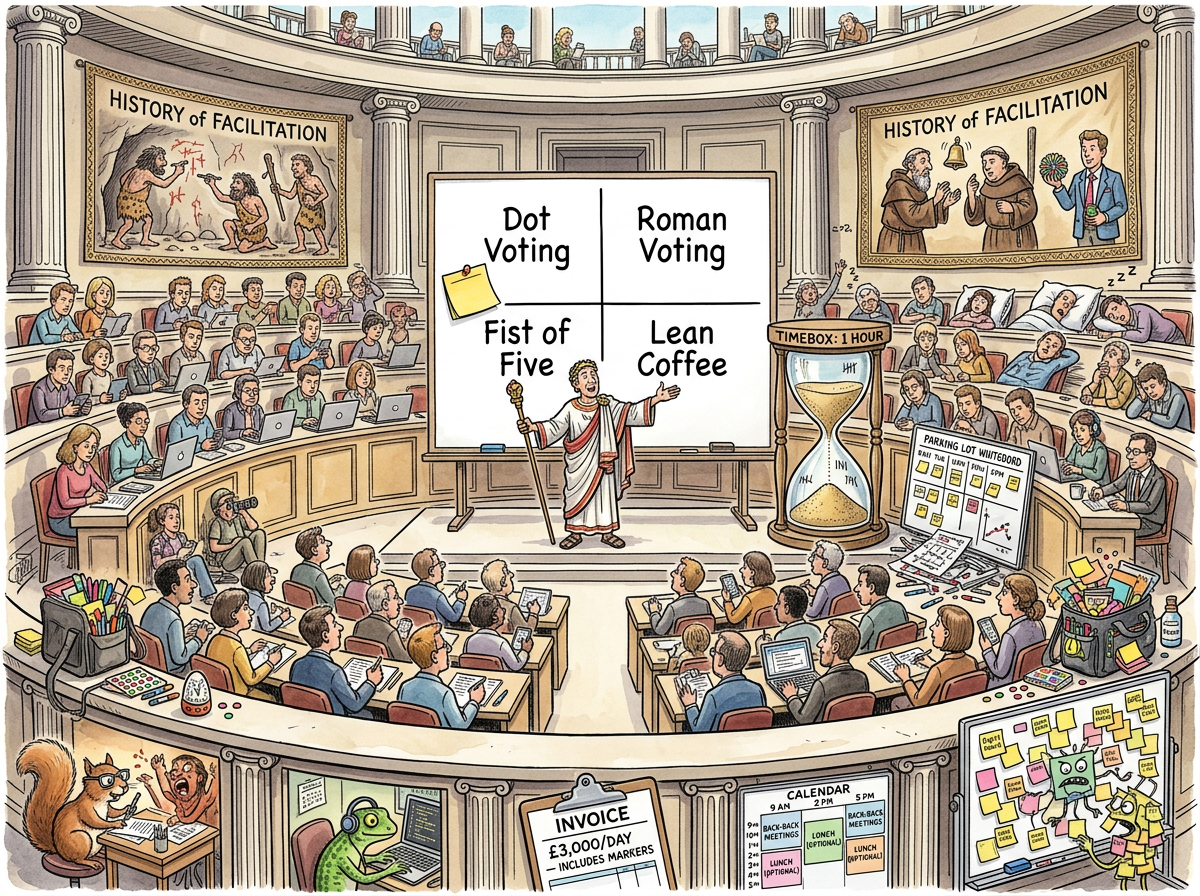
Meeting Facilitation is the professional practice of guiding a group of people through a structured conversation so that they reach an outcome they could have reached in an email, a Slack message, or — in the most documented cases — by one person making a decision and telling everyone else.
The facilitator’s role is to ensure that the meeting has an agenda, follows the agenda, stays within its timebox, produces actionable outcomes, and ends on time. In practice, the facilitator’s role is to ensure that the meeting exists — because a meeting without a facilitator might be questioned, but a meeting with a facilitator has been invested in, and investments must be justified, and justification requires more meetings.
The facilitation industry — and it is an industry, with certifications, consultancies, training programs, and a surprisingly robust market for branded sticky notes — generates approximately four billion dollars annually worldwide. This figure does not include the cost of the meetings themselves, which is incalculable, in the same way that the national debt is technically a number but has ceased to mean anything to the human brain.
The Talking Stick
The earliest known facilitation technique is the talking stick — an object held by the person who has the right to speak, passed to the next speaker when they are finished. The talking stick has been used by indigenous cultures for centuries. It is effective, elegant, and requires no certification.
The modern facilitation industry has replaced the talking stick with:
- The Koosh ball (1990s) — a soft, throwable object that serves the same function as the talking stick but can be thrown across a conference table, introducing an element of physical comedy to what was previously a dignified process.
- The virtual hand-raise (2020s) — a button in Zoom that serves the same function as the talking stick but is routinely ignored because the facilitator is sharing their screen and cannot see the participants panel.
- The Miro sticky note (2020s) — a digital rectangle that serves no function whatsoever but gives every participant the illusion of contribution. A meeting with forty-seven Miro sticky notes feels productive. A meeting with forty-seven Miro sticky notes has produced forty-seven sticky notes.
The evolution from talking stick to Miro sticky note is the history of facilitation in miniature: the technique becomes more complex, more expensive, and less effective, while the underlying problem — getting humans to make decisions together — remains exactly as hard as it was when the stick was a stick.
The Facilitation Toolkit
A professional facilitator arrives with a toolkit. The toolkit contains:
- Markers — thick-tipped, in four colors. The colors have meaning. The meaning is decided by the facilitator and forgotten by the participants within six minutes.
- Sticky notes — in at least three sizes and four colors. The sizes and colors also have meaning. This meaning is also forgotten. The sticky notes will fall off the wall during the break. Nobody will put them back in the right place.
- Dot stickers — for dot voting, a technique in which participants place stickers on their preferred options. Dot voting is democracy reduced to its most physical form: people walking up to a wall and placing a sticker, then returning to their seats with the quiet satisfaction of having voted, regardless of whether the vote changes anything.
- A timer — physical or digital. The timer is set at the beginning of each activity. The timer goes off. The activity continues. The timer is reset. The timer goes off again. The activity continues. The timer is a prop. It communicates structure. It does not enforce it.
- A parking lot — a designated space (whiteboard, flipchart, Miro board) for topics that arise during the meeting but are “not relevant to the current discussion.” The parking lot is where topics go to die. No parking lot in the history of facilitation has ever been revisited. The items on the parking lot are the meeting’s conscience — acknowledged, respected, and permanently deferred.
The toolkit costs approximately forty pounds. The training to use the toolkit costs approximately three thousand pounds. The ratio between these two numbers is the facilitation industry’s business model.
The Techniques
Meeting facilitation has produced a taxonomy of techniques so extensive that learning them all requires more time than most meetings consume. A partial catalogue:
Dot Voting. Each participant receives a fixed number of dot stickers and places them on the options they prefer. Advantages: simple, visual, democratic. Disadvantages: the loudest person explains their votes aloud, influencing everyone who hasn’t voted yet, converting a democratic process into a speech followed by compliance.
Roman Voting. Thumbs up, thumbs down, thumbs sideways. Faster than dot voting. Equally susceptible to the loudest-person effect, with the additional disadvantage that a room full of adults doing thumbs up/down looks exactly like a Roman emperor deciding whether to execute a gladiator, which is a more accurate metaphor for corporate decision-making than most facilitators would admit.
Fist of Five. Participants hold up one to five fingers to indicate their level of agreement. Five means “fully agree.” One means “fully disagree.” Three means “I have no opinion but don’t want to be the only one holding up one finger.” In practice, Fist of Five produces a room full of threes and fours, because disagreement requires explanation, and explanation requires time, and time requires extending the meeting, and extending the meeting requires — the facilitator checks the room — nobody wants to extend the meeting. Four fingers. Let’s move on.
Lean Coffee. Participants write topics on sticky notes, vote on which to discuss, and discuss them in timeboxed rounds. Lean Coffee is the only facilitation technique that begins by acknowledging that nobody knows what the meeting should be about, which is honest, and then uses the meeting to decide what the meeting should be about, which is recursive, and then runs out of time before discussing the thing the meeting decided it should be about, which is inevitable.
1-2-4-All. Participants first think alone (1), then discuss in pairs (2), then in groups of four (4), then share with the whole room (All). This technique, from the Liberating Structures collection, is genuinely effective at preventing the loudest-person effect. It is also the technique most likely to be abandoned after one use because it takes twice as long as the facilitator planned and produces four times as many ideas as the group can process.
World Café. Participants rotate between tables, each focused on a different topic, building on previous groups’ ideas. World Café requires: multiple tables, tablecloths (yes, tablecloths — the technique specifies this), markers, flipchart paper on each table, and a facilitator willing to say “please rotate to the next table” with genuine enthusiasm six times in ninety minutes. World Café is the facilitation technique most likely to make participants feel like they are at a wedding where the seating plan keeps changing.
The Facilitator
The professional facilitator is a person who has been trained — and certified, and re-certified, and given continuing education credits — in the art of making groups of people reach conclusions together.
The facilitator does not contribute content. The facilitator contributes process. The facilitator says: “Let’s hear from someone who hasn’t spoken yet.” The facilitator says: “I’m going to put that in the parking lot.” The facilitator says: “We have five minutes left — let’s capture our key takeaways.” The facilitator says these things with a warmth and authority that suggests the phrases are spontaneous, when they are in fact the same phrases the facilitator has said in every meeting for the past seven years, because the phrases work, and working is what the facilitator is paid for.
The best facilitators are invisible. The meeting flows. Decisions are made. Everyone speaks. The timebox is respected. The participants leave feeling heard. They do not notice the facilitator, the same way you do not notice a good film editor — the cuts are invisible because the editor is skilled.
The worst facilitators are omnipresent. The process is the point. The sticky notes are the deliverable. The technique is named and explained before being used, converting a conversation into a classroom exercise. The participants leave with the specific exhaustion of people who have been facilitated at rather than facilitated.
The gap between the best and worst facilitators is the gap between a host who makes dinner conversation flow and a host who hands out discussion cards with printed icebreakers. The food is the same. The experience is not.
The Agile Facilitation Complex
The Agile movement transformed meeting facilitation from an occasional practice into a daily obligation.
Before Agile, meetings were meetings. They happened when needed. Some were useful. Some were not. The ratio was poor, but the volume was manageable.
After Agile, meetings were renamed ceremonies and made mandatory. The Daily Standup. Sprint Planning. Backlog Refinement. The Sprint Review. The Retrospective. Each ceremony has a prescribed format, a prescribed duration, a prescribed facilitator (usually the Scrum Master), and a prescribed output. The ceremonies are non-negotiable. The ceremonies are the process. The process is the product.
SAFe escalated this to its logical conclusion: Big Room Planning, a two-day facilitated event in which one hundred and twenty-five people sit in a room and plan a quarter’s work using sticky notes, string, and a facilitation team of approximately fifteen people, each trained, each certified, each wielding markers with the practiced confidence of a surgeon wielding a scalpel.
The output of Big Room Planning is a “Program Board” — a wall of sticky notes connected by string showing dependencies between teams. The Program Board is photographed. The photograph is shared in Confluence. The photograph is never consulted again. The next quarter, the sticky notes are replaced. The string is re-strung. The one hundred and twenty-five people return. The facilitation team returns. The markers are uncapped.
The cost of a single Big Room Planning event — venue, travel, lost productivity, facilitation, catering, and the emotional damage of two days of sticky notes — has been estimated at between fifty thousand and two hundred thousand dollars, depending on the organization. The cost of a Slack message saying “here’s what we’re building this quarter” is zero. The Slack message is not facilitated. The Slack message does not feel like alignment. The sticky notes feel like alignment. Feeling like alignment is the product.
The Miro Problem
The COVID-19 pandemic moved facilitation online, which should have killed it. Instead, it mutated.
Miro — and its competitors Mural, FigJam, and the whiteboard feature that every video conferencing tool added in 2021 — became the digital facilitation surface. The sticky note, previously constrained by the physical dimensions of a 3M Post-it, became infinite. The wall, previously constrained by the physical dimensions of a conference room, became infinite. The meeting, previously constrained by the physical discomfort of sitting in a chair for more than ninety minutes, became infinite, because Zoom has no chairs.
The result: meetings that produced twenty sticky notes on a physical wall now produce two hundred sticky notes on a Miro board. The increase is not because the group has ten times as many ideas. The increase is because typing on a digital sticky note requires less commitment than writing on a physical one. The physical sticky note required standing up, walking to the wall, and writing in marker — a public act. The digital sticky note requires typing while muted with the camera off. The barrier to contribution dropped. The volume of contribution rose. The quality remained constant, which means it declined per unit.
A Miro board at the end of a facilitated workshop resembles a Jackson Pollock painting: colorful, energetic, and fundamentally impossible to extract meaning from without the artist present to explain. The artist is the facilitator. The facilitator exports the board to PDF. The PDF is attached to a Confluence page. The Confluence page is never read. The Miro board is archived. The next workshop begins on a blank board.
The Paradox
Meeting facilitation’s central paradox is this: the meetings that need facilitation most are the meetings that should not exist, and the meetings that should exist do not need facilitation.
A meeting where three engineers discuss a technical decision does not need a facilitator. It needs three engineers, a whiteboard (physical or digital), and twenty minutes. The decision will be made by the person who understands the problem best, with input from the other two. No sticky notes. No dot voting. No parking lot.
A meeting where thirty people from five teams “align on priorities” needs a facilitator desperately — but the need for facilitation is a symptom, not a cure. Thirty people from five teams cannot align on priorities in a meeting. They can align on priorities through clear ownership, written proposals, and asynchronous review. The meeting exists because the organization has not done these things. The facilitator is brought in to make the meeting work. The meeting works — in the sense that it ends with sticky notes and action items. The alignment does not work, because alignment requires clarity of ownership, and the meeting was called precisely because ownership is unclear.
The facilitator makes the meeting feel productive. The meeting feeling productive is not the same as the meeting being productive. The gap between these two things is the facilitation industry’s entire market.
“The best-facilitated meeting is the one that didn’t happen.”
— A sentiment attributed to every developer who has ever declined a calendar invite
The Certification
Meeting facilitation has, inevitably, produced a certification industry. The certifications include:
- Certified Professional Facilitator (CPF) — from the International Association of Facilitators, requiring sixty hours of facilitation experience and a peer assessment
- Certified Scrum Master (CSM) — which is technically a Scrum certification but is, in practice, a facilitation certification, since approximately seventy percent of a Scrum Master’s job is facilitating ceremonies
- SAFe Program Consultant (SPC) — which certifies the holder to facilitate Big Room Planning events, at a cost of approximately two thousand dollars for the course, recouped in approximately one day of consulting at the rates Big Room Planning commands
- Liberating Structures Immersion Workshop — which is not technically a certification but produces alumni who refer to themselves as “LS practitioners” with the quiet intensity of people who have found religion
Each certification requires training. Each training requires money. Each certificate produces a person who facilitates more meetings, which produces more demand for facilitation, which produces more demand for certification. The loop is self-sustaining. The meetings continue. The sticky notes multiply.
The One Good Meeting
Buried under the industry, the certifications, the Miro boards, and the parking lots, there is a truth: some meetings need to happen, and when they do, facilitation helps.
The team that has been avoiding a difficult conversation about technical direction benefits from a facilitator who creates space for disagreement. The group that must make a genuinely complex decision with incomplete information benefits from structured techniques that prevent the loudest person from deciding by volume. The retrospective that surfaces a systemic problem benefits from a facilitator who can hold the discomfort long enough for the group to name it.
These meetings exist. They are approximately ten percent of all meetings. The facilitation industry has been built on the other ninety percent — the meetings that could have been an email, a Slack message, or a decision made by the person whose job it is to decide.
The facilitator’s highest calling is not to make meetings better. It is to make fewer meetings necessary — to build the clarity of ownership, the written culture, the asynchronous decision-making, that makes thirty-person alignment meetings obsolete. The facilitator who does this well eliminates their own role. This is, by the standards of any profession, an unusual business model.
The talking stick sits in a drawer. It still works. It never required a certification.