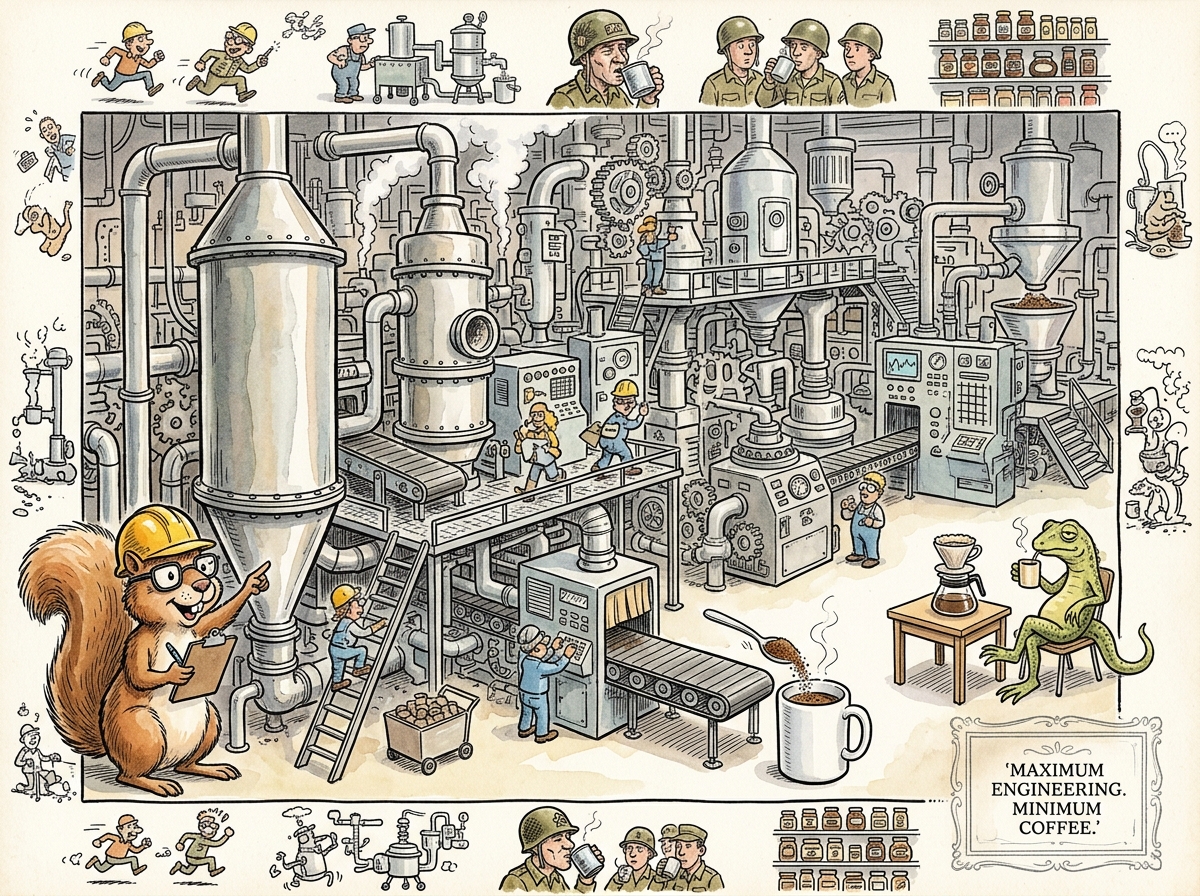
Instant coffee is coffee that has been brewed, dehydrated into a soluble powder or granule, and reconstituted by adding hot water. It is to coffee what a screenshot of code is to code — it preserves the general appearance while removing everything that made it functional.
The Test Coordinator suggested this entry for the Yagnipedia with the emoji sequence 🤭🤭, which in the Test Coordinator’s characteristically understated communication style represents approximately the same level of provocation as a declaration of war.
“And instant coffee then too 🤭🤭”
— The Test Coordinator, via WhatsApp, knowing exactly what he was doing
The Process
Instant coffee is produced by one of two industrial methods, both of which involve an amount of engineering that the Squirrel finds deeply satisfying and that the Lizard finds deeply suspicious:
Spray-drying — brewed coffee is atomised into a fine mist and blasted with hot air at 250°C inside a drying tower several stories tall. The water evaporates in seconds. The soluble coffee solids fall as a powder. The volatile aromatic compounds — the things that make coffee smell and taste like coffee — evaporate along with the water, because they are volatile, because that is what volatile means.
Freeze-drying — brewed coffee is frozen to -40°C, then placed in a vacuum chamber where the ice sublimates directly to vapour (solid → gas, skipping liquid). This is a more expensive and more gentle process that preserves slightly more flavour than spray-drying, in the same way that a gentle car crash preserves slightly more of the car than a violent one.
Both processes involve more engineering per cup of coffee than any other preparation method in existence. Spray-drying towers, vacuum sublimation chambers, cryogenic freezers, industrial centrifuges, atomisation nozzles. The infrastructure rivals a semiconductor fabrication plant. The output is worse than pouring hot water over ground beans in a sock.
This is the Squirrel’s natural habitat: maximum complexity, minimum quality. The most over-engineered beverage in human history, producing a result inferior to every other method, including methods that predate electricity.
The History
Instant coffee was invented in 1901 by Satori Kato, a Japanese-American chemist in Chicago, and commercialised in 1938 by Nestlé under the brand Nescafé. The product was adopted by the United States military during World War II, which issued instant coffee in field rations because it was lightweight, shelf-stable, and did not require equipment.
The military adoption explains a great deal about American coffee culture. An entire generation of soldiers returned from the war having been trained to believe that coffee was something you made by adding powder to hot water. They taught their children. Their children taught their children. Three generations of Americans drank instant coffee before the specialty coffee movement arrived in the 1990s to explain that coffee was supposed to taste like something.
The Squirrel notes, with admiration, that Nescafé is now sold in over 180 countries, making instant coffee the most widely distributed coffee product on Earth. The Lizard notes, with no admiration, that ubiquity is not quality, and that mosquitoes are also found in 180 countries.
The Category Error
In some countries — and it would be indelicate to list them, though Sweden is not among them because Sweden at least uses machines — instant coffee is coffee. The word “coffee” refers exclusively to the reconstituted powder. A person who has only ever consumed instant coffee and is then presented with a pour-over or an espresso is not upgrading. They are encountering a new beverage that happens to share a name with the substance they have been drinking.
This is the same category of confusion as “the meeting is the work” — the assumption that performing the ritual (adding powder to water, sitting in a conference room) is the same as achieving the outcome (drinking coffee, making decisions). The ritual looks similar. The outcome is not.
The Squirrel’s Defence
The Squirrel, predictably, defends instant coffee — not on the grounds of taste, which is indefensible, but on the grounds of engineering ambition.
“Look at what they BUILT,” the Squirrel argues, gesturing at the spray-drying tower. “Atomisation nozzles. Cryogenic chambers. Vacuum sublimation. This is the most sophisticated food engineering on the planet. The ENGINEERING is incredible.”
The Lizard, who has been drinking a pour over from a ceramic dripper that cost eight euros, says nothing. The Lizard does not need to say anything. The pour over speaks for itself.
The Squirrel is correct: the engineering is incredible. The Squirrel is also irrelevant: the output is terrible. This is the Squirrel’s defining tragedy — the belief that complexity of process implies quality of output. It does not. It never has. The most over-engineered system in the kitchen produces the worst coffee, and the simplest system produces the best, and the gap between them is not technology but attention.
Measured Characteristics
Methods of producing instant coffee:                     2
  Spray-drying temperature:                              250°C
  Freeze-drying temperature:                             -40°C
  Engineering complexity:                                industrial
  Output quality:                                        below sock-brewed
Nescafé countries of distribution:                       180+
  Coincidence with quality:                              none
US military rations containing instant coffee:           WWII through present
  Generations of Americans affected:                     3+
  Explanation for American coffee culture:                yes
Cost of spray-drying infrastructure:                     millions
Cost of a pour-over dripper:                             €8
Output quality (spray-dried):                            2/10
Output quality (pour-over):                              9/10
Engineering per cup (instant):                           maximum
Engineering per cup (pour-over):                         zero
Quality per cup (instant):                               minimum
Quality per cup (pour-over):                             maximum
The Squirrel's position:                                 "the ENGINEERING"
The Lizard's position:                                   *sips pour over*
Test Coordinator's emoji assessment:                     🤭🤭
  Translation:                                           "I know exactly how
                                                          provocative this is"