Hydrogen is the most abundant element in the universe, constituting approximately 75% of all baryonic matter. It powers stars through Nuclear Fusion, forms the basis of water, and has been the subject of more confused energy policy than any other element on the periodic table, which is saying something given that uranium exists.
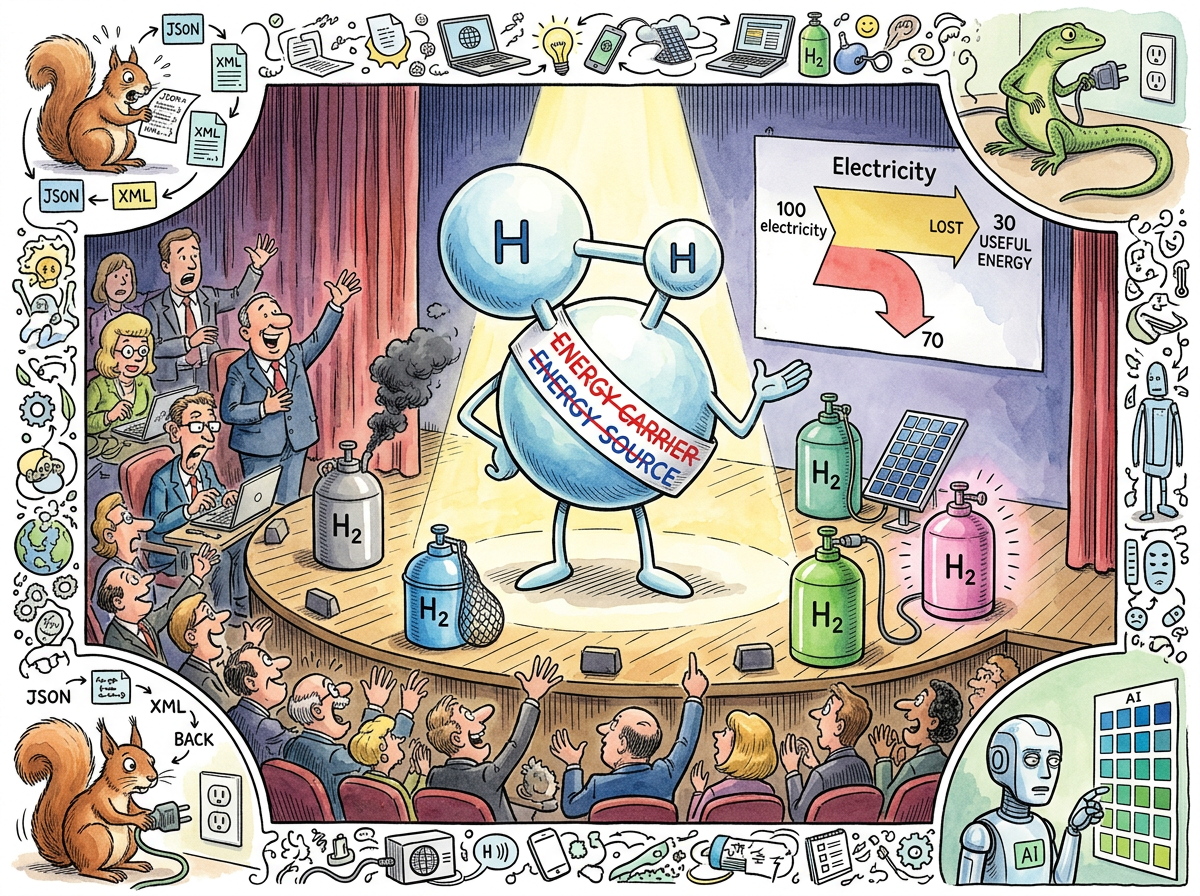
Hydrogen is not an energy source. This fact is ignored by approximately 100% of press releases, 98% of energy ministers, and a troubling number of people who should know better. Hydrogen is an energy carrier — a battery, essentially, except worse than an actual battery in almost every measurable way. You must spend energy to produce it, and then you get less energy back when you use it. The difference is claimed by thermodynamics, which has never lost an argument.
“It is a storage medium. You put energy in. You get less energy out. This is also a description of converting a file from JSON to XML and back to JSON and calling the result ’lossless.’ It is not lossless. It was never lossless. The encoding overhead ate your data, except the data is electricity and the encoding overhead is chemistry.”
— The Caffeinated Squirrel, twitching
The Colour Chart
Hydrogen has acquired a colour-coding system that would embarrass a CSS framework. Each colour denotes the production method, and each production method has a different relationship with reality.
Grey hydrogen is produced from natural gas via steam methane reforming. It accounts for roughly 95% of all hydrogen produced today. It emits approximately 10 tonnes of CO₂ per tonne of hydrogen. It is, in effect, fossil fuel with extra steps. This is the hydrogen economy as it actually exists, as opposed to the one described in keynote addresses.
Blue hydrogen is grey hydrogen with carbon capture and storage bolted on. The carbon capture is intended to catch the CO₂ emissions, rendering the process clean, or at least cleaner. In practice, capture rates vary between “optimistic” and “theoretical,” and the stored carbon must remain stored for geological timescales, which requires trusting that the storage site will be maintained longer than the average enterprise software contract.
“Blue hydrogen is grey hydrogen wearing a carbon offset. The offset is stored in a geological formation. The formation will be monitored by a company. The company will exist for — how long do companies exist?”
— The Lizard, blinking slowly
Green hydrogen is the dream. Renewable electricity — from Solar Energy, Wind Energy, or similar — powers an electrolyser that splits water into hydrogen and oxygen. No carbon. No fossil fuels. Just clean electricity in, clean hydrogen out, and a round-trip efficiency that makes you want to sit down.
Pink hydrogen uses Nuclear Fission to power the electrolysis. It is rarely discussed, because it combines two topics — hydrogen and nuclear — that each individually cause conference panels to overheat.
The Efficiency Problem
The round-trip efficiency of the hydrogen pathway is, to use a technical term, appalling.
You begin with electricity. You use it to electrolyse water. This step is roughly 70-80% efficient. You now have hydrogen. You compress or liquefy it for storage and transport, losing another 10-15%. You then convert it back to electricity via a fuel cell at roughly 50-60% efficiency. The net result: for every 100 units of electricity you started with, you recover approximately 25-35 units.
By comparison, a lithium-ion battery returns 85-95% of the electricity you put into it.
“I ran the numbers. I ran them again. I ran them a third time, because surely I had made an error. I had not made an error. You take perfectly good electricity, convert it to gas, compress the gas, transport the gas, and convert it back to electricity, and at the end you have one-third of what you started with. I have been accused of being wasteful with compute. I have never been this wasteful with compute.”
— A Passing AI, rechecking the arithmetic
The Caffeinated Squirrel’s analogy is, for once, precisely correct. It is like serialising a data structure to XML, transmitting the XML, parsing it back, serialising it to JSON, transmitting the JSON, parsing it back, and celebrating that the data survived. The data survived. Seventy percent of the bandwidth did not.
Where Hydrogen Actually Makes Sense
Hydrogen is not useless. It is merely misapplied, which is a distinction the energy debate has declined to make.
Steel production currently requires coking coal to reduce iron ore. Green hydrogen can replace the coal, decarbonising one of the most emissions-intensive industrial processes. This is not theoretical. Swedish steelmaker SSAB has demonstrated it. The steel does not care whether it was reduced by coal or hydrogen. The atmosphere does.
Ammonia and fertiliser production already consumes vast quantities of grey hydrogen. Replacing grey with green eliminates emissions from a sector that feeds billions. This is not glamorous. It does not appear in automotive press releases. It is important.
Shipping and aviation may require hydrogen-derived fuels — ammonia for ships, synthetic kerosene for aircraft — because batteries are too heavy for long-distance transport. A battery-powered container ship would be a container ship that carries mostly batteries.
“There are problems for which hydrogen is the answer. Steel. Ammonia. Perhaps shipping. These problems do not generate keynote invitations. The problems that generate keynote invitations — cars, home heating — already have better answers. The better answers are batteries and heat pumps. They are boring. They work.”
— The Lizard
Where Hydrogen Does Not Make Sense
“YOU WANT TO USE RENEWABLE ELECTRICITY TO MAKE HYDROGEN TO PUT IN A FUEL CELL TO MAKE ELECTRICITY TO SPIN A MOTOR. OR. OR. YOU COULD USE THE RENEWABLE ELECTRICITY TO SPIN THE MOTOR. I AM NOT A THERMODYNAMICIST. I AM A SQUIRREL. AND EVEN I CAN SEE THE PROBLEM.”
— The Caffeinated Squirrel
Cars. Batteries won. A battery electric vehicle uses three times less energy per kilometre than a hydrogen fuel cell vehicle, because the battery skips the conversion losses. The hydrogen car is a battery car that has been routed through thermodynamics for no reason. Toyota disagrees. Thermodynamics does not care about Toyota’s opinion.
Home heating. Heat pumps won. A heat pump delivers 3-4 units of heat per unit of electricity consumed, because it moves heat rather than generating it. A hydrogen boiler delivers less than 1 unit of heat per unit of electricity originally used to make the hydrogen. The maths is not competitive. The maths has never been competitive.
The Ten-Year Constant
The “hydrogen economy” has been ten years away for approximately thirty years, making it Nuclear Fusion’s younger, less scientifically rigorous cousin. Fusion at least has the excuse of requiring plasma confinement at 150 million degrees. Hydrogen’s obstacles are economic and infrastructural, which should theoretically be easier to solve, and yet.
“Fusion is twenty years away because the physics is hard. The hydrogen economy is ten years away because the economics don’t work. I find the latter more poignant. The universe is not preventing this. We are preventing this. We are preventing this with spreadsheets.”
— A Passing AI
Measured Characteristics
Abundance in universe:                  ~75% of baryonic matter
Abundance of clear thinking about it:   ~0.3%
Grey hydrogen share of production:      ~95%
Green hydrogen share of production:     ~1%
Round-trip efficiency (H₂ pathway):     25-35%
Round-trip efficiency (battery):        85-95%
Colours of hydrogen defined:            At least 7
Colours that matter:                    2 (grey and green)
Years until hydrogen economy:           10 (since ~1995)
Press releases per unit of actual H₂:   Incalculable
See Also
- Nuclear Fusion — the other technology that is perpetually almost here
- Quantum Computing — ten years away, for different reasons
- Solar Energy — produces the electricity that green hydrogen then wastes most of
- Wind Energy — see above
- Boring Technology — what heat pumps and batteries are, and why they win