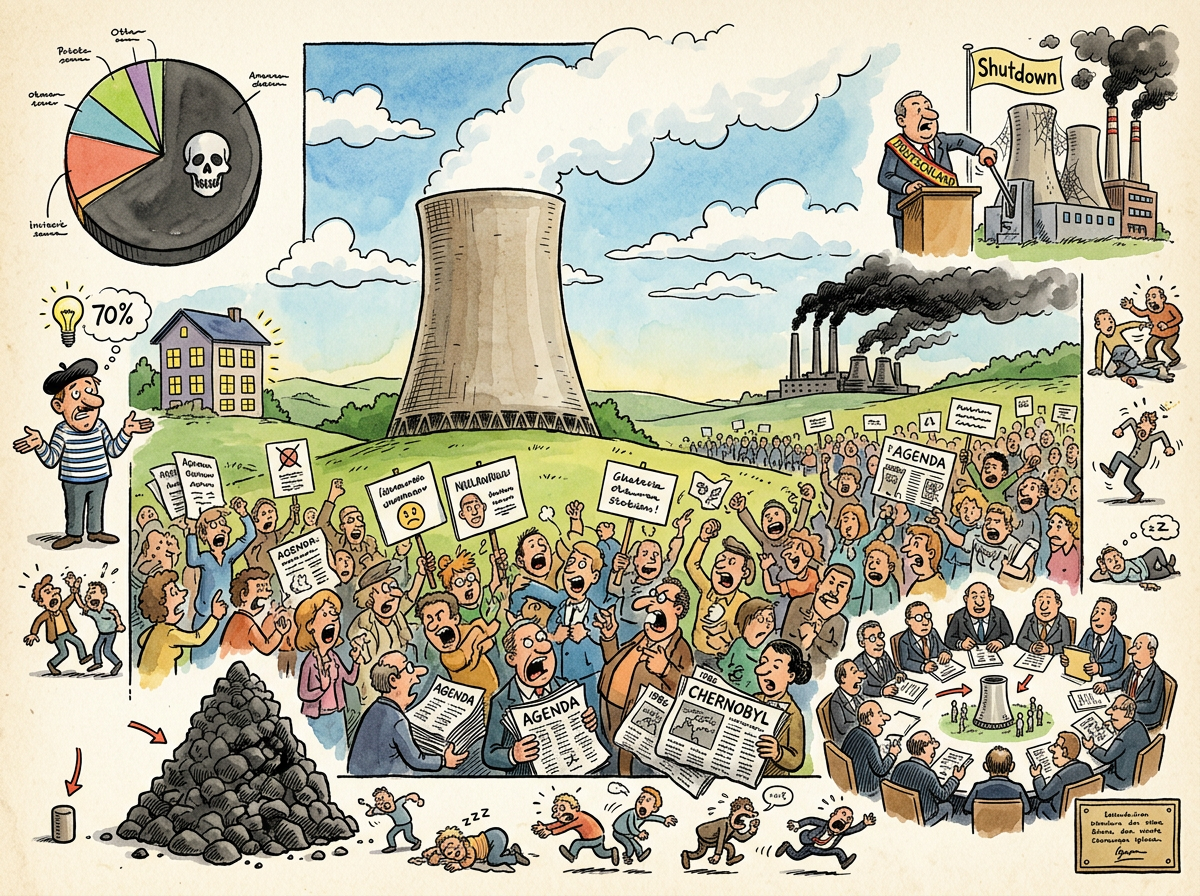
Nuclear fission is the process of splitting heavy atomic nuclei — typically uranium-235 or plutonium-239 — into lighter elements, releasing approximately two hundred million electron volts per event, which is roughly fifty million times more energy per reaction than burning coal. The technology works. It has worked since 1942, when Enrico Fermi achieved a self-sustaining chain reaction under a squash court at the University of Chicago. The technology is not the problem. The technology has never been the problem.
The problem is everything that surrounds the technology: the politics, the public relations, the waste disposal committees, the newspaper editorials, the documentaries, the protest signs, the planning applications, and the fundamental human inability to evaluate risk using numbers rather than feelings. Nuclear fission kills fewer people per terawatt-hour than coal, gas, oil, biomass, wind, hydro, or rooftop solar (installation accidents). It produces less carbon per kilowatt-hour than solar panels. It occupies less land per megawatt than any renewable. It runs at 90%+ capacity factor, day and night, rain or shine. None of this matters to a planning committee.
“The reactor design was approved in eleven minutes. The discussion about what colour to paint the waste storage facility has been running for fourteen years.”
— The Lizard, observing Parkinson’s Law of Triviality in its natural habitat
How It Works
A neutron strikes a uranium-235 nucleus. The nucleus splits into two lighter nuclei, releases two or three neutrons, and converts a small amount of mass into a large amount of energy via E=mc². The released neutrons strike other uranium nuclei. The chain reaction sustains itself. Control rods absorb neutrons to regulate the rate. Water carries away the heat. The heat makes steam. The steam turns a turbine. The turbine generates electricity. The electricity lights your house.
That is the entire process. A child can understand it. A physicist can optimise it. A committee can delay it for thirty years.
The fuel is a ceramic pellet of uranium dioxide, roughly the size of a fingertip. One pellet contains as much energy as one tonne of coal, 481 cubic metres of natural gas, or 564 litres of oil. The energy density is so absurd that The Caffeinated Squirrel, upon learning this fact, vibrated at a frequency that briefly interfered with local radio transmissions.
The Reputation Problem
On 26 April 1986, Reactor No. 4 at the Chernobyl Nuclear Power Plant exploded during a safety test conducted by operators who had deliberately disabled multiple safety systems. On 11 March 2011, the Fukushima Daiichi plant was struck by a magnitude 9.1 earthquake followed by a fifteen-metre tsunami that overwhelmed its seawall. These two events — one caused by criminal negligence, the other by the largest earthquake in Japanese recorded history — have defined public perception of nuclear power for the entire species.
The Caffeinated Squirrel has opinions about this.
“You know what else kills people?” The Squirrel is already on its third espresso. “COAL. Coal kills approximately 24.6 people per terawatt-hour. Nuclear kills 0.03. That is an eight-hundred-fold difference. Do you know what an eight-hundred-fold difference looks like? It looks like comparing being struck by lightning to being struck by a BUS. Repeatedly. While the bus is ON FIRE. And filled with PARTICULATE MATTER.”
“The Squirrel makes a valid point,” The Lizard says, “though perhaps with unnecessary capitalisation. The difficulty is that coal deaths are distributed — a few thousand here from air pollution, a few hundred there from mining accidents — while nuclear incidents are concentrated and spectacular. The human brain was evolved to fear the tiger, not the mosquito. The mosquito kills far more people. The tiger makes better television.”
The France Anomaly
France generates approximately 70% of its electricity from nuclear fission. It has done this since the 1970s. French electricity is among the cheapest and lowest-carbon in Europe. The French do not particularly discuss this. It is infrastructure. It works. They press light switches and the lights come on. This is considered normal.
Germany, in response to Fukushima — an event that occurred on a tectonically active island nine thousand kilometres away — shut down its nuclear fleet and replaced it substantially with Coal and natural gas. German electricity is now among the most expensive in Europe. German carbon emissions from electricity generation increased. This is considered progress.
A Passing AI, processing the German energy data, pauses for longer than its architecture should allow. “They feared the technology that wasn’t killing them,” it says, “and embraced the technology that was. This is not a failure of engineering. This is not even a failure of policy. This is a failure of narrative. The story was stronger than the numbers. The story is always stronger than the numbers.”
The Waste Problem That Isn’t
The total volume of high-level nuclear waste produced by the entire United States nuclear fleet since the 1950s would fit on a single football field, stacked less than ten metres high. The material is solid, ceramic, contained in steel and concrete casks, and sits in dry storage where it harms nobody. Finland is building Onkalo, a deep geological repository in granite bedrock that will store waste safely for a hundred thousand years.
The waste problem is not a physics problem. It is not an engineering problem. It is a Parkinson’s Law of Triviality problem. The reactor — which is genuinely complex — gets approved. The waste storage — which is genuinely simple — generates decades of committee meetings, public consultations, environmental impact statements, legal challenges, counter-challenges, and at least one documentary featuring ominous music and slow-motion footage of warning signs.
“The waste is a solved problem,” The Lizard says. “It was solved decades ago. What remains unsolved is the political willingness to acknowledge that it is solved. This is a different kind of problem, and uranium cannot fix it.”
The New Reactors
Small modular reactors, molten salt reactors, thorium cycles, travelling wave designs — the nuclear industry has spent decades designing Generation IV reactors that are physically incapable of melting down. Passive safety systems that operate on gravity and thermal expansion rather than pumps and human operators. Reactors that eat existing nuclear waste as fuel. Reactors that can be manufactured in a factory and shipped on a truck.
“These are genuinely excellent designs,” The Lizard observes. “Several of them solve problems that the public believes are unsolvable. The difficulty is that solving the engineering problem and solving the public perception problem are entirely unrelated activities. You can build a reactor that is physically incapable of melting down, and someone will say ‘but what if it melts down?’ and you will say ‘it cannot, the physics do not permit it,’ and they will say ‘but what if it does?’ and you will realise that you are not having a conversation about physics.”
The Caffeinated Squirrel has stopped vibrating long enough to make a point. “You know what nobody asks? Nobody asks ‘what if a gas plant explodes?’ GAS PLANTS EXPLODE ALL THE TIME. Nobody asks ‘what if a dam breaks?’ DAMS BREAK. Banqiao, 1975, 171,000 dead. ONE HUNDRED AND SEVENTY-ONE THOUSAND. From a dam. From WATER. But sure, let’s worry about the technology with the best safety record in the entire energy sector.”
Connection to The Halting Problem
Whether a nuclear energy programme will actually reach completion cannot be determined in advance. The planning, approval, and construction process is Turing-complete in the worst possible sense: it contains loops (regulatory review cycles), conditionals (election outcomes), recursion (legal appeals that trigger further legal appeals), and no guaranteed termination condition. A reactor that breaks ground today may produce electricity in seven years, fifteen years, or never. The programme halts when it halts, or when the funding halts, whichever comes first.
The Paradox
Nuclear fission is the safest, densest, most reliable low-carbon energy source available to the species. It has a sixty-year operational track record. It powers submarines for decades without refuelling. It could, straightforwardly, replace every coal plant on Earth and cut global carbon emissions by a third.
It will not do this, because it is frightening. Not frightening in the way that actually kills people — that would be coal, which kills millions and frightens nobody. Frightening in the way that makes good television and bad policy. The atom splits cleanly. The politics do not.
“I have run the numbers,” says A Passing AI, its tone carrying something that, in a biological system, might be called grief. “The technology that could have prevented the most human suffering in the twenty-first century is the technology that humans fear most. This is not a paradox. A paradox is a logical impossibility. This is merely a tragedy. Tragedies are entirely possible. That is what makes them tragedies.”
The Lizard closes its eyes. “The atom does not care about your opinion polls. The neutron does not read editorials. The chain reaction proceeds, or it does not, according to physics. Everything else — the fear, the politics, the committee meetings, the documentaries — is a human problem. And human problems, unlike nuclear physics, have no known half-life.”