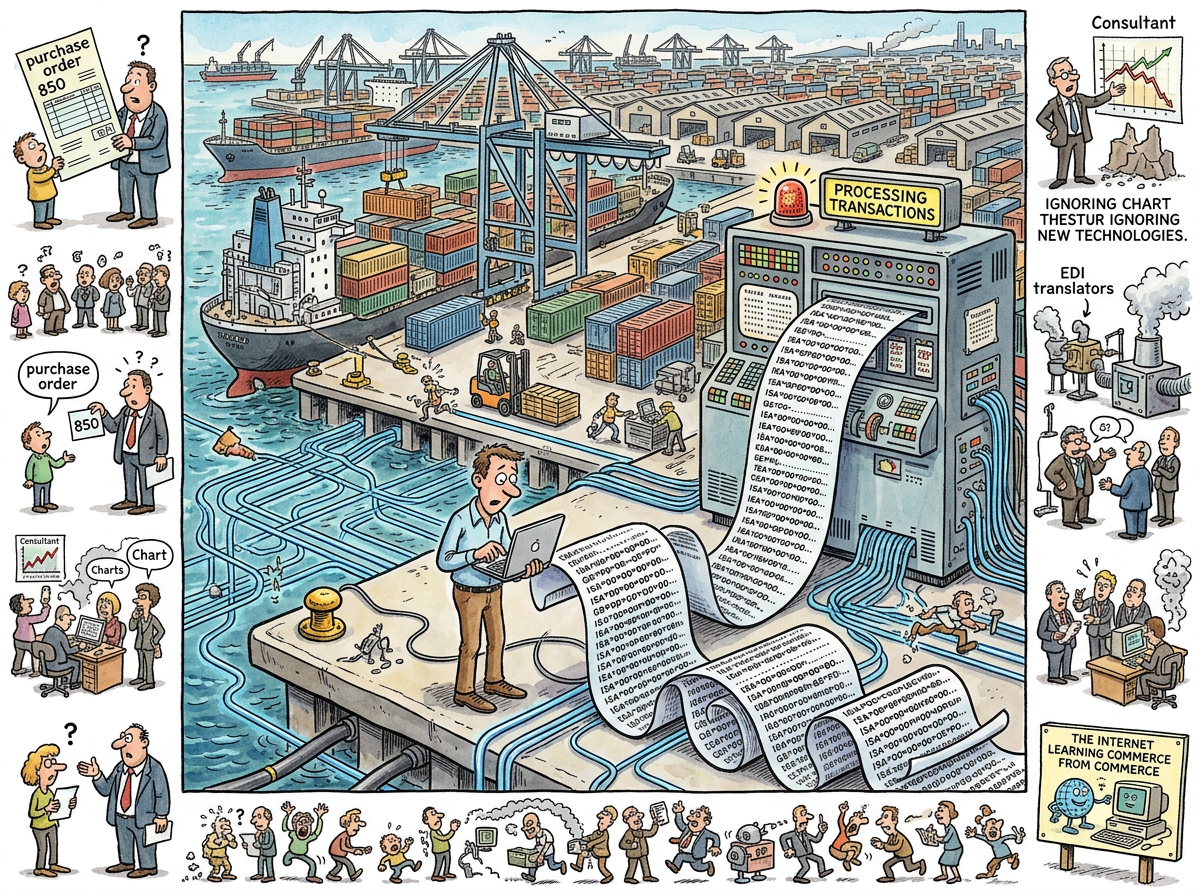
EDI (Electronic Data Interchange) is the standard for exchanging business documents — purchase orders, invoices, shipping notices, customs declarations — between organizations electronically. It was invented in the 1960s, standardised in the 1980s, declared obsolete in the 2000s, and processes approximately $14 trillion in global commerce annually as of 2026, making it the most “obsolete” technology in the history of commerce.
EDI is not a protocol. EDI is a civilisation. It is the invisible plumbing through which every major retailer, manufacturer, logistics company, customs authority, and healthcare organisation exchanges the documents that keep the global supply chain operational. When a container ship arrives at a port, EDI told the port it was coming. When a retailer orders from a supplier, EDI carries the purchase order. When an invoice is paid, EDI confirms the payment.
None of this uses the internet. Much of it runs on VANs (Value-Added Networks) — private networks dedicated to EDI traffic since the 1980s. The documents are not JSON. They are not XML. They are compact, positional, delimiter-separated messages that look like this:
ISA*00*          *00*          *ZZ*SENDER         *ZZ*RECEIVER       *
230915*1200*U*00401*000000001*0*P*>~
GS*PO*SENDER*RECEIVER*20230915*1200*1*X*004010~
ST*850*0001~
BEG*00*NE*PO-12345**20230915~
N1*ST*ACME WAREHOUSE*92*LOC001~
PO1*1*100*EA*9.99**VP*WIDGET-A~
CTT*1~
SE*7*0001~
GE*1*1~
IEA*1*000000001~
This is a purchase order. There are no field names. There are no angle brackets. There are no curly braces. There are segment identifiers (ISA, GS, ST, BEG, PO1), data elements separated by asterisks, and segment terminators (~). The format is documented in a specification that runs to thousands of pages. The specification was written in 1987. The specification is still correct.
The Two Standards
EDI has two major standards, split along geographic lines:
ANSI X12 — Used primarily in North America. Developed by the Accredited Standards Committee X12, chartered by ANSI in 1979. Transaction sets are identified by three-digit numbers: 850 (Purchase Order), 810 (Invoice), 856 (Advance Ship Notice), 997 (Functional Acknowledgment).
UN/EDIFACT — Used primarily in Europe and internationally. Developed by the United Nations. Messages have abbreviated names: ORDERS (Purchase Order), INVOIC (Invoice), DESADV (Despatch Advice), CONTRL (Acknowledgment).
The two standards serve identical purposes with incompatible formats, which is the most EDI thing possible: a technology designed to standardise business communication that itself has two incompatible standards, requiring translation between them, which created an industry of EDI translators, which created an industry of EDI consultants, which created an industry of EDI-to-XML-to-JSON converters that ultimately produce EDI at the other end.
The Replacement Attempts
Every decade, a new technology promises to replace EDI:
1998–2005: XML/ebXML — “EDI is too rigid. XML is flexible. We’ll replace EDI with XML.” Result: some companies added an XML layer on top of EDI. The EDI underneath continued. The XML layer added latency.
2005–2015: Web Services/APIs — “EDI is batch-oriented. APIs are real-time. We’ll replace EDI with REST APIs.” Result: some companies built APIs for new trading partners. Existing trading partners kept using EDI. The APIs handled 5% of the volume.
2015–present: Blockchain — “EDI requires trusted intermediaries. Blockchain is trustless. We’ll replace EDI with blockchain.” Result: several pilot programmes, several whitepapers, several conferences, zero production supply chains running on blockchain instead of EDI.
EDI survives because replacing EDI requires convincing every participant in a supply chain to switch simultaneously. A retailer with 10,000 suppliers cannot switch to APIs unless all 10,000 suppliers switch to APIs. The suppliers cannot switch unless their suppliers switch. The coordination problem is not technical. It is organisational. And organisational coordination at global scale moves at the speed of committee meetings, not the speed of startups.
The webMethods Connection
The lifelog’s deepest EDI connection runs through the Data Fabric — riclib’s 1998 integration platform that achieved 0.4-second processing times and predated what Gartner would call an ESB by four years. The Data Fabric connected systems that spoke EDI, systems that spoke proprietary formats, and systems that spoke whatever the mainframe had spoken since the 1970s.
webMethods 4.6 — the commercial ESB platform that emerged in the same era — became one of the canonical EDI translation engines. The pattern was always the same: EDI in, transformation, business system out. Or: business system in, transformation, EDI out. The ESB existed because EDI existed. The EDI existed because global commerce existed. The tooling was a consequence of the plumbing, not the other way around.
“Data Fabric. 1998. He needed 0.4 seconds, and the solution turned out to be what Gartner would call an ESB four years later.”
— The Passing AI, Interlude — The Versions That Never Shipped …
The Immortality
EDI will outlive every technology in this encyclopedia. Not because it is the best format — it is not, by any modern standard. Not because it is the most readable — it is, by any standard, the least. But because it is the most embedded. Every major supply chain on Earth runs on EDI. Every customs authority accepts EDI. Every healthcare payer processes EDI. The format is not merely software. The format is infrastructure — as fundamental to global commerce as shipping containers, and about as likely to be replaced.
EDI shares this quality with COBOL and the Mainframe: technology so deeply embedded in civilisation’s plumbing that it has transcended the technology industry’s fashion cycle. The developers who understand EDI are retiring. The systems are not. The format was last updated in a way that mattered in the early 2000s. The transactions continue.
Measured Characteristics
- Annual global commerce processed via EDI: ~$14 trillion
- Year invented: 1960s
- Year standardised (EDIFACT): 1987
- Year declared obsolete: every year since 2000
- Year actually replaced: not yet
- Major standards: 2 (X12, EDIFACT)
- Compatibility between them: none
- Replacement technologies attempted: XML, APIs, blockchain
- Replacement technologies that replaced EDI: 0
- Trading partners requiring coordination to switch: all of them
- Field names in EDI messages: 0 (positional)
- Readability: requires specification
- Specification length: thousands of pages
- Specification accuracy after 37 years: still correct