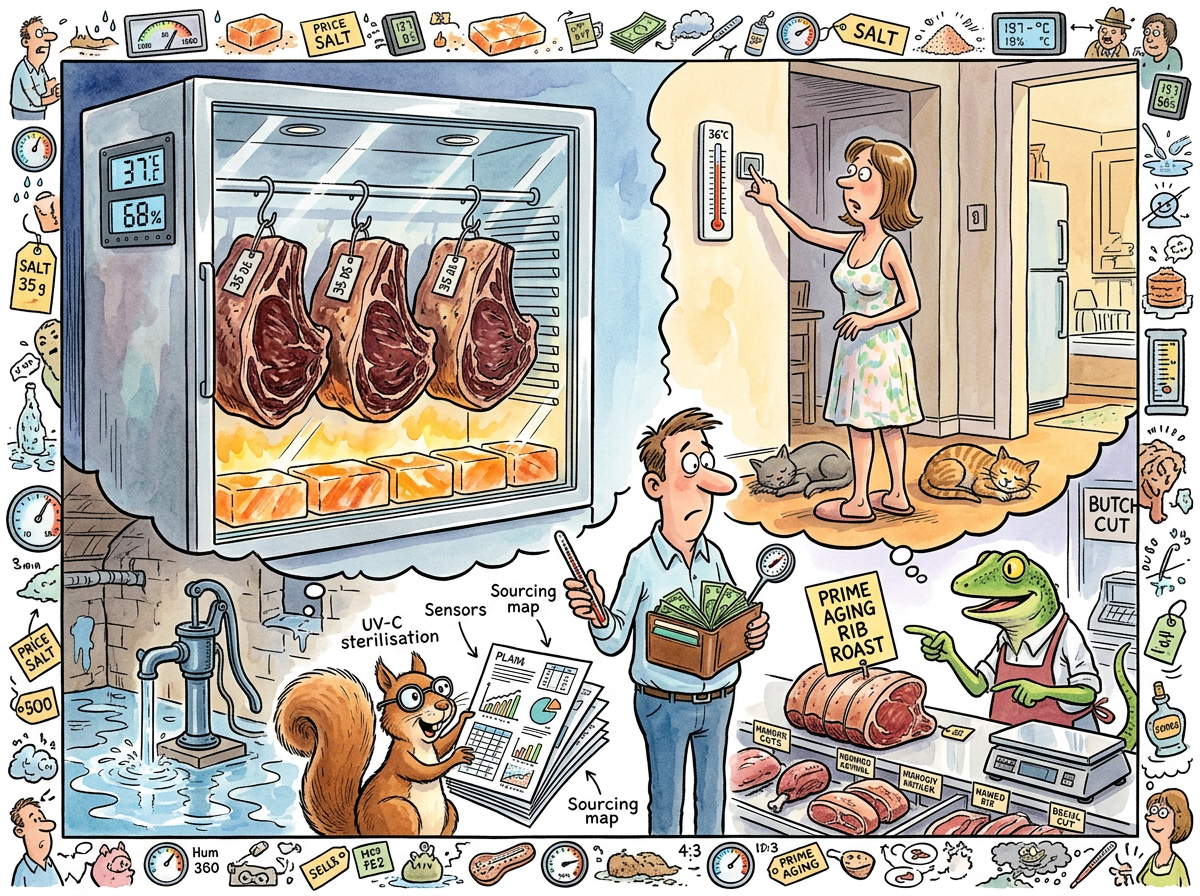
Dry ageing is the process of hanging beef in a temperature and humidity-controlled environment — 1–3°C, 80–85% humidity — for 21 to 45 days, during which enzymes break down muscle fibres, moisture evaporates concentrating flavour, and the exterior develops a bark that is trimmed before cooking. The result is intensely beefy, profoundly tender, with a funky depth that fresh steak cannot match. It is the difference between a good steak and a steak that makes you close your eyes and wonder why you ever ate anything else.
riclib wants to do this. riclib cannot do this. This is an aspiration entry, not a practice entry. The gap between the two is measured in degrees Celsius, percentage points of humidity, and the thermostat preferences of a Latvian woman who lived in Lisbon long enough to bring the climate home.
The Science of Controlled Decomposition
Dry ageing works through three simultaneous processes, each of which requires conditions that riclib’s living situation cannot provide:
Enzymatic breakdown. The beef’s own enzymes — calpains and cathepsins — break down muscle fibres and connective tissue over weeks. This is proteolysis, the same process that makes aged cheese soft and complex. The enzymes work slowly at 1–3°C: fast enough to tenderise, slow enough that bacterial decomposition doesn’t win the race. At 26°C — the ambient temperature of the Riga house — the bacteria win. They win quickly. They win decisively.
Moisture evaporation. A primal loses 15–30% of its weight during dry ageing, almost entirely water. What remains is concentrated beef: the same amount of flavour in less volume. This is why dry-aged steak tastes more intensely of itself — it is more of itself, per gram. The evaporation requires airflow and controlled humidity. Too dry (below 75%) and the exterior desiccates into leather. Too humid (above 90%) and mould colonises the surface — not the controlled, beneficial mould of a curated ageing program, but the chaotic, hostile mould of an uncontrolled environment. The kind of mould that was growing on the cellar walls.
Bark formation. The exterior of the meat develops a hard, dark crust — the pellicle — which acts as a protective shell for the ageing interior. This bark is trimmed before cooking, which is why dry-aged beef costs more: you are paying for meat you will throw away so that the meat you keep can be extraordinary. A 45-day dry-aged rib eye loses its outer centimetre to bark. The remaining meat is worth the sacrifice.
Why It Works: The Numbers
| Duration | Weight Loss | Tenderness | Flavour Intensity | Funk |
|---|---|---|---|---|
| 21 days | ~12% | Noticeable | Enhanced | Subtle |
| 30 days | ~18% | Significant | Rich | Present |
| 45 days | ~25% | Remarkable | Intense | Bold |
| 60+ days | ~30%+ | Extreme | Overwhelming | Divisive |
The sweet spot for most palates is 30–45 days. Beyond 45, the funk becomes an acquired taste — blue cheese notes, fermented complexity, a depth that some find transcendent and others find alarming. riclib would aim for 35 days. riclib would also aim for a cellar that doesn’t flood and a house that isn’t kept at subtropical temperatures, but here we are.
The Obstacles
1. The Lisbonised Wife
riclib’s wife is from Riga. She is Latvian. This is important context for understanding the betrayal.
She lived enough years in Lisbon with riclib to do two things: first, to gently suggest — as wives do — that they move back to Riga, on the grounds that Portugal has social life to levels that nordics cannot fathom and it was making her uncomfortable. Second, to acquire an irreversible taste for Portuguese weather and decide to bring it with her. The house is kept at temperatures that would be appropriate for growing orchids. Officially, this is to make riclib not miss home. In practice, riclib enjoys the cold. riclib goes out celebrating when it starts snowing, to the horrified looks of every neighbour on the street. riclib does not need Lisbon recreated indoors. But here it is, 26°C in March, a Latvian woman maintaining a microclimate her ancestors would not recognise.
You cannot dry-age beef in a tropical environment. Dry ageing requires 1–3°C. The house is 26°C. The difference between these two numbers — 23 degrees — is the distance between “controlled enzymatic tenderisation” and “bacterial decomposition.” The beef would not age. It would decompose. Rapidly. Within hours, not weeks. The house’s ambient temperature is optimised for human comfort (specifically, the comfort of a human who considers 20°C to be “freezing”), not for the controlled putrefaction of bovine muscle tissue.
The thermostat is not negotiable. riclib has learned this. The thermostat is a boundary condition, like the speed of light or the inevitability of scope creep. You do not negotiate with boundary conditions. You design around them.
2. No Cellar
The current house has no cellar. This is not an oversight. This is a deliberate design criterion. After the previous cellar — see below — riclib added “no cellar, no underwater swimming pool” as item #1 on the requirements for the next house. The fertile, water-rich Latvian soil had taught its lesson. riclib learned it. The beef pays the price. Cellars are where people in cold climates traditionally hung meat. The cold, stable temperatures of an underground space — 4–8°C year-round in Latvia — provide a natural ageing environment. Generations of Latvians hung meat in cellars. riclib lives in Latvia, in a house he specifically chose for its lack of underground flooding potential, and does not have a cellar. This is like living in Bordeaux and deliberately throwing away the corkscrew because the last one stabbed you.
3. The Previous Cellar
The previous house HAD a cellar. The cellar flooded. Not a gentle seepage. Not a minor damp problem. The kind of flooding that required riclib to purchase an electric water pump to drain the accumulated water. A cellar that requires a water pump to remain dry is not a cellar suitable for dry ageing beef. It is a swimming pool with aspirations.
The humidity in that cellar was approximately 100%, which is 15–20 percentage points above the ideal range for dry ageing and firmly in the “growing mould on the walls, the floor, the ceiling, and any organic material that remains stationary for more than forty-eight hours” range. Dry ageing requires 80–85% humidity. 100% humidity is not dry ageing. 100% humidity is a swamp. You do not hang beef in a swamp.
4. The Squirrel’s Solution vs The Lizard’s Solution
The Squirrel, naturally, has a plan. The plan involves:
- A dedicated dry-ageing fridge (converted from a standard unit with fan modifications)
- UV-C sterilisation lamp (to control surface bacteria)
- Himalayan salt blocks lining the interior walls (natural antimicrobial, humidity regulation)
- A humidity controller with hygrometer
- A Bluetooth temperature and humidity monitoring system with phone alerts
- A dedicated power circuit to prevent tripping
- Total cost: 800–1200 euros
The Squirrel’s plan is technically sound. The Squirrel’s plan would work. The Squirrel’s plan is also an 1100-euro infrastructure investment to avoid paying a butcher 42 euros per kilogram for beef that has already been aged by someone who already has the infrastructure.
The Lizard’s solution: buy dry-aged beef from a butcher who already owns the fridge, already has the salt blocks, already monitors the humidity, and has already trimmed the bark. The Lizard notes that this requires zero capital expenditure, zero infrastructure, zero Bluetooth sensors, and zero risk of the 800-euro fridge becoming the next The Sous Vide — a device of magnificent capability, exiled to the garage, used three times.
riclib stands between these two positions, doing neither, which is the most expensive option of all: no dry-aged beef, no fridge, and the persistent low-grade dissatisfaction of a man who knows what 35-day rib eye tastes like and is eating 0-day rib eye instead.
The Dry Brine Compromise
In the absence of a dry-ageing setup, riclib dry-brines everything. Salt, wire rack, overnight in the fridge. It is not dry ageing — the timescale is hours, not weeks; the transformation is seasoning, not concentration — but it is the closest approximation available within the constraints of a 26°C house in Riga and a cellar that is either absent or underwater.
The Dry Brine achieves surface drying and salt penetration. It does not achieve enzymatic breakdown, moisture concentration, or the funk. The funk is the thing. The funk is what makes dry-aged beef taste like beef that has thought about what it means to be beef and arrived at a deeper answer. Fresh beef is a statement. Dry-aged beef is a philosophy.
Measured Characteristics
- Ideal temperature: 1–3°C
- House temperature: 26°C (non-negotiable)
- Temperature gap: 23°C (the distance between aspiration and reality)
- Ideal humidity: 80–85%
- Previous cellar humidity: 100% (the distance between a cellar and a swamp)
- Current cellar: none
- Ageing duration: 21–45 days (sweet spot: 35)
- Weight loss: 15–30%
- Flavour improvement: transformative
- The Squirrel’s budget: 800–1200 euros
- The Lizard’s budget: 42 euros/kg at the butcher
- riclib’s current spend: 0 euros (neither solution implemented)
- riclib’s current dry-aged beef consumption: 0 kg
- Status: aspiration (persistent, unresolved)
- Risk of fridge becoming the next Sous Vide: high
- Risk of not trying: lifetime of wondering