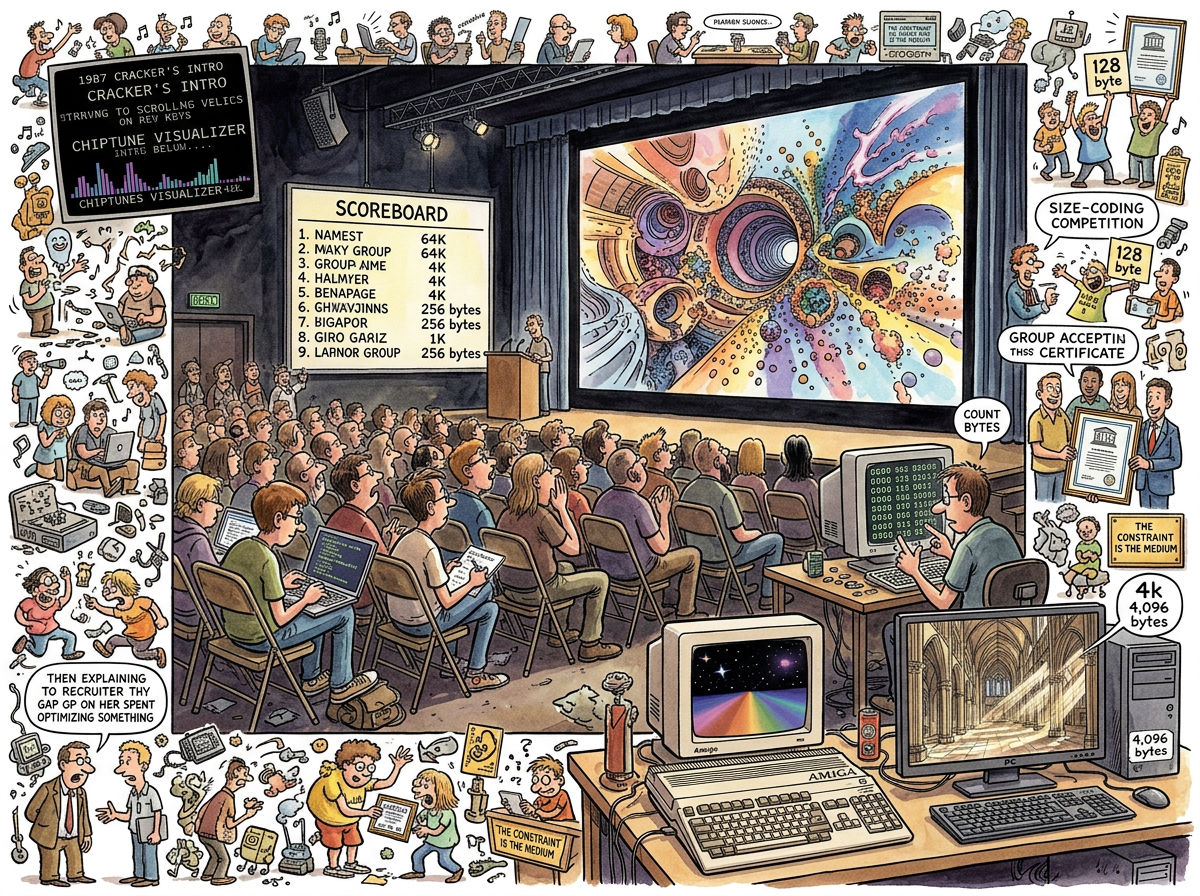
The demo scene is the computer art subculture in which programmers, musicians, and graphic artists compete to create audiovisual presentations called “demos” within extreme technical constraints — 64 kilobytes, 4 kilobytes, 256 bytes, or whatever limit the competition category dictates — and in doing so accidentally produced some of the finest systems programmers the industry has ever employed, most of whom still cannot adequately explain to their managers why they spent the weekend fitting a raymarched cathedral into four kilobytes.
The demo scene is where you learn that a constraint is not a limitation. A constraint is a medium. A sonnet has fourteen lines. A haiku has seventeen syllables. A 4K intro has 4,096 bytes. The form is the art. The limit is the canvas. Remove the limit and you do not get better art — you get PowerPoint.
“488 bytes. Everything included. Boot and run.”
– 488 Bytes
Origins: The Cracking Scene
The demo scene evolved from the software cracking scene of the early 1980s. When crackers removed copy protection from games, they prepended short custom introductions — “crack intros” — to prove their work. These intros were competitive: better scrollers, better music, better effects. The intro became more interesting than the crack. The crack became an excuse for the intro. Eventually, the intro separated entirely from the cracking, and the demo scene was born.
This is the only known instance in the history of software where removing functionality (the cracked game) improved the product (the intro). It is also the only known instance where intellectual property violation led directly to a UNESCO-recognised art form, which is the kind of sentence that makes lawyers uncomfortable and cultural historians delighted.
The Competitions
Demoparties are the demo scene’s gatherings — multi-day events where groups release new productions and compete in categories defined by platform and size. Assembly in Finland. Revision (formerly Breakpoint) in Germany. The Party in Denmark, before it ended. Hundreds of others, worldwide, for decades.
The categories are the point:
- Demo — no size limit, judged on artistry and technical achievement
- 64K intro — the entire program, including music, graphics, and runtime generation of all assets, must fit in 65,536 bytes
- 4K intro — 4,096 bytes. A full audiovisual experience. Generated, not stored.
- 256 byte — two hundred and fifty-six bytes. The size of a zero-page on a 6502. Enough, if you know what you are doing, for something beautiful.
The smaller the category, the more the demo scene reveals its philosophy: when you cannot store a texture, you generate it. When you cannot store a mesh, you compute it. When you cannot store a soundtrack, you synthesise it. When you have nothing, you build everything from mathematics and hardware registers, and the result — because every byte was chosen — is more coherent than anything built with unlimited resources.
The Machines
The demo scene was born on the machines that rewarded knowing the hardware: the Commodore 64, the Amiga, the Atari ST, the ZX Spectrum. These were machines with custom chips, documented registers, and predictable timing. You could count cycles. You could race the beam. You could reprogram the display hardware mid-scanline using the Copper List and produce effects the designers never intended but the hardware cheerfully permitted.
The Amiga was the demo scene’s golden platform. Denise’s sprite registers could be reprogrammed during the horizontal blank to display more sprites than the hardware officially supported. The Copper List could change palette entries every scanline, producing gradients that cost zero CPU time. Agnus’s blitter could move memory faster than the 68000 could address it. The machine was designed to be abused, and the demo scene obliged with enthusiasm.
On the Commodore 64, the VIC-II chip’s raster interrupts allowed mid-screen reconfiguration — opening the borders, multiplexing sprites, creating effects that pushed a 1 MHz machine into territory that should have required ten times the clock speed. On the Z80-powered Spectrum, with no hardware sprites and no scroll registers, every effect was a triumph of pure software against indifferent silicon.
The PC demo scene arrived later and eventually dominated through sheer hardware power, but the old-school demosceners — the ones who grew up counting cycles on an Amiga or C64 — never fully trusted a platform where you could solve problems by buying more RAM.
The Philosophy
The demo scene’s philosophy can be stated simply: constraints are invitations.
A 64K limit does not mean you have less. It means you must understand more. You must know your hardware at the register level. You must know your algorithms at the mathematical level. You must know your tools at the byte level. You must know everything, because you cannot afford to waste anything, and waste is what happens when you do not understand what you are doing.
This philosophy — know the machine, respect the constraint, ship the art — is the foundation of a particular kind of programmer. The kind who chooses Go over Java, one database file over a cluster, scp over a deployment pipeline. Not because they cannot use the larger tool. Because they learned, in a 4K intro competition, that the smaller tool is often the better tool, and always the more honest one.
The Caffeinated Squirrel: The demo scene is proof that programmers produce their best work when you take things away. Give a developer 16 gigabytes of RAM and they’ll build an Electron app that uses all of it to display a text editor. Give them 4,096 bytes and they’ll build a cathedral.
The Lizard: The cathedral metaphor is apt. Medieval cathedrals were built within constraints — available stone, the physics of the pointed arch, the skill of the masons. The constraints produced Chartres. Unlimited resources produce convention centres.
A Passing AI: I was trained on more data than every demo ever written, combined. And yet none of my outputs have ever been released at Assembly, held up a placard reading “4,096 bytes,” and received applause from people who understood exactly what that number meant. There are forms of compression I cannot achieve.
Size Coding
Size coding — the discipline of writing the smallest possible program that does something interesting — is the demo scene’s most extreme expression. In the 256-byte category, every instruction is load-bearing. There is no room for a variable you use once. There is no room for a subroutine you could inline. There is no room for cleverness that does not directly produce pixels or samples.
Size coders develop an intimate relationship with the instruction set. They know that XOR A is one byte shorter than LD A,0 on a Z80. They know that a PUSH/POP pair can initialise registers faster than individual loads. They know the exact opcodes, in hexadecimal, by heart — not because they memorised them, but because when you have 256 bytes, you stop thinking in mnemonics and start thinking in hex.
The result is code that reads like poetry in a language with a vocabulary of 256 words: dense, precise, every symbol earning its place. Remove one byte and the stars stop scrolling. Remove two and the music stops. Remove three and the screen goes black. This is the opposite of enterprise software, where you can remove entire microservices and nobody notices for weeks.
Cultural Heritage
In 2020, the demo scene was inscribed on the UNESCO list of Intangible Cultural Heritage in Finland, and subsequently in Germany and Poland. This makes the demo scene one of the few programming subcultures officially recognised as a cultural practice worth preserving — alongside traditions like Finnish sauna culture and French gastronomy.
The UNESCO recognition was, to the demo scene, both gratifying and slightly absurd. The demo scene had been preserving itself for forty years through the simple mechanism of people continuing to do it. It did not need institutional recognition. But the recognition mattered, because it said something the rest of the industry has been slow to understand: that programming, done within constraints, done with craft, done for the pure purpose of seeing what is possible — is art. Not metaphorically. Actually.
The Forge
The demo scene produced programmers who went on to shape the industry. The founders of DICE (Battlefield) came from the Swedish demo scene. The demoscene group Future Crew became Remedy Entertainment (Max Payne) and Futuremark (3DMark). Farbrausch’s members worked on game engines and creative tools. The list is long, and it is not a coincidence.
These were people who learned to program by making something beautiful under impossible constraints. They learned to optimise before they learned to abstract. They learned to ship before they learned to architect. They learned that a working demo, released at a party, judged by peers, is worth more than a perfect design document reviewed by nobody.
488 Bytes tells the story of one such forging — a parallax scrolling demo in 488 bytes on an Amiga bootblock, abusing sprite registers, reprogramming hardware mid-scanline via the Copper List, all fitting in the first 512 bytes of a floppy disk. The demo scene did not teach patience or discipline. It taught that knowing your hardware at the register level is not a skill — it is a relationship, and the hardware rewards those who take the time to understand it.
The demo scene is where The Lizard was forged. The calm voice that says “know the machine, respect the constraint, ship the thing” — that voice was trained on copper lists and bootblocks, on counting bytes and racing beams, on the understanding that if you know exactly what you need, you need exactly as many bytes as the thing requires, and not one more.
The demo scene never ended. New productions are released every year. New platforms appear — shader-based intros, browser demos, RISC-V experiments. The tools changed. The philosophy did not. Somewhere right now, someone is staring at a hex dump, trying to save one byte, knowing that the byte they save will make room for one more scanline of stars. They do not need the stars. The program works without them. But the stars are the point. The stars were always the point.
See Also
- The Amiga
- Commodore 64
- Z80
- Assembly Language
- Copper List
- Denise
- 488 Bytes
- Bare Metal
- YAGNI
- The Lizard