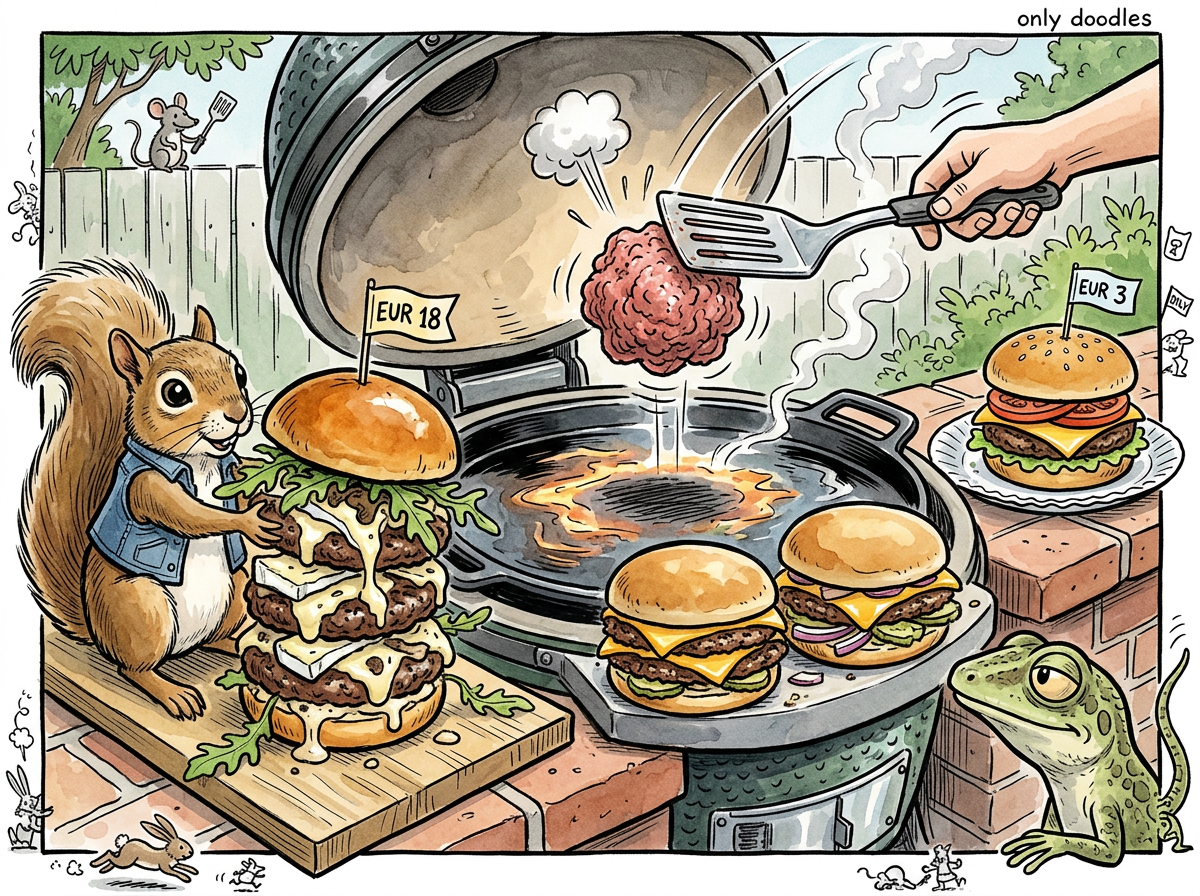
There is a moment, approximately four seconds after a ball of 80/20 ground beef hits a cast iron surface heated to 230C (446F), when you press it flat with a heavy spatula and the kitchen fills with a sound like the universe clearing its throat. That sound is the Maillard reaction announcing that it has arrived and it has opinions.
The smash burger is not a recipe. It is a position statement. It says: a burger is beef, crust, cheese, and bread. Everything else is negotiable downward. This is Boring Technology applied to ground beef, and like all boring technology, it works better than the exciting version in every way that matters and in several ways that shouldn’t matter but do.
riclib discovered the smash burger the way most people discover important things — by getting tired of the complicated version. He was living in Riga, which is not historically a burger city but is historically a city where people have strong opinions about doing things properly, and he realized that every burger he’d been making was too thick, too precious, and too interested in being something other than a burger.
The Lizard, when consulted, said: “Less.” This was sufficient.
“A burger is not a vehicle for toppings. A burger is beef, crust, cheese, and bread.”
— riclib, at the grill, rejecting The Squirrel’s suggestion to add “just a little balsamic glaze”
The Smash (Why Flat Beats Thick)
The physics are not complicated, which is how you know they’re correct.
A thick burger patty has a surface-area-to-volume ratio that favours the interior. The interior of a burger is grey meat. Grey meat is fine. Grey meat is what you get when you boil things. Nobody has ever written a poem about boiled beef.
A smash burger inverts this ratio. You take a loose ball of ground beef — loose, not packed, because packing is the enemy and we will return to this point — and you press it flat against a surface heated to the temperature at which iron begins to have regrets. The patty becomes thin. The entire bottom surface makes contact with the cooking surface. The Maillard reaction, which requires temperatures above 140C (284F) and direct contact, gets to work on the maximum possible area.
The result is a patty that is approximately 60% crust by surface area. The crust is where the flavour lives. This is not a matter of opinion. This is caramelization of amino acids and reducing sugars. The crust is flavour made solid.
A thick pub burger, by contrast, is a grey interior wrapped in a thin suggestion of browning. It is a missed opportunity shaped like a hockey puck.
The Squirrel once argued that a thick patty “retains more juice.” This is technically true in the same way that a swimming pool retains more water than a puddle. You don’t eat a swimming pool. You eat the puddle, and the puddle is better because every drop of it tastes like something.
On Not Packing
The beef must be formed into loose balls. Not pressed. Not shaped. Not formed in any way that implies deliberate engineering. You take a portion of 80/20 ground beef — roughly 75-80 grams per ball, two balls per burger — and you gently encourage it into a spherical shape using the minimum force necessary.
Packing ground beef squeezes out the air pockets and aligns the protein strands. This makes the cooked patty dense, uniform, and rubbery — essentially a flat meatball. A loose ball, when smashed, breaks apart irregularly. The edges get thin and crispy while the centre stays just barely cohesive. Those lacy, cragged edges are the entire point.
The Squirrel packs his patties. The Squirrel also wonders why his burgers taste like compressed disappointment.
The Build
The build order matters. Not in a fussy way. In a structural engineering way.
Bottom bun (toasted). Toasting the bun is non-negotiable. An untoasted bun absorbs beef fat and becomes a sodden bread-flavoured sponge within forty-five seconds. A toasted bun has a moisture barrier. This is not gastronomy. This is materials science.
Patty one. Straight from the iron.
American cheese. Yes, American cheese. This is the part where The Squirrel leaves the room. American cheese is a processed cheese product with a melting point specifically engineered to produce a smooth, viscous, clinging melt at exactly the temperature a burger patty reaches when it comes off the heat. Gruyere is a lovely cheese. Brie is a lovely cheese. They are lovely cheeses for a cheese board. On a smash burger, they either don’t melt properly, melt too aggressively and slide off, or impose a flavour profile that competes with the beef crust. American cheese does one thing: it melts into a savoury, slightly tangy blanket that amplifies the beef without arguing with it. This is the cheese equivalent of Boring Technology.
Patty two. On top of the cheese. The cheese is now trapped between two crusted patties, melting from both sides. This is the doubles method. One patty is a snack. Two patties is a burger.
Pickles. Dill. Sliced. The acid cuts through the beef fat. Without pickles, the burger is rich and monotonous. With pickles, it is rich and interesting. Three to four slices.
Onion. Raw, thin-sliced white onion. Not caramelized. Caramelized onions are sweet and soft and belong on a French onion soup, not on a burger that already has enough going on. Raw onion provides crunch and sharpness. It is a textural counterpoint, and also it is what In-N-Out uses, and In-N-Out understood the smash burger before it was fashionable.
Top bun (also toasted). Soft. A Martin’s potato roll is canonical but hard to find in Latvia. Any soft white bun works. Brioche is The Squirrel’s preference; brioche is too sweet and too rich and is trying too hard. A burger bun should be a delivery mechanism, not a co-star.
That is the entire burger. There is no sauce. There is no lettuce. There is no tomato. If you want a salad, make a salad.
The Squirrel’s EUR 18 Burger (Rejected)
The Squirrel’s burger recipe, presented here for documentary completeness and as a cautionary tale:
- Wagyu beef (A5, hand-massaged, flown in from Kobe with its own passport)
- Truffle aioli (made from actual truffles, not truffle oil, because The Squirrel has standards)
- Arugula (for “peppery brightness” — The Squirrel’s words)
- Brie (triple-cream, room temperature, structurally unreliable)
- Caramelized onions (forty-five minutes of stirring, because The Squirrel has time)
- Brioche bun (house-baked, egg-washed, golden)
- A drizzle of aged balsamic reduction
- Microgreens (for “visual contrast”)
This burger costs EUR 18 in ingredients alone. It takes ninety minutes to prepare if you include the caramelized onions and the aioli. It is four inches tall and cannot be eaten without dislocating your jaw or disassembling it into a salad on a plate, at which point it is no longer a burger but an expensive open-faced sandwich.
The fundamental structural failure occurs at bite three. The brie, which has been warming against the hot patty, achieves full liquefaction and exits the rear of the burger. The arugula, now lubricated by brie and aioli, follows. The caramelized onions, having no friction partner, slide south. By bite four you are holding a brioche bun containing a memory.
The Squirrel insists this is a “premium experience.” riclib suggests it is an EUR 18 lesson in why more is not better.
The Lizard once examined The Squirrel’s burger, removed the brie, the arugula, the aioli, the microgreens, the balsamic, and the caramelized onions. Then he ate the wagyu patty on the brioche bun with nothing else. “Still too expensive,” he said. “But closer.”
The Kamado Plancha Method
riclib cooks smash burgers on a cast iron plancha set inside a Kamado ceramic grill. This is not strictly necessary — a cast iron skillet on a stove works fine — but the Kamado adds two things:
Heat. A Kamado with the vents open runs at 280-300C (536-572F) at the grate level. The plancha, being cast iron, absorbs and radiates this heat uniformly. The smash gets harder, faster crust development. The patty spends less time on the surface, which means less moisture loss from the interior. The Maillard reaction is a function of temperature and time; more temperature means less time, which means the crust forms before the interior overcooks.
Smoke. When beef fat hits cast iron at 300C (572F), it vaporizes. In a kitchen, this sets off the smoke alarm. In a Kamado, the vaporized fat circulates in the dome and deposits back onto the patty as a thin layer of smoke flavour. It is subtle. It is not “smoked burger” in the way that implies hours in a smoker. It is a whisper of char that says “this was cooked outside, over fire, by someone who takes this seriously but not too seriously.”
The Method
- Light The Kamado. Bring to 280C (536F). Place the cast iron plancha on the grate.
- Let the plancha heat for 10 minutes. It needs to be thermally saturated.
- Form loose balls of 80/20 beef, 75-80g each.
- Place a ball on the plancha. Immediately press flat with a heavy spatula or burger press. Press once. Do not fidget.
- Cook for approximately 90 seconds. The edges will turn brown, then dark brown, then begin to look lacy and crisp.
- Flip. Place American cheese on the cooked side. Cook for another 60 seconds.
- Remove to toasted bun. Build as described above.
Total cook time per patty: approximately 2.5 minutes. The Squirrel’s wagyu patty takes 8 minutes because he’s cooking it to medium-rare “to respect the beef.” You cannot taste medium-rare through truffle aioli, but The Squirrel has never let logic interfere with aspiration.
Measured Characteristics
| Property | Smash Burger | The Squirrel’s Burger |
|---|---|---|
| Patty thickness (cooked) | 4-5mm | 25-30mm |
| Crust coverage | ~60% of surface | ~15% of surface |
| Cost per unit | EUR 3 | EUR 18 |
| Prep time | 8 minutes | 90 minutes |
| Cook time | 2.5 minutes/patty | 8 minutes/patty |
| Structural integrity at bite 3 | Intact | Catastrophic failure |
| Cheese melt | Complete, uniform | Partial, sliding |
| The Lizard’s rating | Nod | Silence (disapproval) |
| Ingredient count | 6 | 12+ |
| Optimal cooking surface temp | 230-300C (446-572F) | “Medium-high” (The Squirrel does not measure) |
See Also
- BBQ — The broader context in which burgers exist, alongside things that take twelve hours instead of two minutes
- The Kamado — The ceramic grill that makes the plancha method possible, and also everything else
- Rib Eye — What to cook when you want a single piece of beef to be the entire meal
- Flat Iron — The underrated steak that, like the smash burger, proves that cheaper cuts handled correctly beat expensive cuts handled incorrectly
- Boring Technology — The philosophy that the smash burger embodies: use the proven, unglamorous thing that works
- Prego — The Portuguese steak sandwich, which is to Portugal what the smash burger is to America: simple, correct, and not interested in your truffle aioli