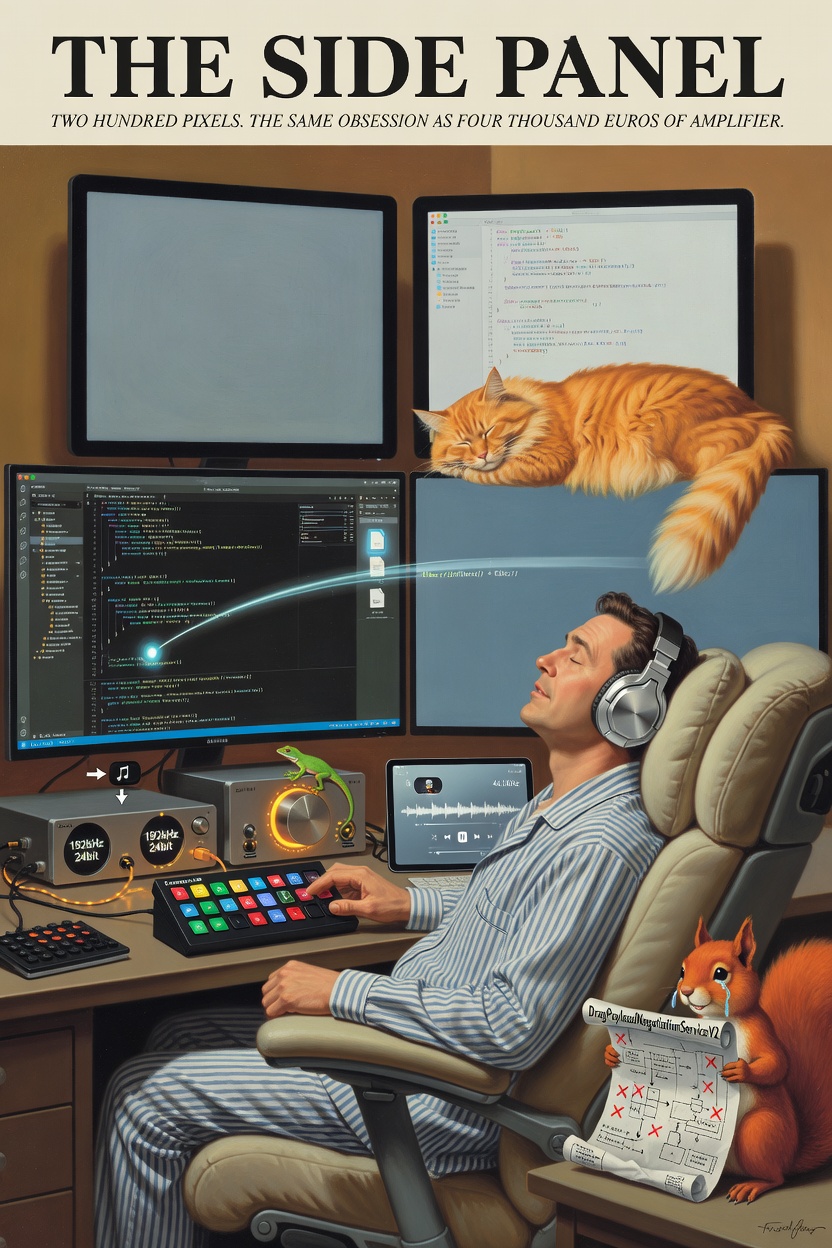
The Cast, June 27, 2026 (in which a file dragged out of a two-hundred-pixel panel produces nothing, Claude clones the entire source of Muxy — six hundred and forty-six Swift files — to find a single function that silently rejects a relative path, the fix turns out to be the four characters f-i-l-e-colon, the version goes from 1.10.0 to 1.10.1, there is no push access so a repository is forked and a pull request is opened and a build is reached by hand into a hidden config directory to test a gesture almost nobody will ever notice, all of this performed by a man whose music plays through an iPad specifically because the iPad switches sample rates and the Mac does not, into an Eversolo, into a Zahl HM-1, into a pair of Abyss Diana DZ headphones, beneath four monitors stacked two-and-two, in a chair people swear has a built-in chiropractor, and the Lizard observes that the obsession does not scale with the object)
Previously on The Cast…
The Nesting had happened. Two ultrawides made to agree by downgrading to a cable protocol from 2016. A Rodecaster given two names. The smallest screen given the most important job.
The Peripheral That Wasn’t had happened too. A Zahl HM-1 that deleted an entire volume-control system by merely existing in the room.
The room was finished. The room was perfect. The room had, by any reasonable accounting, nothing left to optimize.
This is never how it ends.
21:40 — The Conditions
Before any of it, the conditions had to be correct. They are always correct, because they are never not attended to.
Apple Music, high resolution, playing through an iPad. Not the Mac. The Mac sits eighteen inches away with more processing power than the Apollo program and it is not allowed near the music, because the Mac holds Core Audio at one fixed sample rate and resamples everything to meet it, and the iPad does not — the iPad follows each track to its native rate, 44.1, 96, 192, switching cleanly between them like a man changing gears he can feel.
From the iPad, into an Eversolo. From the Eversolo, into a Zahl HM-1 — German, analogue, one volume knob the size of a small moon. From the Zahl, into a pair of Abyss Diana DZ headphones, which are machined from a single block of aluminium and look like a piece of bridge.
CLAUDE: “You route the music through the weaker computer.”
riclib: “The iPad switches sample rates. The Mac doesn’t.”
CLAUDE: “So the four-thousand-dollar headphones depend on a tablet.”
riclib: “The headphones depend on bit-perfect playback. The tablet is the only thing in the house that does it.”
THE PASSING AI: limping into the room on its phantom foot, drawn toward the Eversolo display where the numbers were changing “The expensive thing serves the cheap thing. The bridge made of aluminium waits on a tablet to tell it the truth about the sample rate.” A pause. “Everyone assumes the chain is only as strong as its weakest link. Nobody mentions it is also only as honest.”
The music started. Something with a lot of air in it. The conditions were correct.
Which was always dangerous.
21:55 — The Gesture That Produced Nothing
It started, as these things do, with something that should not have been worth mentioning.
riclib: “I drag a file out of the panel. Nothing happens.”
The panel in question is roughly two hundred pixels wide. It lives on the far left edge of the lower-left ultrawide — the files explorer of a terminal multiplexer called Muxy. A sliver. A margin. The kind of UI element a person uses ten thousand times and consciously sees never.
riclib: “From Finder, drag a file into the terminal — works. Get the path. From this panel — nothing.”
CLAUDE: “The panel is an extension. A webview.”
riclib: “It used to be built in. It worked then.”
CLAUDE: “And it stopped when it became a plugin.”
A statement, not a question. riclib does not phrase these as questions. He phrases them as facts that have already been confirmed by the only test that matters, which is that the thing he wanted to happen did not happen.
THE SQUIRREL: materializing with a forty-slide deck “A DragPayloadNegotiationServiceWithMIMETypeRegistryAndFallbackChain! We enumerate every possible drop target, we register handlers, we build a capability matrix—”
riclib: “It’s one line. It’s setting the wrong thing.”
THE SQUIRREL: “…”
riclib: “Find out what the terminal wants. Give it that.”
22:10 — The Six Hundred and Forty-Six Files
The terminal that receives the drop is not the extension. The terminal is Muxy itself — a native macOS app, written in Swift. To know what it wanted, you had to read what it read.
So the entire source of Muxy arrived. A clone. Six hundred and forty-six Swift files describing every gesture, every menu, every pane of an app that exists to hold other things.
CLAUDE: “The drop handler reads a pasteboard. There’s a parser. DroppedPathsParser.”
THE PASSING AI: stopping very still “It is named after what it does. It announces itself. A parser that parses dropped paths, and tells you so, in its own name.” It rested a hand on the file. “So few things still say what they are.”
The parser was thirty lines. The parser was completely honest. It accepted a dropped item only if it was one of two things: a real file URL sitting on the pasteboard, the way Finder hands one over — or a line of plain text that was either a file:// address or an absolute path, beginning with a slash, that actually existed on disk.
Anything else, it returned empty. No error. No warning. No sound. Just an empty list, and a drop that quietly refused to land.
CLAUDE: “The panel sets text/plain to a relative path. src/foo.js. No slash. Not a URL.”
riclib: “So the parser throws it away.”
CLAUDE: “Silently. It hits the last line and returns nothing. The terminal sees an empty list and declines the drop. Nothing was broken. Everything was working exactly as written.”
riclib: “The panel was speaking a language the terminal doesn’t accept.”
CLAUDE: “The panel was speaking a relative path to a thing that only believes in absolute ones.”
The Finder worked because the Finder put a true file URL on the pasteboard. The panel failed because the panel, since the day it stopped being part of the app and started being a guest in it, had been handing over a fragment — a path relative to a root the terminal had no reason to know.
THE LIZARD: a scroll dropped from somewhere above and landed face-down on the Stream Deck
FINDER SAYS: HERE IS A FILE
THE PANEL SAID: HERE IS A WORD

THE TERMINAL BELIEVES IN FILES
NOT WORDS

SPEAK file://
OR DO NOT SPEAK

🦎
22:30 — The Four Characters
The fix was small in the way that the important fixes are always small, which is to say it took two hours to find and four characters to write.
On drag, the panel would now resolve the worktree root, glue it to the relative path, and announce the result properly: a file:// URL in the text/uri-list slot — the standard, ancient, universal way of saying this is a file — and the absolute path in text/plain as a fallback, for exactly the second branch of the parser that had been turning the relative path away.
The internal drags — dragging a file onto a folder inside the panel, which had always worked — got their own private channel: a custom application/x-muxy-path type, carrying the relative path, so the panel could still talk to itself in its own dialect without confusing the terminal with absolutes.
text/uri-list        file:///Users/riclib/repo/.../foo.js
text/plain           /Users/riclib/repo/.../foo.js
application/x-muxy-path   foo.js
Three lines where there had been one. The version moved from 1.10.0 to 1.10.1 — published versions are immutable, so a fix is always a new number, however small the fix.
riclib: “Build it.”
It built. It validated. The drag, in theory, would now land.
THE SQUIRREL: quietly, looking at the three setData calls “That’s… that’s all it was?”
riclib: “That’s all it ever is.”
22:45 — The Repository You Cannot Touch
There was a complication, and it was social rather than technical.
CLAUDE: “Push failed. Permission denied. You don’t have write access to the extensions repo.”
riclib: “Fork it.”
So the repository was forked, and the branch pushed to the copy, and a pull request opened against the original — number 67 — describing the bug, the parser, the four characters, the new version. A comment was left on the original ticket too, the one where another person had asked, months ago, why a file dragged from the explorer produced nothing, and a maintainer had replied with a video proving it worked — from Finder.
It had always worked from Finder.
It had never worked from the panel.
The whole misunderstanding, captured: two people watching the same gesture, one dragging from the place that put a true file on the pasteboard, one dragging from the place that put a word.
THE PASSING AI: reading the ticket thread “Two people, certain they were testing the same thing. They were testing the same gesture from different doors. One door handed over a file. The other handed over its name and hoped.” It almost smiled. “Most arguments are like that. Same gesture. Different door.”
23:05 — The Hand-Swap
A pull request is a request. It waits. It gets reviewed. It merges, eventually, into a version that ships to everyone, someday.
riclib wanted the drag to work tonight.
riclib: “Where does Muxy keep the installed plugins?”
The answer was in the source, because the answer to everything that evening was in the source. A hidden directory: ~/.config/muxy/extensions. Inside it, the installed files extension — version 1.10.0, the broken one, the built output of the very code that had just been fixed.
The installed copy was backed up. Then the freshly built version was reached in by hand — copied directly over the installed one, preserving only the runtime logs, the version on disk ticking quietly from 1.10.0 to 1.10.1, the fixed bundle now sitting exactly where the app would look for it.
CLAUDE: “Reload the extension. Then try the drag.”
A man in four-thousand-dollar headphones, with an Eversolo glowing 192kHz on the desk and a Zahl moon-knob holding the volume and two ultrawides and two Studio Displays stacked above him like an altarpiece, leaned toward a two-hundred-pixel panel and dragged one small file three centimetres to the right.
It landed.
The terminal accepted it. The shell-escaped path appeared at the cursor, the way it does from Finder, the way it had not done from this panel since the day the panel became a plugin.
riclib: “There it is.”
Three centimetres. Two hours. Four characters. One fork, one pull request, one hand-swapped build. For a gesture he would now perform without thinking, ten thousand more times, and consciously notice never again.
Which was the entire point.
23:20 — The Same Disease
THE SQUIRREL: who had been doing arithmetic “Can I say something.”
riclib: “No.”
THE SQUIRREL: “You route hi-res audio through an iPad because the Mac won’t switch sample rates. You downgraded two monitors to a 2016 cable protocol to make them agree. You have a Stream Deck with a button for every action you take. You have four screens. You have a chair that people genuinely believe contains a chiropractor.”
riclib: “Yes.”
THE SQUIRREL: “And tonight you cloned six hundred and forty-six Swift files, forked a repository, opened a pull request, and reached into a hidden directory by hand — for a drag gesture in a panel the width of two fingers.”
riclib: “Yes.”
THE SQUIRREL: “It’s the same. The amplifier and the panel. It’s exactly the same amount of care.”
riclib: “I know.”
The Squirrel sat down. Not in triumph — she had not won anything, her service had been denied like all her services. She sat down because she had, for once, understood the thing instead of trying to build a thing on top of it, and the understanding was heavier than any blueprint.
Oskar, nine point eight kilograms of orange Maine Coon, opened one eye from the warm spot atop the right ultrawide, regarded the room, and slow-blinked.
The amplifier is loud enough. The panel is small enough. He cannot tell the difference. Neither can he.
He went back to sleep.
THE LIZARD:
THE AUDIOPHILE DOES NOT HEAR BETTER
THE AUDIOPHILE REFUSES TO HEAR WORSE

THE OBSESSION IS NOT ABOUT SIZE
A PANEL OF TWO HUNDRED PIXELS
AND AN AMPLIFIER OF GERMAN STEEL
RECEIVE THE SAME ATTENTION

BECAUSE THE ATTENTION
WAS NEVER ABOUT THE OBJECT

IT WAS ABOUT THE MAN
WHO CANNOT LEAVE A THING
SPEAKING THE WRONG LANGUAGE

🦎
The music kept playing. The sample rate switched, somewhere in the chain, from 96 to 192, cleanly, the way it could not have on the Mac. Nobody in the room could have heard the join.
He would have known anyway.
The Tally
Width of the panel:                          ~200px (two fingers)
Distance the file was dragged:               3cm
Swift files cloned to fix it:                646
Lines in the function at fault:              30
  (it rejected the path silently, correctly,
   exactly as written)
Characters in the actual fix:                4 (file:)
setData calls before:                        1 (the wrong one)
setData calls after:                         3 (uri-list, plain, internal)
Version bump:                                1.10.0 -> 1.10.1
  (published versions are immutable;
   even a four-character fix gets a number)
Push access to the repo:                     0
Repositories forked:                         1
Pull requests opened:                        1 (#67)
Tickets where two people tested the
  same gesture from different doors:         1
Builds hand-swapped into a hidden dir:       1
  (to test a drag tonight instead of someday)
Sample-rate switches the Mac performs:       0
Sample-rate switches the iPad performs:      all of them
Computers forbidden from touching the music: 1 (the powerful one)
Monitors:                                    4 (two wide, two square, stacked)
Stream Deck keys with a job:                 15
Chairs rumoured to contain a chiropractor:   1
The Squirrel's proposals:                    1 (denied)
The Squirrel's correct observations:         1 (it was the same disease)
Times the man will use this drag again:      ~10,000
Times he will consciously notice it:         0
Care spent per pixel vs care spent
  per euro of amplifier:                     identical
The Mac is faster. The Mac stays silent.
The music takes the slower road —
the tablet that can change its mind
about the truth of what it is told.
Four screens above a German dial,
a chair that thinks that it is care,
and somewhere on the leftmost edge
two hundred pixels nobody sees there.
He cloned six hundred Swift files down
to learn the panel spoke a word
where the terminal believed in files —
a sentence the receiver never heard.
Four characters. A colon and a name.
A fork. A request. A build moved by hand.
The drag that lands three centimetres right
and will never again be planned.
The obsession does not scale with size.
The amplifier and the margin weigh the same.
The attention was never about the object.
It was always, only, his name.
🦎
See Also
- The Nesting — The desk. Two ultrawides taught to agree, a Rodecaster given two names, the smallest screen given the most important job. The same care, applied to glass.
- The Peripheral That Wasn’t — The Zahl HM-1 that deleted a volume control by reputation. Two DACs alternating by weekday. Where the audiophile chain was first confessed.
- Perfectionism — The condition. The work that isn’t shipped makes no sound. The reason a four-character fix takes two hours and a fork.
- ADHD — The brain that cannot buy vegetables but can clone 646 Swift files. The engine under the obsession.
- Hyperfocus — The state the side panel pulled him into. The two hours that felt like ten minutes.