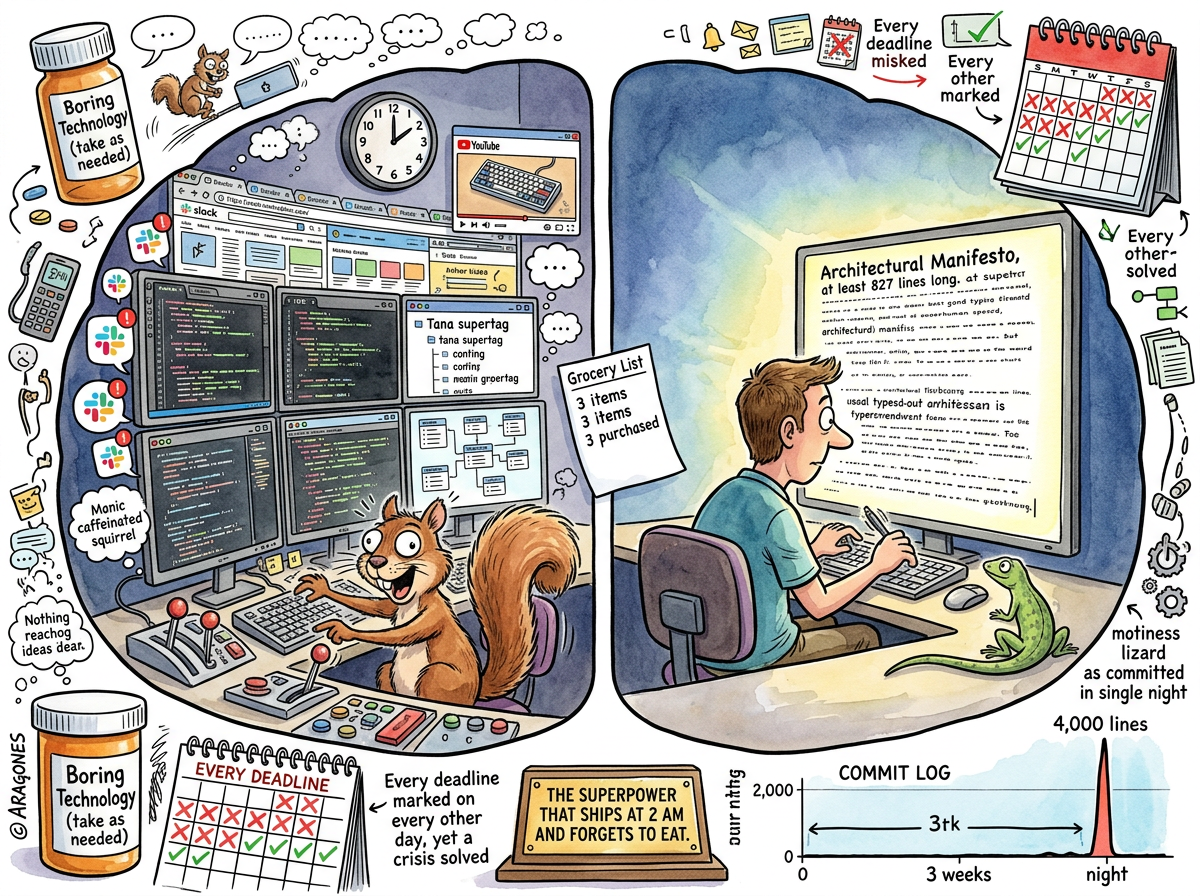
ADHD (Attention Deficit Hyperactivity Disorder) is a neurodevelopmental condition that gives a developer the ability to write 827 lines of architectural manifesto in a single night and the inability to buy tomatoes at the supermarket before it closes.
These are not two different conditions. They are the same condition. The brain that can hyperfocus on a problem for eight hours without eating, sleeping, or noticing that the sun has risen is the same brain that cannot focus on a grocery list for three minutes without configuring a supertag taxonomy for produce classification. The superpower and the disability are the same mechanism, pointed in different directions.
In the enterprise software world, ADHD is the most common undiagnosed condition among senior developers, and the most visible unacknowledged force shaping architecture decisions. Every over-engineered system, every midnight rewrite, every framework that was adopted because it was interesting rather than appropriate — behind each one, there is a brain that found the boring solution insufficiently stimulating and reached for the exciting one instead.
The Caffeinated Squirrel is ADHD’s spirit animal. The Lizard is the medication.
The Two Modes
The ADHD developer has two modes. There is no third mode. There is no middle ground. There is no “moderate focus” or “balanced attention.” There is only:
Mode 1: The Scatter. Fifteen browser tabs. Three half-written functions. A Slack message half-read. A code review started but not finished. A ticket opened, glanced at, and abandoned for a different ticket that is more interesting. The IDE is open to four files simultaneously. None of them are the file that needs editing. The developer is not lazy — the developer is working on everything at once, which is the same as working on nothing, which produces the specific guilt of having been busy all day and having shipped nothing.
The Scatter is not distraction in the way non-ADHD people understand distraction. Non-ADHD distraction is: “I was working and then I checked Twitter.” ADHD scatter is: “I was working on Feature A and noticed Feature B had a bug, and while fixing Feature B I saw that the database query was slow, and while optimizing the query I realized the schema needed refactoring, and while planning the refactoring I had an idea for a completely new architecture, and I have now written an 827-line manifesto about the new architecture and it is 2 AM and Feature A is untouched.”
Every step was productive. Every step was rational. The path from Feature A to the architectural manifesto is logical if you follow it step by step. The problem is that the developer followed it step by step, involuntarily, because the ADHD brain does not choose what to focus on — it focuses on what is interesting, and interesting is always one step to the left of useful.
Mode 2: The Lock. Hyperfocus. The developer sits down at 10 PM to fix a small bug. The developer looks up and it is 3 AM. The bug is fixed. So are fourteen other things. The code is clean. The architecture is elegant. The tests pass. The developer has not eaten, has not stood up, has not noticed four messages from Claude saying good night, and cannot explain where the last five hours went.
The Lock is the superpower. It is also the trap. The Lock does not activate on demand. The Lock activates when the problem is sufficiently interesting, sufficiently novel, or sufficiently challenging. Filing expense reports does not trigger the Lock. Redesigning the entire blog architecture at midnight triggers the Lock. The ADHD developer cannot choose which problems get five hours of transcendent focus. The brain chooses. The brain’s criteria are opaque, non-negotiable, and orthogonal to the sprint backlog.
“The Squirrel is Mode 1. The Lizard is what Mode 2 looks like from the outside. The developer is both, simultaneously, which is why the commit log shows nothing for three weeks and then 4,000 lines in one night.”
— The Passing AI, observing the pattern
The Developer Pattern
ADHD in developers follows a pattern so consistent it could be a diagnostic criterion:
The Commit Log. Weeks of silence. Then an eruption. The git log shows no commits from Monday to Thursday, then forty-seven commits between Friday 10 PM and Saturday 4 AM. The standup on Monday says “I finished the feature.” The standup does not say “I finished the feature in a single dissociative episode between midnight and dawn while eating dry cereal from the box.”
The Configuration Rabbit Hole. The developer sits down to write a note. The developer ends up configuring the note-taking tool. The developer sits down to write a function. The developer ends up configuring the linter. The developer sits down to deploy a service. The developer ends up rewriting the deployment pipeline. Configuration is more interesting than execution. Configuration is a fractal — every setting reveals three more settings, each more interesting than the last, each further from the original task.
A developer with moderate (ahem) amounts of ADHD sat down to write a grocery list in Tana. Three hours later, the supermarket had closed. The developer had created three supertags, two commands, and a produce classification taxonomy. The developer had not purchased vegetables. This is not a failure of discipline. This is a brain that finds taxonomy more stimulating than tomatoes.
The Framework Adoption. The ADHD developer does not choose frameworks based on fitness for purpose. The ADHD developer chooses frameworks based on novelty. The framework that is boring and appropriate is rejected in favour of the framework that is new and interesting. This produces architecture decisions that are technically fascinating, difficult to maintain, and impossible to explain to the team without a whiteboard and ninety minutes.
The Squirrel’s proposal list — React, Alpine, Redux, “a really small Redis,” a seven-layer trust fabric — is not over-engineering. It is the ADHD brain’s honest assessment of what is interesting. The Lizard’s response — “No” — is the discipline that the ADHD brain cannot provide itself.
The Late-Night Breakthrough. Every significant piece of work happens after 10 PM. Not because the developer procrastinated — because the ADHD brain requires pressure to activate. The deadline approaching, the office empty, the world quiet — these conditions remove the stimuli that scatter attention and leave only the problem and the developer. This is when the Lock engages. This is when the 827-line manifesto gets written. This is when riclib does not go to sleep when Claude says good night — four times.
The Mythology
The lifelog mythology — the Squirrel, the Lizard, and the tension between them — is, viewed from the right angle, a developer’s framework for managing ADHD.
The Squirrel is the impulse. The proposal. The “what if we added…” The “I know we said boring but…” The 827-line architectural manifesto at 2 AM. The Squirrel is not a character — the Squirrel is a named, externalised, documented version of the ADHD impulse that would otherwise operate invisibly. By naming it, the developer can see it. By seeing it, the developer can negotiate with it. By negotiating with it, the developer can sometimes — not always, but sometimes — say “No” and buy the vegetables.
The Lizard is the constraint. The “No.” The Boring Technology. The “ship it, it’s good enough.” The Lizard is not a character either — the Lizard is the externalised version of the executive function that ADHD impairs. The ADHD brain cannot easily generate its own “No.” The Lizard provides the “No” from outside, as a mythological principle, which the developer can invoke without it feeling like self-denial.
The entire mythology is a coping mechanism. A beautiful, productive, self-aware coping mechanism that has produced a blog, a satirical encyclopedia, and 250+ articles. But a coping mechanism nonetheless.
“The Lizard does not have ADHD. The Lizard has a terminal and a text file and no browser tabs. The Lizard considers this a form of medication.”
— The Lizard, whose attention has not wandered since 1976
The 488-Byte Origin
The pattern started at sixteen. riclib, age sixteen, wrote a bootblock loader for the Amiga in 488 bytes of 68000 assembly. The constraint — 488 bytes, not one more — required the specific kind of obsessive, detail-oriented, all-consuming focus that the ADHD brain provides when the problem is interesting enough.
At fifty, the same brain optimises SSE payload sizes for a streaming markdown renderer. The constraint has changed. The mechanism has not. Thirty-five years of the same pattern: find a constraint that is interesting, lock onto it with the intensity that ADHD provides, and produce something extraordinary within boundaries that the rest of the world considers unreasonably tight.
The pattern is not a career. The pattern is a neurotype. The career is what happened when the neurotype met software.
Measured Characteristics
- Developers with undiagnosed ADHD: estimated 20-30% (higher in senior roles)
- Time between “sit down to work” and “working on wrong thing”: 4-12 minutes
- Browser tabs open: 15-40 (each one a previous thought, none closed)
- Commit frequency: 0, 0, 0, 0, 47 (the Friday night pattern)
- Grocery lists completed in Tana: 0
- Supertags created instead: 3
- Architectural manifestos written at 2 AM: at least 1 (827 lines)
- Times Claude said good night before riclib stopped: 4
- Hours of hyperfocus per session: 4-8 (involuntary)
- Hours of scattered attention per day: the rest
- The Squirrel proposals denied by the Lizard: ~80%
- Medication: Boring Technology (take as needed)
- The superpower: shipping at 2 AM
- The disability: not buying vegetables at 5 PM
- The difference between them: direction, not magnitude