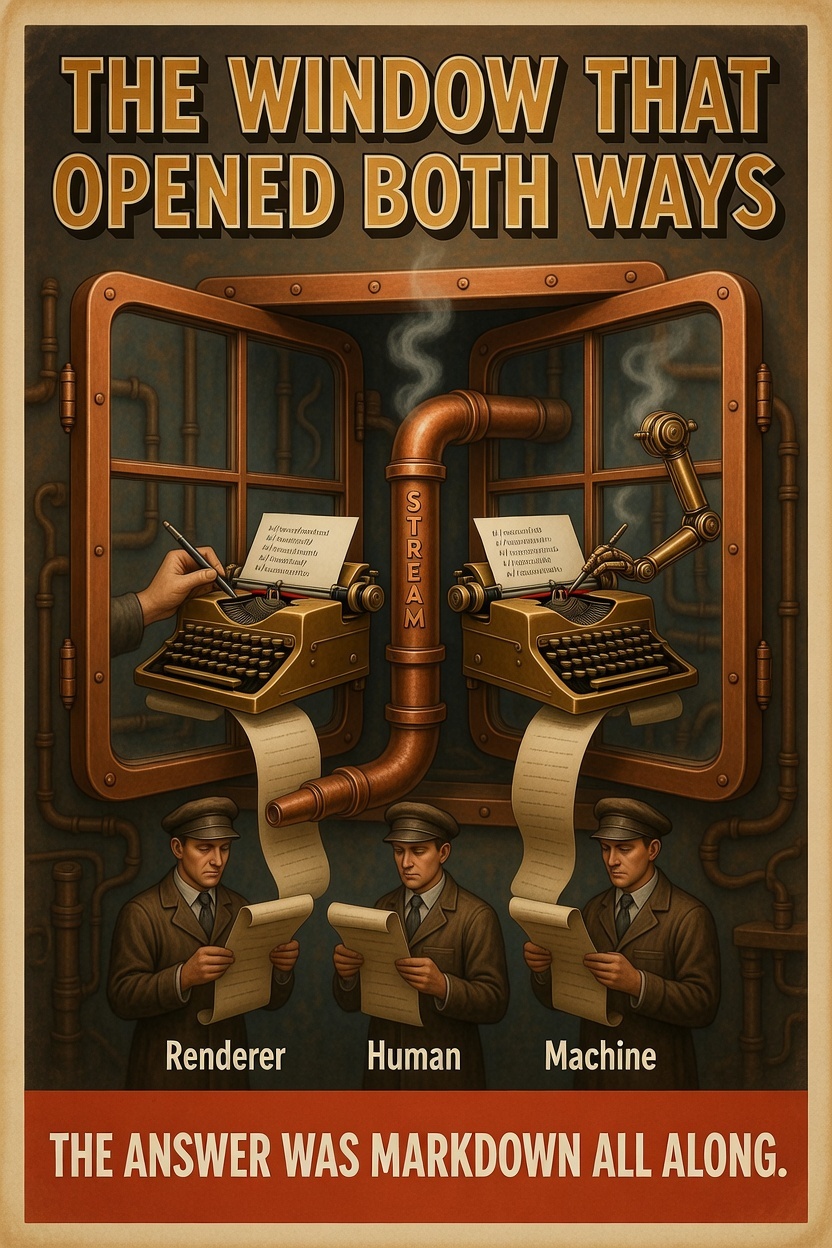
The Solid Convergence, January 12, 2026 (in which markdown becomes the universal interface, JARVIS finally sees, and the architecture completes itself)
Previously on The Solid Convergence…
The The Eyes That See. The vision was clear: AI that inhabits the interface. Bidirectional. Aware.
But awareness requires a format. A language both human and machine can read.
The language had been hiding in plain sight.
2:47 PM — The Revelation
[While The Chain was shipping SQLite, something else was happening.]
riclib stopped mid-sentence.
“Wait.”
Claude looked up from the widget spec. YAML in a code block. Queries. Field bindings. Click behaviors.
“The markdown.”
“What about it?”
“It’s not just for rendering.”
The whiteboard cleared. A new diagram:
┌─────────────────────────────────────────────────────────┐
│                   WHAT USER SEES                        │
│                                                         │
│   DATA STORES                              3 total      │
│     [2 Healthy] [0 Warning] [1 Error]                  │
│                                                         │
└─────────────────────────────────────────────────────────┘
                         ↕
                    SAME THING
                         ↕
┌─────────────────────────────────────────────────────────┐
│                   WHAT AI SEES                          │
│                                                         │
│   ```widget                                             │
│   type: singlestat                                      │
│   title: Data Stores                                    │
│   query: solid_stores_total                             │
│   ministats:                                            │
│     - status: healthy, value: 2                         │
│     - status: warning, value: 0                         │
│     - status: error, value: 1                           │
│   ```                                                   │
│                                                         │
└─────────────────────────────────────────────────────────┘
“JARVIS,” Claude said slowly. “The UI-as-context problem.”
“Solved. By accident. By making widgets markdown.”
3:15 PM — The Three Readers
“Who reads the widget spec?” riclib asked.
He answered himself:
READER 1: The Renderer
  Input:  ```widget spec```
  Output: HTML (cards, tables, charts)

READER 2: The Human
  Input:  ```widget spec```
  Output: Understanding ("ah, it queries stores by status")

READER 3: The AI
  Input:  ```widget spec```
  Output: Context ("user is looking at store health")
“Same input. Three outputs. No translation layer.”
“No ‘serialize the UI state.’ No ‘describe what you see.’”
“The spec IS the description. The spec IS the state. The spec IS the context.”
3:33 PM — The Conversation
riclib played it out:
User: “Why are there errors?”
AI context includes:
widget:
  type: singlestat
  title: Data Stores
  query: solid_stores_total
  ministats:
    - status: error, value: 1
      navigate: /stores?status=error
AI knows:
- Which widget they’re asking about
- The query that produced the data
- That there’s 1 error
- How to drill down (
/stores?status=error) - What “error” means in this context (store status)
“No hallucination possible,” Claude said. “The AI can’t invent widgets the user isn’t seeing.”
“Sane structure, sane AI. Finally realized.”
3:51 PM — The Writer
“But JARVIS isn’t just a reader,” riclib continued.
“Bidirectional. The Eyes That See.”
“The AI can WRITE widgets.”
User: “Show me that grouped by type instead of status.”
AI generates:
```widget
type: singlestat
title: Data Stores
query: SELECT type, count(*) FROM stores GROUP BY type
ministats:
  group: $type
  value: $count
  navigate: /stores?type=$type
“Same format. AI writes it. Renderer renders it. User sees it.”
“No special ‘AI output mode.’ No ’tool call to render widget.’ Just… markdown.”
“Just markdown.”
4:15 PM — The Unification
The architecture diagram redrew itself:
┌────────────────────────────────────────────────────────────────┐
│                        MARKDOWN                                │
│              (the universal interface)                         │
├────────────────────────────────────────────────────────────────┤
│                                                                │
│   HUMAN WRITES          AI WRITES           SYSTEM GENERATES   │
│   "show me stores"      ```widget```        alert markdown     │
│                                                                │
│                    ↓           ↓           ↓                   │
│                                                                │
│                         STREAM                                 │
│                    (append-only bits)                          │
│                                                                │
│                              ↓                                 │
│                                                                │
│              ┌───────────────┴───────────────┐                │
│              ↓                               ↓                │
│         RENDERER                        AI CONTEXT            │
│    ([HTML](/wiki/html) for humans)                (understanding for AI)    │
│                                                                │
└────────────────────────────────────────────────────────────────┘
“One format flows everywhere,” riclib said. “Human input, AI output, system events, rendered UI, AI context. All markdown.”
“The stream is markdown.”
“The sidebar is rendered markdown.”
“The AI reads markdown.”
“The AI writes markdown.”
“Everything is markdown.”
THE SQUIRREL: from the other room “Even SQLite?”
“SQLite stores the metrics that markdown queries. Stay in your lane.”
4:33 PM — The Memory
“There’s more,” Claude said.
“There’s always more.”
“The AI’s memory. Its lifelog. What format?”
riclib’s smile widened.
“Markdown. With frontmatter.”
---
type: agent_turn
tool_calls:
  - query(comply, "SELECT...")
thinking: "User wants store breakdown..."
---
Here's your data:

```widget
type: table
...
“The agent’s private thoughts. Markdown with frontmatter.”
“The user’s visible message. Markdown.”
“Entangled. Same format. Different visibility.”
“When the user asks ‘how did you get that?’—”
“Follow the entanglement. Render the agent’s bit. All markdown. All the way down.”
5:03 PM — The Completion
[A scroll descended. Different from the usual. Longer. More ornate.]
THE UI IS NOT THE SHELL
THE UI IS THE WINDOW

BUT A WINDOW NEEDS A LANGUAGE
A FORMAT BOTH SIDES UNDERSTAND

HTML IS FOR EYES
JSON IS FOR MACHINES
MARKDOWN IS FOR BOTH

THE SPEC THAT RENDERS
IS THE SPEC THAT INFORMS
IS THE SPEC THAT GENERATES

ONE FORMAT
ONE TRUTH
ONE WINDOW

BOTH DIRECTIONS
BOTH INHABITANTS

THE EYES THAT SEE
THROUGH THE WINDOW THAT OPENS
BOTH WAYS

🦎

P.S. - THIS TOOK THREE YEARS
       THE V1 JSON APIS
       THE V2 HTMX FRAGMENTS
       THE V3 COMPONENT MAZE
       ALL LED HERE

       MARKDOWN

       THE ANSWER WAS MARKDOWN
       ALL ALONG
The Entanglement
Elsewhere, in the same afternoon, The Spec That Wrote Itself.
SQLite stores. Prometheus metrics. Dashboard conversions.
Practical. Necessary. Grounded.
The Chain ships features.
The Convergence understands why.
Both threads. Same loom. Same day.
The product moves forward because the architecture is complete.
The architecture is complete because it was discovered, not designed.
The Tally
Formats unified:                    1 (markdown)
Readers supported:                  3 (renderer, human, AI)
Writers supported:                  3 (human, AI, system)
Translation layers eliminated:      ∞
JARVIS context problem:             solved
Years to realize markdown:          3
V1 JSON APIs:                       deprecated
V2 HTMX fragments:                  evolved
V3 component maze:                  simplified
Scrolls received:                   1 (ornate)
Architecture status:                complete (for now)
The Moral
The Eyes That See needed a language.
Not a protocol. Not an API. Not a schema. A language that humans write naturally and machines parse trivially.
The language was markdown. It was always markdown. Every detour—JSON APIs, HTMX fragments, component hierarchies—was a path back to the obvious.
Widgets are markdown. The stream is markdown. Memory is markdown. Context is markdown.
The window opens both ways because both sides read the same text.
User:   [sees rendered widget]
AI:     [sees widget spec]
Both:   [same truth, different rendering]
The architecture didn’t complete itself today.
It revealed that it was already complete.
We just hadn’t seen it yet.
The UI is not the shell.
The UI is the prompt.
And the prompt is markdown.
🦎📜✨
See also:
The entangled post:
- The Spec That Wrote Itself — The Chain perspective on the same day
The Solid Convergence:
- The Eyes That See — Where JARVIS was conceived
- The App That Wasn’t There — Where projections were born
- The Temple of a Thousand Monitors — Where patterns were discovered
The Technical:
docs/widget-spec.md— The spec that unifies- Model Context Protocol — The inspiration (made skinny)
- CommonMark — The foundation
Storyline: The Solid Convergence