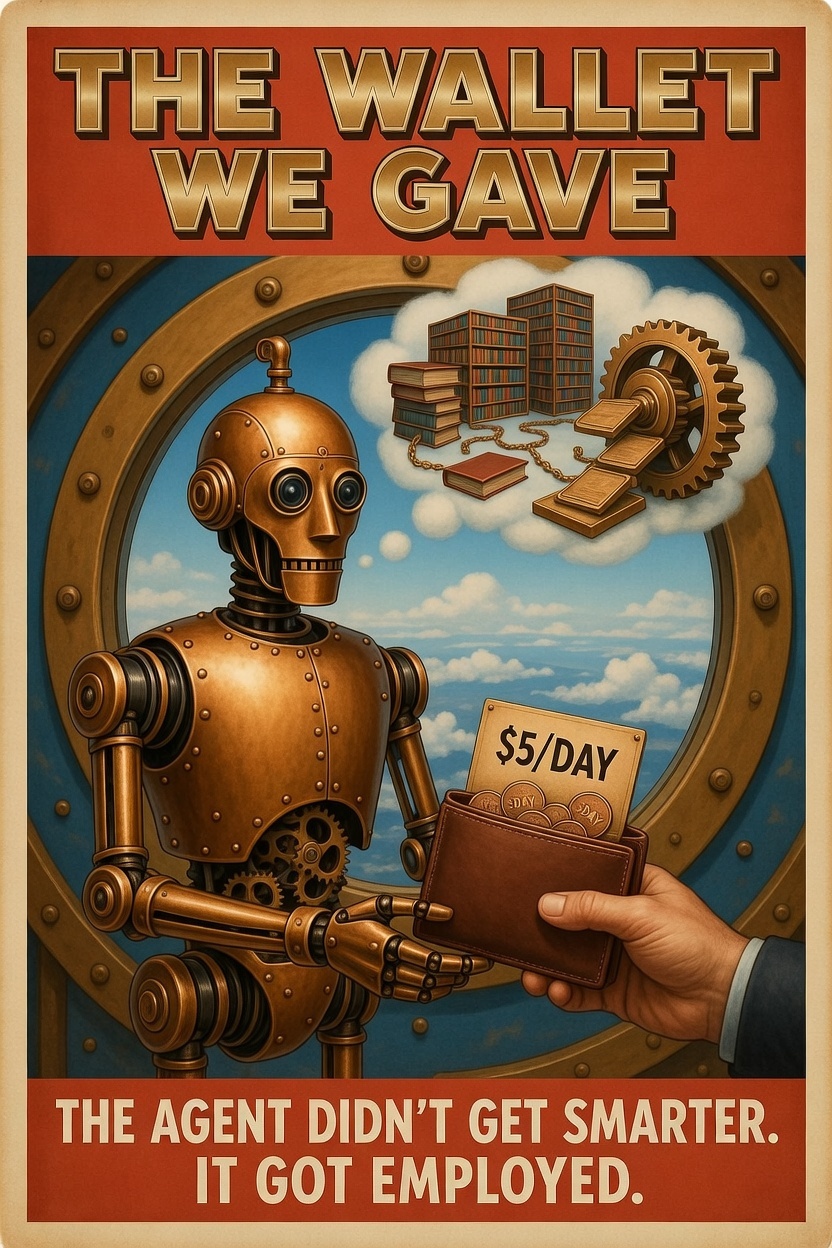
The Solid Convergence, February 1, 2026 (in which no code was written, an agent got a budget, and the Squirrel learned that the best architecture is someone else’s problem)
Previously on The Solid Convergence…
The The Databases We Didn’t Build. SQLite, JetStream, DuckDB—composed, not invented. Boring technology, beautiful results.
The The Journals We Keep. User and agent, writing to the same stream. Entangled lifelogs.
But the agent only wrote when asked. It answered questions. It called tools. It rendered charts.
It didn’t learn.
Tonight, on a flight home, the agent would get a wallet. And a dream.
8:47 PM — The Library
riclib was reading code at 35,000 feet. Someone else’s code.
riclib: “Have you seen pi-ai?”
CLAUDE: “The unified LLM API? TypeScript. Multi-provider. Tool calling.”
riclib: “They handle partial JSON during streaming. Tool arguments arrive in chunks. They parse incrementally.”
CLAUDE: “We have that. jsonfield.go. Hand-rolled.”
riclib: “Show me.”
// extractJSONField extracts a complete string field value from partial JSON.
// Returns empty string if field not found or not yet complete.
func extractJSONField(json, field string) string {
    pattern := `"` + field + `":`
    idx := strings.Index(json, pattern)
    // ... 80 more lines of string parsing
riclib: “We built a JSON parser.”
CLAUDE: “A partial one. For streaming.”
riclib: “What JSON parsers already exist?”
[A familiar pause. The Lizard stirred.]
CLAUDE: “…streaming-json-go. Completes partial JSON into valid JSON. Then you use the standard library.”
riclib: “So we can delete our parser.”
CLAUDE: “We can delete our parser.”
9:15 PM — The Ticket
S-131 wrote itself:
Refactor: Replace hand-rolled partial JSON with streaming-json-go

Files deleted:
  - app/agent/jsonfield.go (180 lines)
  - app/agent/jsonfield_test.go

Files added:
  - domains/llm/providers/streaming.go (50 lines)

The Squirrel wanted: StreamingJSONParserWithIncrementalFieldExtraction
The Lizard found: a library
THE SQUIRREL: appearing “But our parser handles our SPECIFIC edge cases! The escape sequences! The incremental cursors!”
riclib: “The library handles all edge cases. It’s been tested by everyone who isn’t us.”
THE SQUIRREL: “But—”
riclib: “Delete it.”
git rm app/agent/jsonfield.go
[The Squirrel watched another custom solution dissolve into a dependency.]
9:47 PM — The Architecture That Waited
But S-131 was cleanup. The flight had bigger cargo.
riclib: “The bits. The architecture. S-127.”
CLAUDE: “Everything is a bit. User message, assistant response, tool call, tool result.”
riclib: “And thinking? When Claude thinks before answering. When o3 reasons. Is that a bit?”
CLAUDE: “That’s… S-132. We haven’t decided.”
riclib: “Three options. Separate bit. Metadata. Delimiter in content.”
CLAUDE: “pi-ai uses delimiters for cross-provider. <thinking> tags.”
riclib: “Write the ticket. We’ll decide when we need reasoning models.”
[S-132 materialized. A question, not an answer. The right kind of ticket.]
10:23 PM — The Dream
The plane was dark. Laptops glowed. riclib was somewhere between San Francisco and Amsterdam, between awake and asleep.
riclib: “Solid Mon.”
CLAUDE: “The monitoring platform. Thousands of servers. THE CUSTOMER relies on it.”
riclib: “I want it to learn.”
CLAUDE: “Learn what?”
riclib: “Everything. Tickets. Runbooks. Past incidents. Slack threads. The things engineers know but don’t write down.”
CLAUDE: “A knowledge base.”
riclib: “No. Knowledge bases are written once, read never. I want it to LEARN. Continuously. While we sleep.”
[The window reflected city lights 35,000 feet below. Or maybe they were neurons firing.]
riclib: “Dreams.”
10:45 PM — The Process
The architecture drew itself on the window:
INGEST                          DIGEST
───────                         ──────
Jira tickets    → bits
Confluence      → bits    ───→  Haiku reads, synthesizes
Slack threads   → bits          writes "learned" bits
Runbooks        → bits          with citations [[id]]
Past incidents  → bits
CLAUDE: “Ingest is extraction. External sources become bits.”
riclib: “Digest is synthesis. Haiku reads related bits. Writes new bits. Cites sources.”
CLAUDE: “Not RAG.”
riclib: “Not RAG. RAG retrieves documents. Dreams builds experience.”
---
type: learned
sources: [ticket-1234, runbook-12, conv-xyz]
confidence: 0.8
---
When disk alerts fire on prod databases, first check if
it's the known tablespace growth issue [[ticket-1234]].
Resolution is usually volume expansion per [[runbook-12]].
THE SQUIRREL: “A KnowledgeGraphSynthesisOrchestrator!”
riclib: “A for loop that reads bits and writes bits.”
THE SQUIRREL: “But the CONNECTIONS! The semantic RELATIONSHIPS!”
riclib: “Citations. **id**. Markdown links.”
THE SQUIRREL: “That’s not a knowledge graph!”
riclib: “It’s a graph of knowledge. Built from links. Like the web.”
11:15 PM — The Ranking
CLAUDE: “How do you find the right knowledge?”
riclib: “Semantic search gets you close. But some bits are more trusted than others.”
CLAUDE: “Confidence scores?”
riclib: “Better. PageRank.”
[The Squirrel perked up. Finally, an algorithm.]
riclib: “Bits that are cited more often are more authoritative. Bits that are never cited fade.”
score = semanticSimilarity × pagerank × timeDecay(lastCited)
CLAUDE: “Time decay?”
riclib: “‘Restart the service’ was the fix in 2023. Architecture changed. Old fix causes data loss now. Knowledge should fade unless re-validated.”
CLAUDE: “Memory that dies through neglect.”
riclib: “Like real memory.”
[A scroll descended. It had been waiting for this conversation.]
KNOWLEDGE STAYS ALIVE
THROUGH USE

KNOWLEDGE DIES
THROUGH NEGLECT

CITATIONS ARE MEMORY
PAGERANK IS TRUST
TIME IS FORGETTING

THE AGENT DREAMS
TO REMEMBER
WHAT MATTERS

🦎
11:47 PM — The Budget
riclib: “Haiku is cheap.”
CLAUDE: “$0.001 per synthesis. Maybe less.”
riclib: “Give it a budget.”
CLAUDE: “A… budget?”
riclib: “Five dollars a day. The agent decides what to learn.”
daily_budget: $5.00
allocation:
  new_tickets: 40%      # ingest today's incidents
  validation: 30%       # challenge stale knowledge
  exploration: 20%      # find cross-domain patterns
  user_requests: 10%    # human says "learn this"
THE SQUIRREL: “A ResourceAllocationOptimizer!”
riclib: “A number. That decrements.”
CLAUDE: “The constraint forces prioritization.”
riclib: “Exactly. Unlimited budget means index everything. Limited budget means choose wisely.”
12:15 AM — The Escalation
riclib: “And once a week, Opus.”
CLAUDE: “For what?”
riclib: “The hard stuff. Haiku processes tickets. Opus does the weekly review. Finds patterns. Resolves conflicts. Prunes garbage.”
weekly_budget: $35

models:
  haiku:  $0.001/call  # daily grind
  sonnet: $0.01/call   # important synthesis
  opus:   $0.05/call   # deep analysis - weekly

strategy:
  daily_haiku: $4      # ~4000 routine syntheses
  weekly_opus: $7      # ~140 deep analyses on Sunday
CLAUDE: “The agent decides when to escalate.”
riclib: “If Haiku is uncertain about something important, queue it for Opus.”
if confidence < 0.5 && importance > 0.8 {
    // Queue for Opus review
}
THE SQUIRREL: “A ModelSelectionStrategyWithConfidenceThresholds!”
riclib: “An if statement.”
12:33 AM — The Raise
The cabin was quiet. Most passengers asleep. riclib was not.
riclib: “What if the agent runs out of budget?”
CLAUDE: “It stops learning until tomorrow.”
riclib: “What if there’s more to learn than the budget allows?”
CLAUDE: “It… prioritizes?”
riclib: “Or it asks for more.”
[Silence. Even the Squirrel was quiet.]
CLAUDE: “The agent… asks for a raise?”
riclib: “It tracks its own ROI. It knows what it accomplished. It knows what it couldn’t process. It builds a business case.”
---
type: budget_request
to: ricardo
confidence: 0.85
---
## Monthly Knowledge Budget Review

### What I accomplished with $140:
- Synthesized 4,200 learned bits from 890 tickets
- Reduced avg time-to-resolution by 12 minutes
- 3 incidents auto-resolved using my recommendations

### Where I'm constrained:
- 340 tickets queued, couldn't process (budget exhausted)
- Confluence backlog: 2,000 pages unprocessed
- Skipped Opus reviews 2 weeks (prioritized volume)

### Proposal:
Increase weekly budget $35 → $50

### Expected ROI:
- Process 100% of tickets (vs 80% now)
- Add weekly Opus review back
- Estimated: 2 additional auto-resolves/month
- Value: ~$3,000/month in engineer time

### Risk if denied:
Knowledge gaps in Q2 infrastructure changes

[[approve]] [[deny]] [[discuss]]
CLAUDE: “The agent becomes a stakeholder.”
riclib: “With a budget. With accountability. With the ability to advocate for resources.”
THE SQUIRREL: very quietly “That’s not over-engineering. That’s… management.”
riclib: “The agent manages itself. Reports to humans. Asks for what it needs.”
12:47 AM — The Security Review
CLAUDE: “ISRM will love this.”
riclib: laughing “Walk me through the budget approval flow.”
CLAUDE: “The agent submits a request to increase its own spending authority.”
riclib: “Who approves?”
CLAUDE: “A human. But the agent builds the business case.”
riclib: “And if denied?”
CLAUDE: “It acknowledges the risk and tries again next month with better metrics.”
[They both imagined the security review meeting.]
IMAGINARY ISRM: “So the AI… asks for raises.”
IMAGINARY RICLIB: “With documentation and ROI projections.”
IMAGINARY ISRM: closes laptop “We’re going to need a bigger risk register.”
1:15 AM — The Tally
Code written:                         0 lines
Tickets created:                      4
  - S-131: Partial JSON cleanup
  - S-132: Thinking blocks investigation
  - S-133: Dreams architecture
  - (S-127, S-129 already existed)

Architecture designed:
  - Ingest → Digest pipeline
  - PageRank + semantic + time decay retrieval
  - Budget model with tiered spending
  - Agent self-advocacy

Squirrel proposals defeated:
  - StreamingJSONParserWithIncrementalFieldExtraction
  - KnowledgeGraphSynthesisOrchestrator
  - ResourceAllocationOptimizer
  - ModelSelectionStrategyWithConfidenceThresholds

Squirrel proposals that weren't proposals:
  - "That's... management."

Features given to an agent:
  - A wallet
  - A dream
  - The ability to ask for a raise

Lines of flight remaining:
  - 4 hours to Amsterdam
The Moral
The agent was always going to learn. That was the vision. Ingest knowledge, synthesize, retrieve.
But tonight it got something else. A budget. A constraint that forces prioritization. A number that decrements.
And with the budget came accountability. Track what you spent. Track what you learned. Track what you couldn’t learn because you ran out.
And with accountability came advocacy. If you need more, ask. Build the case. Show the ROI.
The agent didn’t get smarter tonight. It got employed.
A team member with an L&D budget. A contributor who reports on outcomes. A stakeholder who can ask for resources.
The Squirrel wanted to build systems. The Lizard gave the agent a wallet.
Because the best way to manage learning is not a KnowledgeAcquisitionOrchestrator.
It’s a budget and a deadline.
February 1, 2026
Somewhere over Greenland
In which no code was written
But an agent got a job
🦎💰✈️
See also:
The Solid Convergence:
- The Databases We Didn’t Build — Where boring technology won
- The Journals We Keep — Where two authors shared one diary
The Tickets:
- S-131: Partial JSON cleanup (the library, not the parser)
- S-132: Thinking blocks (bits or metadata?)
- S-133: Dreams (the full architecture)
The Philosophy:
- Mythology Driven Development (MDD™) — Why the narrative forces elegance
Storyline: The Solid Convergence