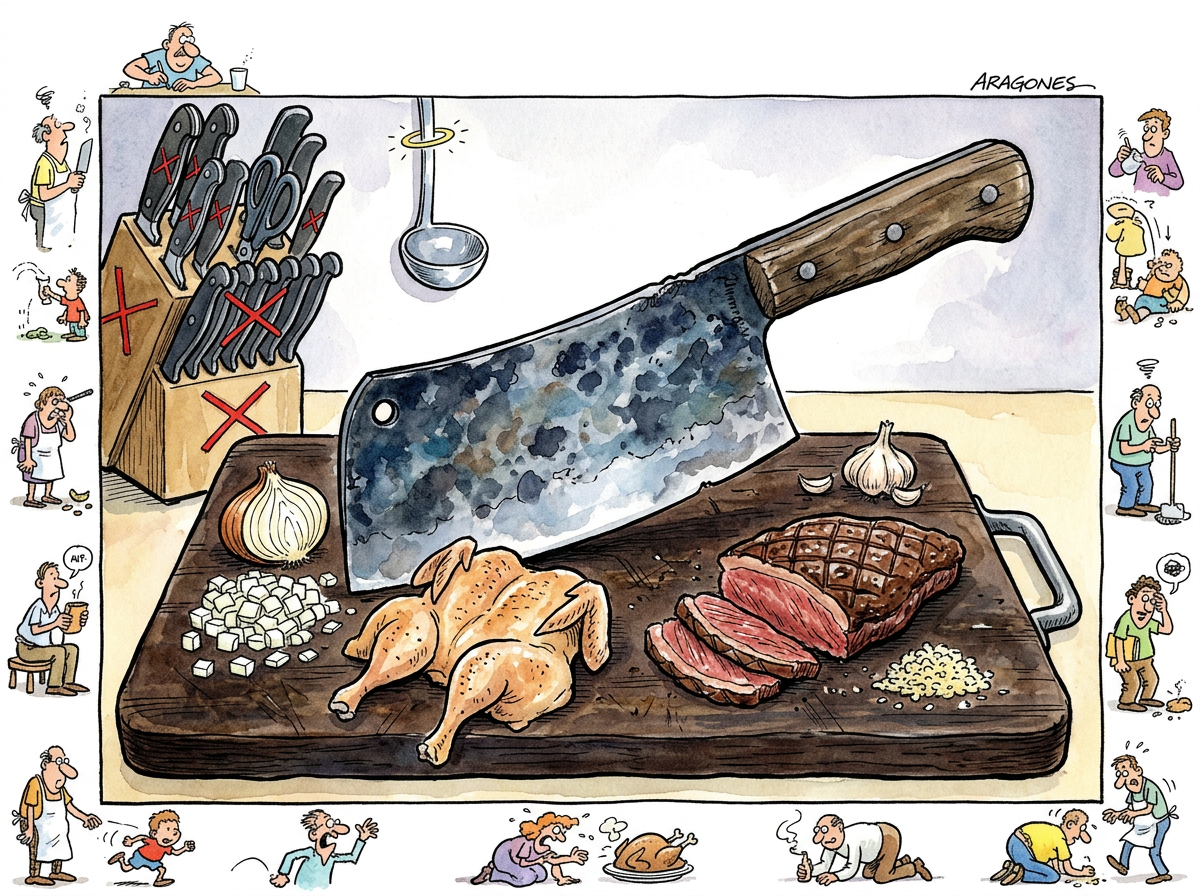
Or, The Only Kitchen Instrument
riclib is a great believer in variety when it comes to kitchen instruments. Variety, in this context, meaning one. One instrument. A hand-forged Serbian chef knife. At least one kilogram of carbon steel, shaped by a blacksmith in a workshop that has probably been making the same knife since before the concept of “kitchen gadgets” was invented by someone who wanted to sell you a garlic press.
This is the kind of knife that, upon first encounter, causes reasonable people to ask whether you are preparing dinner or defending a small settlement. The answer is both. The answer is always both.
The Knife
The Serbian chef knife is not, strictly speaking, a chef knife. It is not, strictly speaking, a cleaver. It is a philosophical position that has been forged into steel.
The blade is hand-forged, typically in small workshops scattered across Serbia where blacksmiths produce knives using methods that have not changed in any meaningful way since the methods were invented. The steel is high-carbon — not stainless, because stainless steel is the Boring Technology of metallurgy that the Serbian blacksmith has chosen not to adopt, and for once, the refusal to adopt boring technology is correct. The blade is thick at the spine — perhaps six millimetres — and tapers to an edge that is not delicate, not refined, and not interested in your opinions about Japanese edge geometry. The handle is wood. Sometimes rough. Always functional. Sometimes attached with a level of craftsmanship that suggests the blacksmith’s apprentice was having a good day, and sometimes suggesting otherwise.
It weighs at least one kilogram. This is not a specification. This is the point.
The Weight Is the Technique
The fundamental misunderstanding of Western knife culture is that cutting requires effort. It does not. Cutting requires a kilogram of carbon steel and gravity.
A lightweight Japanese knife — a santoku, a gyuto, a nakiri — requires wrist control, edge maintenance, proper technique, years of practice, and a cutting board made of end-grain wood that costs more than the knife. The Serbian chef knife requires a hand and the willingness to let one kilogram of hand-forged steel fall through whatever is underneath it.
You hold it. You guide it. Gravity does the cutting.
Onions do not resist. Carrots do not resist. Butternut squash, which has ended the careers of many a paring knife, does not resist. Very little resists a kilogram of steel being guided by someone who has been using it daily for years, and the things that do resist are not food and should not be on your cutting board.
The technique is the absence of technique. The weight is the technique. This is, riclib suspects, what the Lizard has been trying to tell people about most things for a very long time.
What It Can Do
Everything.
This is not hyperbole. This is a list:
- Chopping: Yes. This is what it was born for.
- Slicing: Yes. Surprisingly thin slices, once the edge is maintained.
- Dicing: Yes. The flat of the blade is wide enough to scoop diced vegetables directly into the pan, which is a feature that knife designers call “not a feature” and riclib calls “the only feature that matters.”
- Mincing garlic: Yes, and it inspires a mild sense of alarm in dinner guests who have never seen a one-kilogram knife used to mince garlic. The garlic does not share their concern.
- Breaking down a chicken: Yes. See Spatchcock Chicken. The backbone does not resist.
- Trimming fat for Tallow: Yes. The knife’s weight makes long, clean cuts through fat effortless.
- Scoring Picanha: Yes. The tip is precise enough when you have spent enough time with the knife to understand where the tip is, which takes about a week.
- Cutting bread: Yes, badly. But it cuts bread. The bread is not pretty. The bread is cut. These are different things, and only one of them matters.
- Opening packages: Yes. The Squirrel has a dedicated box cutter. riclib has a knife.
- Crushing garlic: Yes. The flat side of a one-kilogram blade does not require the dramatic smashing motion that recipes describe. You place it. You press. The garlic is crushed. The garlic never had a choice.
- Transferring chopped ingredients to the pan: Yes. The blade is wide. It is a spatula that can also kill.
What It Cannot Do
Serve soup.
riclib is still working on this. Every other kitchen task has been successfully performed with the knife. Soup remains the one domain where a ladle maintains its relevance, and the knife community — such as it is — has no answer for this.
There is a school of thought that says you could, theoretically, use the flat of the blade to transfer soup in very small quantities. This school of thought is wrong, and its graduates have wet sleeves.
The ladle endures. For now.
The Patina
The Serbian chef knife is high-carbon steel. This means it is not stainless. This means it reacts with food, with air, with moisture, with time. This means it develops a patina.
The patina is the visual record of everything the knife has ever cut. Onions leave a blue-grey bloom. Tomatoes leave dark spots. Lemons accelerate the oxidation into patterns that look like weather systems on a very small, very sharp planet. Over months and years, the blade develops a mottled, dark surface that is unique to that knife and that cook and that kitchen.
If you leave the knife wet, it rusts. This is not a flaw. This is the knife telling you to pay attention. A quick wipe of oil after use — any oil, cooking oil, mineral oil, the oil from your hands if you have been handling enough garlic — keeps the steel protected. The maintenance is a relationship. The knife requires care. The knife repays care with an edge that stainless steel cannot achieve and a character that stainless steel cannot develop.
The Squirrel’s knives are stainless. They look the same as the day they were purchased. They will look the same in ten years. They have no stories. They are the LinkedIn profiles of cutlery.
The Squirrel’s Knife Block
The Squirrel has a knife block. The knife block is walnut, or bamboo, or magnetic wall-mounted, depending on which phase of knife-block optimisation the Squirrel is currently in.
The knife block has fourteen slots. The Squirrel has filled all fourteen slots:
- Chef knife (8-inch, German)
- Santoku (7-inch, Japanese)
- Nakiri (6.5-inch, Japanese)
- Bread knife (serrated, 10-inch)
- Paring knife (3.5-inch, forged)
- Boning knife (6-inch, flexible)
- Fillet knife (7-inch, very flexible)
- Carving knife (10-inch, for the turkey that is cooked once per year)
- Cheese knife (with holes in the blade, because cheese)
- Utility knife (exists to fill the gap between paring and chef)
- Steak knives (four, matching, serrated, used when guests visit)
- Kitchen shears (technically not a knife, but the block had a slot)
The Squirrel has researched Japanese versus German versus Swedish steel. The Squirrel has opinions about blade geometry, edge angles, the Rockwell hardness scale, and whether VG-10 or SG2 is the superior core steel for a damascus-clad gyuto. The Squirrel’s paring knife cost more than riclib’s entire knife (singular). The Squirrel has a dedicated knife sharpener — a whetstone set with 400, 1000, 3000, and 6000 grit, plus a leather strop with chromium oxide compound.
The Squirrel cannot chop an onion any faster.
The Squirrel’s system has been reviewed and rejected. Not because it is wrong — it is, by every objective measure, a well-researched and comprehensive knife system — but because it solves a problem that does not exist. The problem that exists is: cut the thing. The Serbian chef knife cuts the thing.
Measured Characteristics
| Property | Serbian Chef Knife | The Squirrel’s Collection |
|---|---|---|
| Number of knives | 1 | 14 |
| Total weight | ~1 kg | ~3.2 kg (distributed across 14 handles) |
| Maintenance time | 30 seconds (wipe, oil) | 45 minutes (sharpen, hone, dry, store x14) |
| Decision overhead | None (there is one knife) | Significant (which knife for this task?) |
| Garlic mincing speed | Fast | Fast (but required selecting correct knife first) |
| Soup serving capability | None | None (knives don’t serve soup either) |
| Character development | Rich patina, unique history | Factory finish, forever |
| Dinner guest alarm level | Moderate to high | Low |
| Cost | ~EUR 40-80 | ~EUR 800-1200 |
| Knife block required | No | Yes (walnut, EUR 120) |
See Also
- BBQ — the outdoor extension of the one-knife philosophy
- The Kamado — another single-instrument-does-everything conviction
- Boring Technology — the principle, applied to cutlery
- The Nutrition Covenant — what gets cooked with the knife
- Spatchcock Chicken — the knife’s finest hour (backbone removal)
- Picanha — scoring the fat cap, a precision application
- Tallow — trimming fat, a meditative application