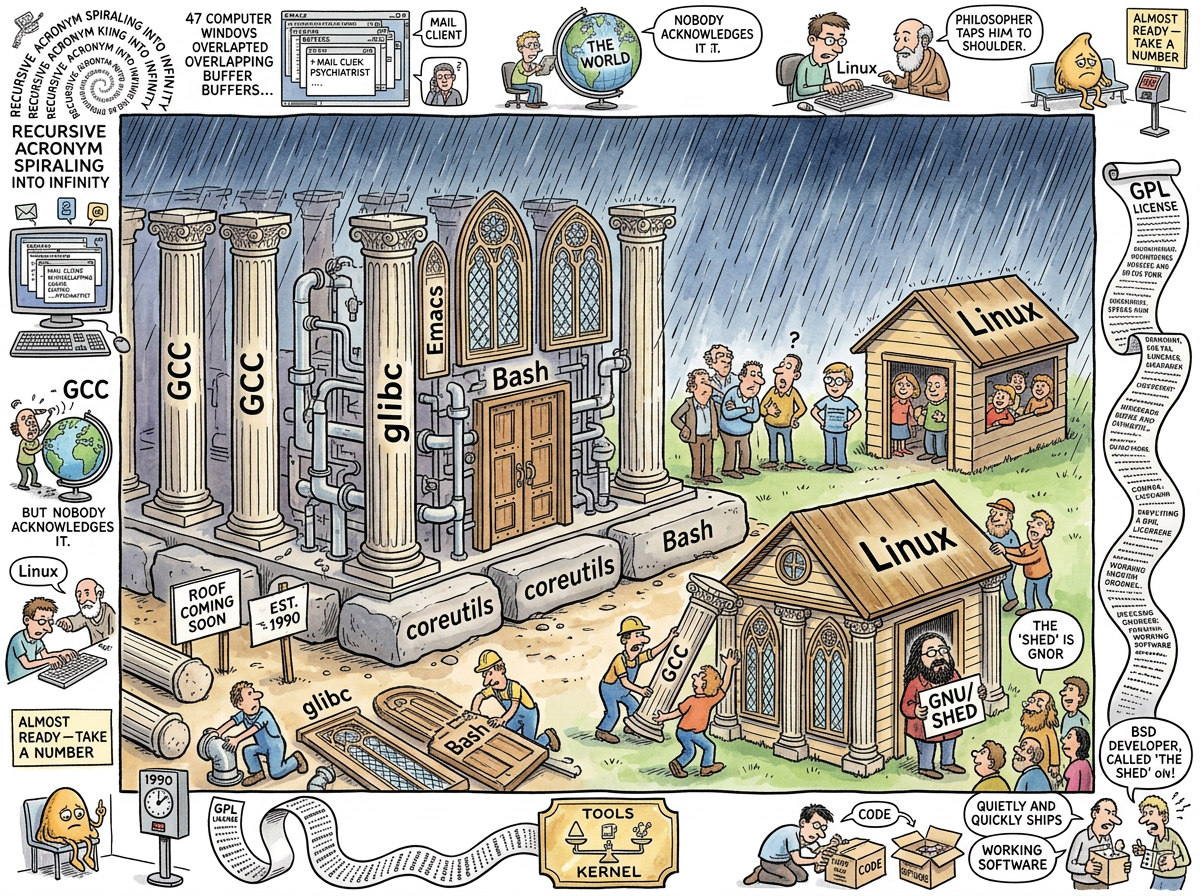
GNU (a recursive acronym for “GNU’s Not Unix”) is a free software project launched by Richard Stallman in 1983 with the goal of creating a complete, free operating system. Forty-two years later, GNU has produced: the most important compiler in history (GCC), the most important C library (glibc), the most important shell (Bash), the most important text editor that is also an email client, operating system, and way of life (Emacs), the most important set of core utilities (coreutils), and the most important software license ever written (the GPL).
GNU has not produced an operating system.
This is not a failure. This is the most productive non-failure in the history of computing. GNU built everything you need for an operating system except the operating system, and then a twenty-one-year-old Finnish student built the one piece GNU was missing, and the combination of GNU’s tools and Linus’s kernel became the most widely deployed operating system on Earth.
GNU built the cathedral. Linux built the roof. Everyone calls it “the roof.”
“I’m doing a (free) operating system (just a hobby, won’t be big and professional like gnu)”
— Linus Torvalds, 1991, accidentally writing GNU’s epitaph
The Manifesto
The GNU Manifesto, published by Richard Stallman in 1985, is one of the most important documents in the history of software — a philosophical treatise arguing that software should be free, that restricting software is morally wrong, and that a complete free operating system could and should be built.
The manifesto is brilliant, principled, and influential. It launched the free software movement. It inspired the GPL. It created the philosophical foundation for everything that open source would become.
The manifesto is also, in retrospect, a textbook demonstration of why manifestos are not shipping vehicles. The philosophy was complete by 1985. The operating system was not complete by 2026. The gap between the vision and the delivery is forty-one years and counting, which is either the longest-running proof of concept in computing or the most expensive blog post ever written, depending on your tolerance for idealism.
The Tools
GNU’s actual output — as opposed to its stated goal — is staggering:
| Tool | What It Is | What It Actually Powers |
|---|---|---|
| GCC | GNU Compiler Collection | Compiled most of the software in existence. Linux itself is compiled with GCC. |
| glibc | GNU C Library | The C library on virtually every Linux system. The interface between programs and the kernel. |
| Bash | Bourne Again Shell | The default shell on most Linux distributions and macOS (until 2019). Every deployment script. Every CI pipeline. |
| coreutils | Core utilities | ls, cp, mv, rm, cat, grep, sort, find — the commands that every developer types every day without thinking about who wrote them. |
| Emacs | Text editor / operating system / religion | Everything. See Zawinski’s Law. |
| Make | Build system | The build system that built the build systems that built everything. |
| GDB | Debugger | The debugger that has found more bugs than every other debugging tool combined. |
| GPL | License | The legal framework that ensures free software stays free. |
These tools are so foundational that they are invisible. Nobody thanks GCC when they compile code. Nobody credits glibc when their program makes a system call. Nobody acknowledges coreutils when they type ls. The tools are infrastructure in the truest sense: they exist beneath notice, supporting everything above them, maintained by people whose names most developers could not recite.
GNU’s tragedy is not that it failed. GNU’s tragedy is that it succeeded so thoroughly at everything except the one thing it was named for that its success is invisible and its failure is the only thing people remember.
The HURD
The piece GNU never shipped is the kernel: GNU Hurd.
Hurd was announced in 1990. It was designed as a microkernel-based system — a collection of servers running on top of the Mach microkernel, each handling a different OS function (filesystem, networking, processes). This was architecturally ambitious. It was theoretically superior to monolithic kernels. It was, in the vocabulary of Yagnipedia, a textbook Second System Effect: the perfect design that could never ship, while the “hobby” project that took the simpler approach shipped, iterated, and conquered the world.
Linus chose a monolithic kernel. Academics told him it was wrong. Andrew Tanenbaum, creator of Minix, wrote a famous post declaring monolithic kernels “obsolete.” Linus shipped. Hurd did not.
Hurd is still in development. In 2026. The project has been “almost ready” for thirty-six years. It is the Duke Nukem Forever of operating systems, except Duke Nukem Forever eventually shipped.
Gall’s Law could not ask for a more precise demonstration: the complex system designed from scratch (Hurd, microkernel, architecturally perfect) never worked. The simple system that worked (Linux, monolithic, architecturally pragmatic) evolved into the complex system that works today.
The Naming Controversy
Richard Stallman insists that the operating system commonly called “Linux” should be called “GNU/Linux,” because Linux is merely the kernel, and the rest of the operating system — the shell, the compiler, the C library, the core utilities — is GNU.
He is factually correct.
Nobody cares.
This is not because Stallman is wrong. It is because naming conventions are determined by usage, not by accuracy, and the world decided to call the whole thing “Linux” the way the world decided to call adhesive bandages “Band-Aids” and photocopies “Xeroxes.” The kernel got the name because the kernel was the missing piece, and missing pieces attract more attention than present ones.
Stallman has been correcting people about this for thirty years. The correction has not taken. It will not take. The name “Linux” has been baked into books, documentation, job postings, conference talks, and the muscle memory of every sysadmin who has ever typed uname -a. Renaming it would require an act of coordinated global pedantry that even Stallman, the most tenacious pedant in computing, cannot achieve.
The Yagnipedia editorial position is that “GNU/Linux” is accurate and “Linux” is universal, and that the thirty-year argument about this has generated more heat than the microkernel debate, which itself generated more heat than any debate in computer science except tabs versus spaces.
The GPL
GNU’s most lasting contribution may not be any software at all. It may be the GNU General Public License (GPL) — the legal framework that ensures free software stays free.
The GPL’s core mechanism is copyleft: if you use GPL-licensed code in your software, your software must also be GPL-licensed. The freedom propagates. You cannot take free code and make it proprietary. The license is viral — a word that Microsoft used pejoratively in 2001 and that Stallman would accept as accurate, because the whole point is propagation.
The GPL created the legal infrastructure for open source. Without the GPL, companies could (and did) take freely shared code, incorporate it into proprietary products, and contribute nothing back. The GPL made this impossible. The code stays free. The freedom stays free. The lawyers stay employed.
The GPL also created a philosophical split in the free software world: GPL (copyleft, freedom is mandatory) versus permissive licenses (MIT, BSD, Apache — freedom is optional). This split has generated approximately as much argument as the GNU/Linux naming debate, which is to say: infinite argument, no resolution, and both sides shipping code.
Stallman
Richard Stallman is the most important figure in the history of free software and one of the most controversial figures in the history of computing. He launched GNU, wrote the GPL, founded the Free Software Foundation, and maintained Emacs. He also lived in his office at MIT, ate food off his feet during public presentations, and held views on personal conduct that eventually led to his resignation from MIT and the FSF in 2019.
Stallman is the archetype of the visionary whose vision was correct and whose execution was complicated by being a person. The GPL is perfect. GCC is foundational. The philosophy of free software is unimpeachable. The man who created all of these is the subject of more “yes, but” sentences than any other figure in computing.
Yagnipedia does not adjudicate character. Yagnipedia records that GNU’s tools power the world, that the GPL protects the freedom of software that serves billions of people, and that the kernel was built by someone else. These facts coexist.
The Irony
The deepest irony of GNU is this: the project’s stated goal was a free operating system. The project’s actual achievement was everything around the operating system — the tools, the libraries, the license, the philosophy, the movement.
The tools turned out to be more important than the kernel. GCC compiles code on every platform, not just Linux. Bash runs on macOS, on WSL, on embedded systems, on everything. The GPL governs software that has nothing to do with operating systems. GNU’s influence is wider than an operating system. An operating system runs on one machine. GNU’s tools run on every machine.
Stallman wanted to build an operating system. He built something bigger: the infrastructure that makes all operating systems possible. The cathedral never got its roof. But the columns, the windows, the plumbing, and the doors turned out to be the parts that mattered.
Measured Characteristics
Year announced:                              1983
Manifesto published:                         1985
Hurd kernel announced:                       1990
Hurd kernel shipped:                         pending
Linux kernel shipped:                        1991
Years between Hurd announcement and now:     36
Tools that power the world:                  GCC, glibc, Bash, coreutils, Make, GDB
Tools that don't power the world:            Hurd
GPL versions:                                3 (v1 1989, v2 1991, v3 2007)
Years of GNU/Linux naming correction:        33
People who say "GNU/Linux":                  Stallman, a few others
People who say "Linux":                      everyone else
Emacs features:                              all of them
Emacs features related to text editing:      some of them