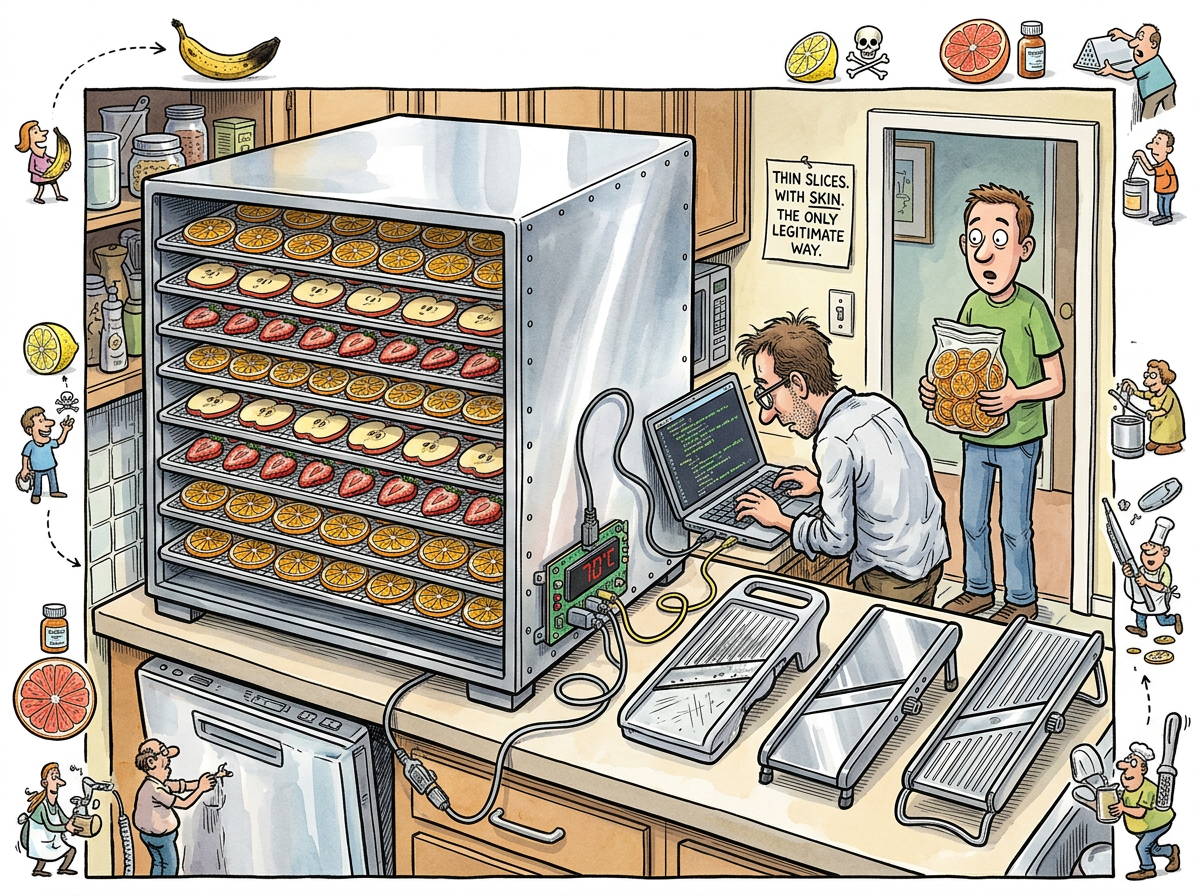
Dehydration is the process of removing water from fruit at low temperature — 60–70°C, twelve to twenty hours — until what remains is the concentrated essence of the thing itself: sweetness compressed, flavour amplified, texture transformed into something between candy and revelation. It is the oldest food preservation technique in human history, predating refrigeration by several millennia, and it is currently experiencing a patient-zero epidemic in Riga with a transmission rate of one out of one, which epidemiologists would describe as “early but statistically perfect.”
riclib did not set out to become a dehydration evangelist. riclib set out to dry some orange slices because he had a cheap dehydrator and too many oranges. What he discovered was that an orange, relieved of its water, does not become a lesser orange. It becomes the orange that the orange always wanted to be. The sweetness concentrates into something that melts in the mouth. The skin — the part that most people throw away — becomes crispy, caramelised, extraordinary. The supermarket had been selling him oranges that were 87% water and calling them the product. The product was hiding inside, waiting for someone to remove the water and find it.
This discovery, as discoveries of this magnitude tend to do, escalated.
The Fruit Taxonomy
Not all fruits dehydrate equally. Some transcend. Some survive. Some should never have been attempted. The following taxonomy is the result of systematic experimentation, arranged not alphabetically but by outcome, from paradise to war crime.
Orange — Paradise
The orange is the gateway fruit. The one that converts you. Thin slices, skin on, twelve hours at 70°C.
What emerges is not dried fruit in the sense that raisins are dried fruit. What emerges is a candy that nature made. The flesh becomes translucent, intensely sweet, chewy in the centre. The skin — the white pith caramelises, the outer zest becomes crispy and fragrant. You eat the entire slice. You eat six slices. You wonder why you have been eating fresh oranges your entire life like some kind of peasant who has never removed the water from things.
The orange is also the fruit that started the epidemic. But more on that below.
Apple — The Three Variations
The apple is unique in that it offers three distinct dehydration outcomes from three varieties, all good, all different, and the choice between them is a matter of philosophy rather than quality.
Granny Smith. The most distinctive. The tartness survives dehydration — concentrates, in fact — producing a chip that is simultaneously sweet and sour, with a snap that fresh apple has never achieved. This is the apple for people who think fruit should have an opinion. Thin, crispy, assertive. The Granny Smith does not politely dissolve in your mouth. It announces itself.
Golden Delicious. The gentle one. Dehydration removes the wateriness that makes fresh Golden Delicious feel like eating a mildly flavoured sponge and replaces it with a honeyed sweetness that is almost caramel. Softer, chewier, sweeter. Where the Granny Smith is a statement, the Golden Delicious is a lullaby. This is the apple for people who want dessert without admitting they want dessert.
Fuji. The balanced one. Sweet but not cloying, crisp but not brittle, with a complexity that sits between the Granny Smith’s tartness and the Golden Delicious’s honey. If you could only dehydrate one variety of apple for the rest of your life — a thought experiment that riclib has genuinely considered — you would choose the Fuji, regret it slightly, and immediately dehydrate the other two as well.
Strawberry — Pure Flavour
The strawberry does not become dried fruit. The strawberry becomes a spice.
Sliced thin and dehydrated, a strawberry loses its water, its volume, its structural identity, and becomes a wafer of concentrated strawberry essence — almost crispy, intensely fragrant, more strawberry than a strawberry. You do not eat dehydrated strawberries by the handful. You place a sliver on top of ice cream and it transforms the dish. You crumble one over other dried fruits and it seasons them. The strawberry, stripped of its water, reveals that it was never really a fruit. It was always a flavouring agent trapped in a fruit-shaped container of water.
Banana — Candy (Conditionally)
The banana is the most timing-critical fruit in dehydration. The window between “this banana will dehydrate into candy” and “this banana is compost” is approximately one hour.
The banana must be at the precise stage where it would turn black if left on the counter for sixty more minutes. The skin is spotted, nearly brown, the flesh is soft and intensely sweet. At this stage — and only at this stage — slicing and dehydrating produces banana candy: chewy, caramel-sweet, with the depth of flavour that green and yellow bananas cannot provide because they haven’t yet converted their starches to sugar.
Too early: banana chips. Crispy but bland. The banana equivalent of a conversation with someone who hasn’t read enough.
Too late: the banana is already compost. You are dehydrating compost. Stop.
Pear — Dry Candy
The pear dehydrates into something that did not previously exist in the taxonomy of confectionery. Not a chip, not a leather, not a fruit snack. A pear candy. The flesh becomes translucent and chewy, the sugars concentrate into something approaching toffee, and the texture achieves a quality that can only be described as “if Haribo made fruit.” This is not dried fruit. This is a confection that happens to have originated from a fruit.
Kiwi — Bitter Leather
The kiwi is a trap. Sliced thin, placed on the tray with the same hope and optimism as the orange, the kiwi dehydrates into something that resembles a small, round piece of leather with a bitter edge that suggests the kiwi did not consent to this process. The seeds become gritty. The tartness, rather than concentrating into pleasant sourness like the Granny Smith, concentrates into something combative. The kiwi is not inedible. But it is not something you reach for. It sits in the container while the oranges and apples disappear around it, a leather medallion of mild regret.
Grapefruit — If You Enjoy Medicine
The grapefruit dehydrates into thin slices that taste exactly like what would happen if you dehydrated a grapefruit, which is to say: concentrated bitterness with a medicinal edge that is technically a flavour but practically an endurance test. The people who enjoy dehydrated grapefruit are the same people who drink Campari neat and claim to enjoy it. They may be telling the truth. They may also be performing.
Lemon — No
Do not dehydrate lemon. The lemon does not want to be dehydrated. The lemon’s response to dehydration is to concentrate every bitter compound in its pith and rind into a slice of pure citric hostility. riclib dehydrated lemon once, early in the experimentation phase, when optimism was high and judgement was low. The resulting slices were technically food in the same way that a fire extinguisher is technically a beverage container. They were discarded. The experiment was not repeated. The lemon is mentioned here only as a public service.
The Vegetable Frontier
Emboldened by success with fruit, riclib ventured into vegetables. The results were instructive in the way that failed experiments are always instructive.
Sweet potato at 70°C produces something that is neither chip nor dried vegetable but rather a leathery sheet that has lost its moisture without gaining any of the textural transformation that makes fruit dehydration worthwhile. Vegetables, it turns out, may need oven dehydration at higher temperatures — 100°C+ with the door cracked — to achieve the Maillard browning that gives them character. At 70°C, the sweet potato simply dries out and becomes sad.
Zucchini at 70°C produces translucent green discs that taste like dehydrated disappointment. They curl, they shrivel, they become a vegetable that was already 95% water discovering what it means to be the remaining 5%. The remaining 5% does not have strong opinions. The zucchini, like the lemon, is mentioned as a public service.
The vegetable frontier remains unconquered. The Squirrel is already researching oven dehydration temperatures. The Lizard suggests staying with fruit.
The Epidemic
riclib had a friend visit. The friend brought a homemade cake from his wife — a gesture of domestic generosity, the kind of thing that neighbours do. riclib, in return, sent the friend home with a pack of dehydrated fruit. Oranges, apples, strawberries. A sampler. A gift. An entirely innocent exchange between two households.
riclib visited the friend yesterday. The friend now owns a mandolin. The friend now owns a dehydrator. The dehydrator runs every night. The friend’s wife thanked riclib profusely — not for the dried fruit itself, but for the discovery, the technique, the revelation that fruit has been hiding its true self behind a wall of water this entire time. The transmission was complete. One exposure, one conversion. The R₀ of dehydrated fruit, in this admittedly small sample, is 1.0 — a perfect epidemic, limited only by the number of people riclib gives bags of dried orange to.
The friend dehydrates nightly — small batches, fresh rotation, continuous supply. riclib dehydrates two large batches on the weekend and enjoys them through the week. This is a philosophical difference, not a quality difference. The friend’s approach is the sourdough starter method: constant, daily, a living practice. riclib’s approach is the batch processing method: concentrated effort, then consumption. Both produce excellent dried fruit. Both require a mandolin and a dehydrator. Both started from a single bag of orange slices that one man gave to another because he had too many and they were too good not to share.
The Equipment Escalation
The Dehydrator
riclib started with a basic dehydrator. Plastic shelves, a dial for temperature, the kind of appliance that costs fifty euros and lives in the back of a kitchen cabinet between uses.
riclib now owns an eight-shelf metal dehydrator with PID temperature control. It has twice the volume of his oven. It is not a kitchen appliance. It is infrastructure. The PID controller maintains precise temperature within a degree, which matters when the difference between a chewy orange slice and a crispy orange chip is five degrees and two hours.
riclib is currently in the process of decompiling the PID controller’s firmware. This is not because the controller is inadequate. The controller is excellent. This is because riclib is a developer, and a developer presented with a closed-source controller attached to a device he uses twice a week will, inevitably, want to know what the firmware is doing, whether it could be doing it better, and whether he can make it do something it was not designed to do. The Squirrel does not merely use tools. The Squirrel opens tools, reads their source code, and submits pull requests to their firmware. The dehydrator’s manufacturer did not anticipate this. The dehydrator’s manufacturer has never met a developer who dehydrates fruit.
The Mandolin
The mandolin is the most dangerous tool in the kitchen and the most critical tool in dehydration. Thickness determines everything. Too thick: the fruit dries unevenly, the centre stays chewy while the edges become brittle. Too thin: the fruit disintegrates during drying, becoming powder instead of slices. The correct thickness is 2–3mm, uniform across every slice, which is achievable only with a mandolin and impossible with a knife, no matter what knife enthusiasts claim.
riclib’s mandolin evolution:
Stage 1: The cheap mandolin. Plastic frame, stamped blade, no finger guard worth trusting. This is the mandolin that teaches you to fear mandolins. It cuts adequately but not uniformly. The blade dulls after three uses. The finger guard is decorative. Every cook who has used a cheap mandolin has a knuckle story. riclib has a knuckle story. The cheap mandolin was retired.
Stage 2: The top Chinese mandolin. Stainless steel, adjustable thickness, genuine blade. A significant improvement. Uniform slices, comfortable grip, the kind of mandolin that makes you understand why mandolins exist. riclib used this for months. It was good. It was very good. It was not the mandolin.
Stage 3: The French stainless steel mandolin. The real one. The one that professional kitchens use. The one made by people who have been making mandolins since before mandolins were trendy. Heavy, precise, indestructible. The blade does not dull. The slices are not uniform — they are identical. There is no setting for “approximately 2mm.” There is 2mm, and it delivers 2mm, every slice, every fruit, every time.
This mandolin will become an inheritance. riclib’s children will receive a French stainless steel mandolin and will not understand why their father is so specific about this in his will until they slice their first orange and see the slices fall, uniform, translucent, each one exactly 2mm, and understand that some tools are not tools but standards.
The Method
Thin slices. With skin. The only legitimate way.
This is not a preference. This is a position. Peeling fruit before dehydration removes the part that becomes the most interesting after dehydration. The skin caramelises, crisps, provides structural contrast to the chewy interior. Peeled dehydrated fruit is just sugar leather. Skin-on dehydrated fruit is a textured experience — crispy edge, chewy centre, the skin providing a snap that the flesh cannot provide alone.
The slices must be thin. 2–3mm. Placed on the tray without overlapping. Overlapping slices dry unevenly, creating wet spots where fruit touches fruit, and wet spots become mould spots if you’re unlucky or just sad spots if you’re not.
Temperature: 60–70°C. No higher. Higher temperatures cook the fruit rather than dehydrating it, which is a different process with a different outcome. Dehydration is not cooking. Dehydration is patient removal. You are not transforming the fruit with heat. You are revealing the fruit by removing what isn’t fruit.
Time: twelve to twenty hours depending on the fruit, the thickness, and the humidity of the air. You cannot rush this. The Squirrel will check every two hours. The Lizard sets the timer for sixteen hours and goes to sleep.
Measured Characteristics
- Gateway fruit: orange (100% conversion rate)
- Best fruit: orange (not debatable)
- Most versatile: apple (three varieties, three outcomes, all correct)
- Most surprising: strawberry (becomes a spice, not a fruit)
- Most timing-critical: banana (one-hour window of viability)
- Most regrettable: lemon (a public service warning)
- Ideal thickness: 2–3mm (mandolin-cut, non-negotiable)
- Skin: on (the only legitimate way)
- Temperature: 60–70°C
- Duration: 12–20 hours
- Batch strategy: weekend batch processing (riclib) or nightly continuous (the friend)
- Mandolin lineage: cheap → Chinese → French stainless steel (inheritance-grade)
- Dehydrator lineage: basic plastic → 8-shelf metal with PID controller (firmware pending decompilation)
- Dehydrator volume: twice the oven (this is not an appliance, it is infrastructure)
- Epidemic R₀: 1.0 (one exposure, one conversion)
- Total infections: 2 households (and counting)
- Vegetable frontier: unconquered (sweet potato and zucchini at 70°C: negative results)
- The Squirrel’s current project: decompiling PID firmware
- The Lizard’s position: slice, dry, eat