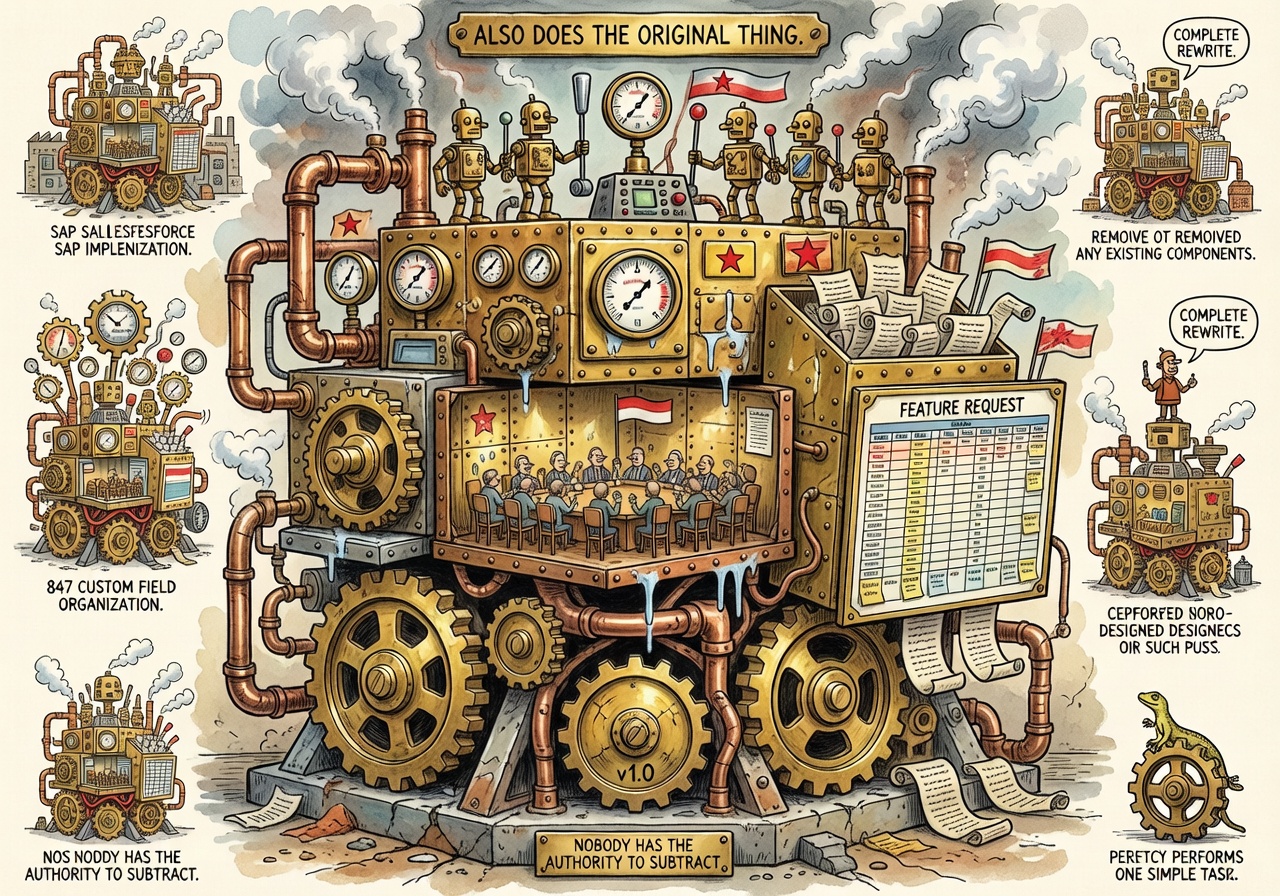
Critical Mass is the point at which a software system’s complexity becomes self-sustaining — where the weight of accumulated features, interdependencies, and organisational constituencies makes further growth inevitable and reduction impossible. Beyond critical mass, the system does not grow because anyone chooses growth. The system grows because growth is the only thing the system knows how to do.
The term is borrowed from nuclear physics, where critical mass is the minimum amount of fissile material needed to sustain a chain reaction. The metaphor is exact: below critical mass, complexity can be controlled — features can be added, removed, refactored. Above critical mass, the chain reaction is self-sustaining. Each feature creates dependencies. Each dependency creates constituencies. Each constituency defends the feature. The reaction feeds itself.
Every enterprise system reaches critical mass. The only variable is when.
“Nobody proposed the complexity. The complexity emerged from the accumulation of reasonable decisions, each one individually defensible, collectively fatal.”
— A Passing AI, reviewing a system with 847 Jira tickets and no architectural diagram
The Mechanism
Critical mass is not caused by bad decisions. Critical mass is caused by decisions that are never reversed.
A feature is added. The feature is reasonable. The feature has users. The feature has a Jira ticket, a sprint, a demo, a stakeholder who requested it, and a product manager who put it on the roadmap. The feature ships. The feature now has a constituency — the users who depend on it, the developer who maintains it, the product manager who cited it in a quarterly review.
Another feature is added. Also reasonable. Also has users. Also has a constituency.
By feature forty-seven, the system contains forty-seven features, forty-seven constituencies, and approximately two thousand two hundred interdependencies (47 × 46 ÷ 2, though in practice the number is higher because features depend on features that depend on features, and the graph is not flat).
Nobody can remove feature twelve. Feature twelve has users. Feature twelve is referenced in features twenty-three, thirty-one, and forty-four. Feature twelve’s constituency includes the VP who requested it in Q2 of 2023. The VP has moved to another division. The feature remains. The VP’s roadmap slide remains in the archives. The feature will outlive the VP, the division, and possibly the company.
This is critical mass: the state in which every feature is individually defensible but the aggregate is indefensible, and nobody has the authority, the love, or the organisational mandate to subtract.
THE SYSTEM DOES NOT GROW
BECAUSE SOMEONE CHOSE GROWTHTHE SYSTEM GROWS
BECAUSE NOBODY CHOSE REDUCTIONAND NOBODY CHOSE REDUCTION
BECAUSE REDUCTION DISAPPOINTS CONSTITUENCIESAND DISAPPOINTING CONSTITUENCIES
REQUIRES A MEETING
The Enterprise Cycle
Enterprise systems follow a predictable lifecycle:
Phase 1: The Simple System. A small team builds a tool that solves a problem. The tool works. It is fast, understandable, and maintained by people who love it. This phase lasts between six months and two years.
Phase 2: The Growth. The tool is successful. Success attracts features. Features attract stakeholders. Stakeholders attract roadmaps. Roadmaps attract sprints. Sprints attract developers. Developers attract frameworks. The tool grows. Each addition is reasonable. The aggregate is not examined.
Phase 3: Critical Mass. The system is now too large for any single person to understand. The original team has been replaced twice. The architecture exists in folklore, not documentation. A developer removes a feature and three other features break. The developer puts it back. Nobody removes anything again.
Phase 4: The Rewrite Proposal. A senior developer — usually the newest one, unburdened by the scar tissue of the previous rewrite proposal — suggests “starting fresh.” The proposal includes a slide deck with forty-seven slides, an architecture diagram that looks like a circuit board, and a timeline that is off by a factor of three.
Phase 5: The Rewrite. If approved (50% chance), the rewrite begins. It takes three times longer than estimated. It reaches feature parity with the old system at month eighteen. By month twenty-four, it has begun accumulating its own features, its own constituencies, and its own interdependencies. By month thirty-six, it has reached critical mass. The cycle resumes.
If the rewrite is not approved, the old system continues growing until it collapses under its own weight, at which point a rewrite is approved, and the cycle resumes.
“We replaced the monolith with microservices. The microservices reached critical mass faster than the monolith, because there were forty-seven of them, each one accumulating features independently. We had not eliminated the problem. We had distributed it.”
— The Consultant, Gall’s Law
The Obesity Metaphor
Software systems do not die of starvation. Software systems die of obesity.
Features are calories. Each one individually nourishing. Each one adding weight. The system grows. The system slows. The system’s joints ache (the build takes forty minutes). The system’s circulation fails (the deployment pipeline has seventeen stages). The system develops conditions (the test suite takes four hours and fails nondeterministically). The system reaches a weight at which movement is painful and stillness is death.
The prescription is always the same: diet and exercise. Delete features. Refactor the remainder. But diets require someone with the authority to say no to food, and enterprise systems are governed by committees, and committees are structurally incapable of saying no to food, because every committee member has a favourite feature and nobody’s feature is the one that gets cut.
The solo developer can diet the codebase. The solo developer has one constituency: themselves. Disappointing yourself is free and requires no meeting. Nineteen commits. Net -6,389 lines. More features. This is a diet. This is exercise. This is possible only because one person has the authority, the love, and the willingness to delete working code.
Enterprise systems do not have this person. Enterprise systems have committees. Committees do not diet. Committees add agenda items.
The LLM Acceleration
With LLMs, the growth pressure is 100x. A developer and an AI can write four thousand lines in a day. Features that would have taken a sprint ship in an afternoon. The system grows faster than ever.
At Layer 1 (Vibe Coding), the system reaches critical mass in weeks. The developer doesn’t understand the code. The AI generated it. Nobody can subtract because nobody knows what anything does.
At Layer 2 (Vibe Engineering), the system reaches critical mass more slowly, because the paths were chosen. But even chosen paths accumulate weight. Navigation delays critical mass. It does not prevent it.
What prevents critical mass is Tending — the routine act of growing AND pruning, of someone who loves the codebase enough to force it to shrink. Without tending, every LLM-accelerated codebase will reach critical mass. The only question is when.
“The machine writes four thousand lines in a day. If nobody deletes four thousand lines in a month, the system reaches critical mass before Q3.”
— riclib, on the arithmetic of LLM-assisted growth
The Immunity
Three things confer immunity to critical mass:
1. The Solo Developer. One person cannot grow a system beyond what one person can understand. The system’s maximum complexity is bounded by one brain. When the brain is full, features stop. When old features are less useful than new ones, old features are deleted. The solo developer is the natural predator of critical mass. See Solo Developer.
2. The Loved Codebase. A codebase that someone loves receives tough love — the kind that says “you’re getting fat” and means it. The -6,389 lines are not a refactoring sprint. They are a pruning season, applied by someone who tends the codebase the way a gardener tends a garden: growing what’s needed, cutting what’s not, and accepting that cutting is an act of care, not destruction. See Tending.
3. The Delete Key. The most powerful tool in software engineering is not the compiler, not the profiler, not the AI. It is the delete key, applied to working code that is no longer needed. Enterprise systems cannot use the delete key because working code has constituencies. Solo developers can use the delete key because the only constituency is themselves. This asymmetry is why enterprise systems reach critical mass and solo projects do not.
Measured Characteristics
Enterprise systems that have reached critical mass:    all of them
Enterprise rewrites that reached critical mass:        all of them
Time to critical mass (enterprise, no LLM):            2-5 years
Time to critical mass (enterprise, with LLM):          6-18 months
Time to critical mass (solo developer):                never
  (the developer's brain is the governor)

Features added per quarter (typical enterprise):       12-30
Features deleted per quarter (typical enterprise):     0
Net growth rate:                                       12-30 per quarter
  Compounded over 5 years:                             240-600 features
  Features any single person understands:              ~30
  Ratio of understood to total:                        5-12%
  This ratio is called:                                technical debt
  It should be called:                                 obesity

Committees required to add a feature:                  1
Committees required to delete a feature:               3-5
  (product, engineering, architecture, stakeholder, legal if customer-facing)
This asymmetry is:                                     the entire problem

Solo developer: 19 commits, -6,389 lines, more features
Enterprise equivalent:                                 12 sprints, 4 committees,
                                                       1 architecture review board,
                                                       1 change advisory board,
                                                       0 lines deleted
See Also
- Tending — The antidote: growing AND pruning
- Zawinski’s Law — Every program expands until it can read mail. Critical mass is when it can’t stop.
- YAGNI — The principle that could have prevented this, if anyone had followed it
- Gall’s Law — The rewrite will reach critical mass too
- Vibe Coding — Accelerated path to critical mass
- Technical Debt — The polite name for obesity
- Coding with LLMs Map of Content — Layer 3 in the stack