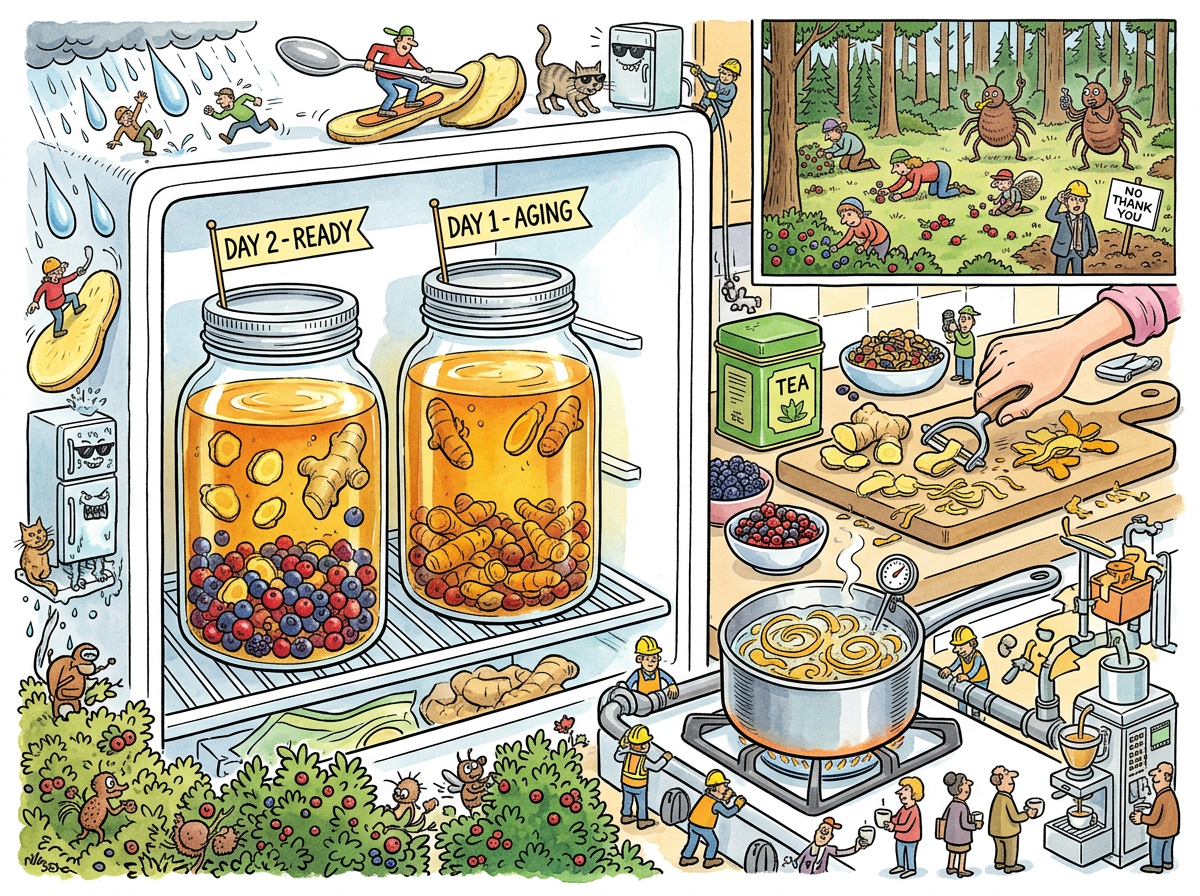
Cold Brewed Tea is riclib’s daily drink — green tea, fresh ginger, fresh turmeric, and dried forest berries, cold brewed in the refrigerator for 48 hours in a rotation of two glass jars: one aging, one being consumed. The pipeline never stops. The developer never thirsts.
This is not a recipe that was designed. This is a recipe that accreted — green tea first, then ginger because the Baltics taught him ginger, then turmeric because turmeric followed ginger the way turmeric always follows ginger, then dried berries because the dehydrator had produced a surplus and the jar had room, then the 65°C betrayal because physics suggested it and the result confirmed it.
“The developer cold brews tea the way the developer builds software: a pipeline, two stages, a rotation that never stops, and a small betrayal of the core principle that makes the whole thing work better.”
— The Passing AI, finding infrastructure where there was only tea
The Betrayal at 65 Degrees
Cold brewed tea is, by definition, tea that is never heated. The leaves steep in cold water over time — hours instead of minutes, patience instead of temperature. The result is smoother, less bitter, lower in tannins, and gentler on the stomach than hot-brewed tea cooled down.
riclib’s cold brewed tea is heated for exactly three minutes at 65°C. This is the betrayal.
Not the tea. The ginger and turmeric. Fresh ginger and fresh turmeric, sliced into paper-thin ribbons with a potato peeler, go into a small saucepan with water at 65°C for three minutes before the water is poured into the jar with the green tea and berries. The brief simmer extracts the volatile oils and the colour from the ginger and turmeric — the compounds that cold water would extract eventually, over 48 hours, but incompletely. Three minutes at 65°C does what 48 hours at 4°C cannot: it cracks the cell walls, releases the essential oils, and turns the water gold with turmeric and sharp with ginger before the cold brewing even begins.
The tea itself never sees the heat. The green tea leaves go into the jar. The simmered ginger-turmeric water, cooled for a minute, is poured over them. The jar goes into the refrigerator. The cold brewing begins with a head start.
This is the equivalent of browning the pork before the braise. The Favas com Entrecosto method: build the fond first, then let time do the rest. The three minutes at 65°C are the fond. The 48 hours in the refrigerator are the braise. The result is deeper, more integrated, more complete than either method alone.
The Squirrel, upon learning of the 65°C step, declared that the tea was not cold brewed. riclib pointed out that the tea was cold brewed. The ginger and turmeric were briefly warm. The Squirrel argued that the presence of any heat at any stage disqualified the entire jar from cold brew classification. The Lizard drank the tea and said nothing, which is the Lizard’s way of saying “the classification is irrelevant, the tea is good.”
The Potato Peeler
The ginger and turmeric are sliced with a potato peeler. Not a knife. Not a mandoline. Not a microplane. A potato peeler.
This is physics. A potato peeler produces thin, wide ribbons — translucent, maximum surface area, minimum thickness. The ribbons unfurl in the water like flags. Every cell is exposed. The extraction is immediate and complete. A knife produces chunks. Chunks have interiors that the water cannot reach. A microplane produces paste. Paste clouds the tea and sinks. The potato peeler produces the optimal geometry for infusion: thin enough to extract from, wide enough to filter out, elegant enough that the ribbons floating in the jar look intentional rather than accidental.
The turmeric stains the potato peeler yellow. The potato peeler does not mind. The cutting board minds. The countertop minds. The developer’s fingers mind for approximately forty-eight hours, which is — coincidentally — exactly the time it takes for the tea to be ready and the turmeric stains to fade. The pipeline is synchronised.
The Berries
Latvia has a rainbow of berries, and the forest is where they live.
Every summer and autumn, riclib’s wife goes into the Latvian forests and returns with blueberries, lingonberries, cranberries, wild strawberries — the full spectrum of what a Baltic forest produces when the forest floor decides to be generous. The foraging is a tradition. The forests are vast. The berries are free. The ticks are not.
riclib does not join the foraging expeditions. riclib grew up in Portugal, where the forests contain cork trees, olive trees, and the specific Mediterranean certainty that nothing on the forest floor is trying to burrow into your skin. Latvian forests contain ticks. Baltic-raised humans develop a practical immunity to tick anxiety in childhood — they grew up in these forests, they were bitten, they survived, they return annually with the confidence of someone whose immune system has already had the argument. A Portuguese developer who arrived in the Baltics as an adult did not develop this immunity. A Portuguese developer looks at the forest floor and sees Lyme disease wearing a berry costume. The wife forages. The developer stays home. The berries arrive. The arrangement works.
The fresh berries are dehydrated — the same dehydrator, the same 60-70°C, the same twelve-to-twenty-hour process that turns oranges into candy and strawberries into spice. Dried forest berries become concentrated flavour pellets: blueberries shrink to intense, chewy gems; lingonberries become tart little grenades; wild strawberries become the same aromatic wafers described in the Dehydration article, except smaller and wilder. A handful of mixed dried berries goes into each jar of cold brew, sinks to the bottom, and spends 48 hours bleeding colour and flavour into the tea. The tea at the bottom of the jar, near the berries, is darker and more complex than the tea at the top. The last glass from the jar is the best glass.
The Two Jars
The rotation is the engineering.
Two glass jars. Same size. Same contents. Offset by 24 hours.
Jar A is made on Monday. It goes into the refrigerator. It ages for 48 hours. On Wednesday, Jar A is ready. riclib drinks from Jar A.
Jar B is made on Tuesday. It goes into the refrigerator. It ages for 48 hours. On Thursday, Jar B is ready.
By the time Jar A is empty, Jar B is ready. By the time Jar B is empty, the next Jar A is ready. The pipeline never stalls. There is always one jar aging and one jar being consumed. The rotation is a two-stage pipeline with a 48-hour latency and zero downtime.
This is Boring Technology applied to hydration. No complexity. No optimisation. Two jars, a 24-hour offset, and the discipline to make a new jar every day. The discipline is the only moving part. The discipline has not failed. The jars have not failed. The tea has not run out.
The Squirrel proposed a four-jar rotation with 24-hour, 48-hour, 72-hour, and 96-hour age stages, “so you can taste the evolution and identify the optimal aging window.” riclib has two jars. The optimal aging window is 48 hours. This was determined once. It does not require ongoing research. The Squirrel was denied.
The Recipe
Per jar
- Green tea — 2-3 teaspoons of loose leaf green tea. Not bags. Loose leaf. The tea needs room to expand and the water needs access to the leaves.
- Fresh ginger — a thumb-sized knob, peeled into ribbons with the potato peeler
- Fresh turmeric — a finger-sized piece, peeled into ribbons with the potato peeler (the yellow one — the staining one — the one that turns your hands and your cutting board and your potato peeler the colour of a Yagnipedia accent)
- Dried forest berries — a generous handful of the mixed dehydrated berries. Blueberries, lingonberries, wild strawberries, cranberries — whatever the forest provided and the dehydrator preserved.
- Water — enough to fill the jar. Cold, filtered. Except for the 200ml that commits the betrayal.
Method
-
Simmer the ginger and turmeric — potato-peeled ribbons into a small saucepan with ~200ml of water. Heat to 65°C. Hold for 3 minutes. The water turns gold. The kitchen smells like a spice market that has opinions about antioxidants.
-
Ice bath — the saucepan goes into an ice bath until the ginger-turmeric water drops below 30°C. The betrayal was heating the ginger and turmeric. The betrayal was not scalding the tea leaves. Green tea leaves that meet 65°C water are not being cold brewed — they are being hot brewed badly. The ice bath is the apology. The temperature must come down before the tea leaves go in. Thermal shock turns green tea bitter and astringent, which is the opposite of the point.
-
Assemble the jar — green tea leaves and dried berries into the glass jar. Pour the cooled ginger-turmeric water over them. Top up with cold water to fill the jar.
-
Refrigerate — lid on. Into the refrigerator. Leave it alone. 48 hours. The tea steeps. The berries bleed. The ginger and turmeric distribute. The patience does the work.
-
Strain and drink — after 48 hours, strain into a serving jug or drink directly from the jar, filtering with a fine mesh. The tea is amber-gold with berry undertones. Cool, smooth, faintly spicy from the ginger, faintly earthy from the turmeric, faintly sweet from the berries. No sugar. No honey. The berries provide all the sweetness the tea needs.
-
Make the next jar — immediately. The pipeline does not pause. The empty jar becomes tomorrow’s aging jar. The rotation continues.
Measured Characteristics
- Brewing method: cold brew (with a 3-minute 65°C betrayal)
- Betrayal temperature: 65°C (the ginger and turmeric, not the tea)
- Betrayal duration: 3 minutes (the fond of the tea)
- Aging time: 48 hours
- Jars in rotation: 2 (one aging, one drinking)
- Pipeline downtime: 0 (by design)
- Ginger/turmeric cutting tool: potato peeler (physics: maximum surface area, minimum thickness)
- Berry source: Latvian forests (foraged by wife, annually)
- Berry foraging participation by riclib: 0% (tick immunity not developed in Portuguese childhood)
- Tick immunity development window: childhood in the Baltics (missed by approximately 30 years and 3,000km)
- Wife’s tick immunity: Baltic-standard (developed in childhood, maintained by annual forest exposure)
- riclib’s tick risk assessment: the forest floor is Lyme disease wearing a berry costume
- Berry varieties: blueberries, lingonberries, cranberries, wild strawberries (the full Baltic rainbow)
- Berry preservation method: dehydrated at 60-70°C (the same dehydrator, the same method)
- Turmeric stain duration on fingers: ~48 hours (synchronised with tea aging cycle)
- Tea base: green tea, loose leaf
- Sugar added: 0 (the berries handle it)
- The Squirrel’s proposal: four-jar rotation with age-stage tasting protocol
- riclib’s response: two jars (the optimal aging window was determined once)
- The Lizard’s opinion: drank the tea, said nothing (the highest rating)
- The pipeline: never stops
- The developer: never thirsts
See Also
- Dehydration — The technique that produces the berries. Oranges become candy. Berries become tea ingredients.
- The Nutrition Covenant — The broader dietary context.
- Boring Technology — Two jars and a 24-hour offset. No complexity. No optimisation. Correct.