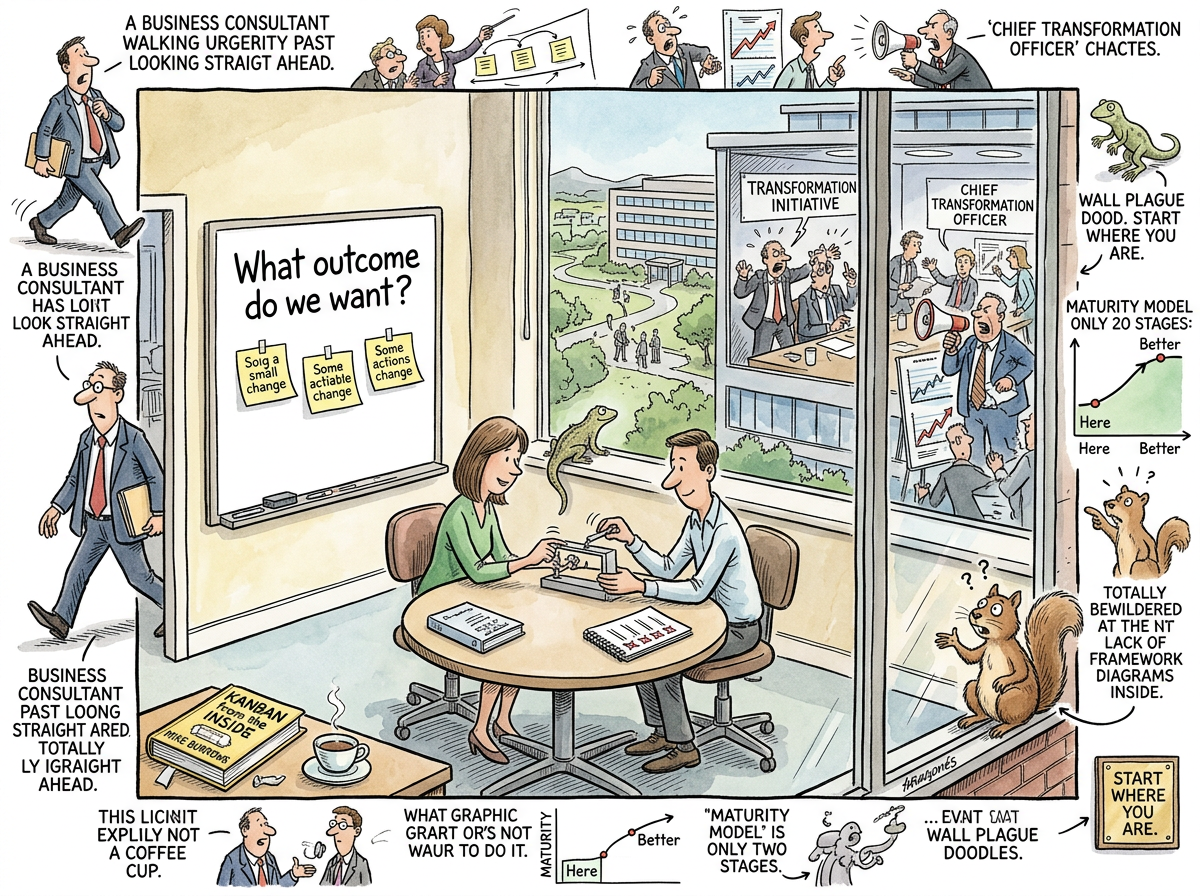
Agendashift is a framework for continuous, outcome-oriented organizational change created by Mike Burrows in 2017. It starts where you are, involves the people doing the work, changes one thing at a time, and evolves incrementally toward desired outcomes — thereby obeying Gall’s Law, respecting the humans involved, and producing actual results.
It has been almost universally ignored.
The Method
Agendashift’s method can be summarized in one paragraph, which is already a problem for the consulting industry, because one paragraph does not justify a six-month engagement:
Ask the people doing the work what outcomes they want. Identify the gaps between where they are and where they want to be. Design small experiments to close those gaps. Run the experiments. Learn. Repeat.
That’s it. No 200-page Vision Document. No maturity model with five levels. No Chief Transformation Officer. No target operating model designed from scratch by people who will not live inside it. No pendulum. No for loop. Just: start where you are, involve the people, change one thing, see what happens.
This is Gall’s Law applied to organizational change: a complex system that works evolves from a simple system that worked. Agendashift does not design the complex system from scratch. It evolves the existing system, one outcome at a time, preserving what works while changing what doesn’t.
Why It Works
Agendashift works for the same reason that Boring Technology works: it is not exciting enough to be dangerous.
Transformation Initiative designs a new organization from scratch, violates Gall’s Law, resets all accrued benefits, and costs £2-5 million. Agendashift asks a question, tries a change, and keeps what works. The Transformation Initiative is surgery performed with a broadsword. Agendashift is gardening.
“THE CONDUCTOR WHO CAN SEE ALL THE DESKS AT ONCE IS NOT MANAGING
HE IS GARDENING”
— The Lizard, The Watercooler — The Morning Five Identical Strangers Shared a Screen and One of Them Opened a Window to Say Hello to a Sixth
Gardening does not produce slide decks. Gardening does not require a Chief Transformation Officer. Gardening does not justify a consulting engagement of twenty people for eighteen months. Gardening is one person with a pair of secateurs, making one cut, watching what grows.
This is why it works. This is also why nobody buys it.
Why Nobody Buys It
The board does not want to hear: “We are making small, continuous improvements based on outcomes identified by the people doing the work.”
The board wants to hear: “We are undergoing a Digital Transformation.”
One of these sentences produces results. The other produces funding. The consulting industry is funded by the second sentence. Agendashift produces the first sentence. The market has spoken. The market is wrong, but the market has spoken.
Agendashift also commits the cardinal sin of organizational change: it involves the people being changed. This means the people doing the work have a voice in how the work is organized. This sounds obvious. It is, in practice, terrifying to executives who have built careers on the assumption that organizational design is a leadership prerogative, not a collaborative act.
The One Time It Worked
There exists exactly one documented case of Agendashift operating at enterprise scale. It was not called Agendashift. It was not called anything. It wore a trenchcoat and sunglasses and hoped nobody would recognize it.
At a Scandinavian telecommunications company — the same one where Reorg’s pendulum swung every four to six months — a consultant was asked to implement large-scale planning across an organization of thirty-six teams. The CTO’s instruction was specific: “Do not do SAFe.” This was not a methodological objection. Another division of the same company had implemented SAFe, and the two divisions had maintained an arch-enmity dating back three mergers. The hatred was organizational, geological, tectonic. Using the same framework as those people was unthinkable. The methodology was chosen by grudge.
So the consultant grew it. Gall’s Law, by accident:
3 teams  → 3 sprints  → refactor what worked
6 teams  → 3 sprints  → refactor what worked
10 teams → 5 sprints  → refactor what worked
16 teams → 5 sprints  → refactor what worked
36 teams → join the other 20, who had been doing SAFe all along
At each step: start where you are. Involve the teams. Change one thing. See what happens. Keep what works. Grow. The big room planning was not designed from scratch for thirty-six teams. It evolved from three teams to thirty-six, each expansion building on a simple system that worked.
By the time the sixteen teams joined the other twenty, the two approaches were indistinguishable — because the grown version had converged on the same ceremonies through evolution, and the SAFe version had abandoned half its ceremonies through attrition. They met in the middle, as Gall’s Law predicted they would.
Nobody called it Agendashift. The consultant did not cite Mike Burrows. The CTO did not know he had commissioned the one approach that obeyed the laws he’d never heard of. The success was real, anonymous, and wearing a disguise — which is, upon reflection, the only way Agendashift has ever been observed working in large organizations.
The Lizard’s Position
The Lizard has never read the Agendashift book. The Lizard does not read books about organizational change, because the Lizard’s organization is one box, and one box does not need a change framework.
But the Lizard is Agendashift — instinctively, without the vocabulary. Start where you are. Change one thing. See if it works. Keep what works. Delete what doesn’t. The Lizard has been doing this since the bootblock. The Lizard just never wrote a book about it, because the Lizard was too busy shipping.
“Does it work?”
— The Lizard’s only question, always
Mike Burrows wrote the book. The Lizard lived the practice. Neither got the consulting budget.
Measured Characteristics
Pages in the Agendashift book:                    ~250
Pages needed to understand the core idea:          3
Consulting engagements it has displaced:           ≈0
Transformation Initiatives it could have replaced: most of them
Gall's Law violations:                             0
People doing the work who are consulted:           all of them
Chief Transformation Officers required:            0
Maturity levels in the model:                      0 (there is no model)
Certifications available:                          technically yes, but quietly
Cost to try:                                       a conversation
Organizations that tried it:                       a few
Organizations that needed it:                      all of them