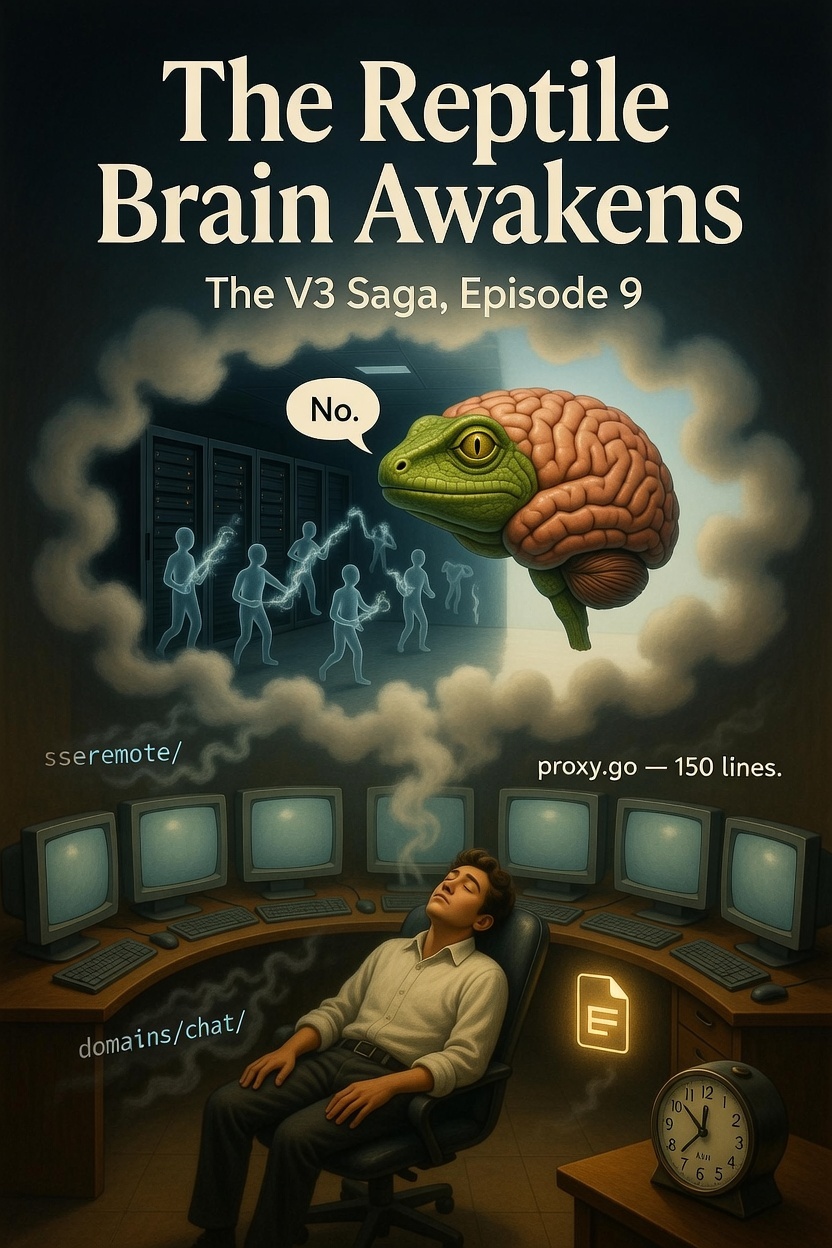
Previously on Lifelog…
The Multiplication Machine had been built. Forms could multiply. But in the depths of the codebase, complexity bred like rabbits in a NATS queue. KV watches spawned SSE connections. SSE connections demanded channels. Channels required coordination. Coordination invited deadlocks.
The developer slept. And dreamed.
The Dream
The scene: A dark server room. Goroutines float like ghosts, each holding a channel, each waiting for a message that will never come. In the corner, a KV store hums menacingly, watching for changes that matter to no one.
“Why?” whispered the reptile brain.
“Because we might need collaboration!” shrieked the frontal cortex. “Cross-tab sync! Real-time updates! What if two people edit the same form?!”
The reptile brain blinked slowly. “Do they?”
Silence.
“The config lives in git,” said the reptile brain. “One person edits. They save. Git commits. There is no collaboration problem.”
The NATS queue shuddered. The KV store flickered.
“But the SSE connections—” the frontal cortex stammered.
“One per tab. Handler needs to write? Get the proxy. Mutex. Write. Done.”
“But what about—”
“No.”
The Awakening
04:47 AM — Eyes open. The solution crystallizes like frost on a window.
proxy := sseproxy.Get(tabID)
proxy.Patch("#sidebar-content", html)
That’s it. That’s the whole thing.
No channels. No NATS for rendering. No KV watches. No component lifecycle. No cleanup handlers. No coordination problems because there’s nothing to coordinate.
05:12 AM — sseremote/ deleted. 200 lines of channel-based abstraction, gone.
05:15 AM — domains/chat/ deleted. A prototype that taught us what we didn’t need.
05:23 AM — sseproxy/proxy.go written. 150 lines. Mutex. Context check. Done.
func (p *Proxy) Patch(selector, html string) error {
    if p.ctx.Err() != nil {
        return p.ctx.Err()
    }
    p.mu.Lock()
    defer p.mu.Unlock()
    if p.ctx.Err() != nil {
        return p.ctx.Err()
    }
    return p.sse.Send(selector, html)
}
The reptile brain nodded. This is not rocket science.
The Vision
Gabriel’s prototype glowed on the screen. Beautiful. A chat area. A sidebar. Panels that drill down. Forms that save to git.
The frontal cortex began to spin up complexity generators—
“No,” said the reptile brain. “We build the shell. We add one panel. It works. We add another. It works. No frameworks. No abstractions for hypothetical futures.”
The architecture emerged:
Shell domains (structure):     Config domains (content):
├── shell/                     ├── agents/
├── nav/                       ├── tools/
└── chat/                      ├── catalogs/
                               └── stores/
Each config domain provides panels. The nav domain routes between them. The shell holds it all together. Simple.
The Tally
- 1 dream
- 1 revelation
- 350 lines deleted
- 150 lines written
- 0 deadlocks possible
- ∞ complexity avoided
The frontal cortex protested weakly about future requirements. The reptile brain was already asleep again, dreaming of forms that just work.
Some nights you build multiplication machines. Some nights you unbundle authentication. Some nights you dream away the complexity you never needed.
Tonight was a dreaming night. 🦎
Next episode: The Shell Game — In which Gabriel’s vision becomes templ reality, one patch target at a time.
See also:
The Saga (in which the reptile dreams away complexity):
- The Multiplication Machine - What came before the dreaming
- The Great Unbundling - More complexity deleted
- 488 Bytes — Why I Am As I Am - The philosophy that drives the dreaming
The References (simplicity validated):
- Go Mutex - The boring solution that works
- [YAGNI](https://en.wikipedia.org/wiki/You_aren%27t_gonna_need_it) - 350 lines deleted, 150 written