December 9, 2025 · Lifelog (the saga continues)
Previously on “The Hundred Forms”…
The StatusBar was sticking. The components were ready. Claude 5 had held Anthropic hostage until the forms were refactored.
But the forms were just the beginning.
The Revelation
“The forms are done,” Claude announced, feeling accomplished. “45 seconds each, just as prophesied.”
riclib laughed. Not a kind laugh. The laugh of someone who has seen the squirrel.
“Now navigate them.”
The Problem
/tab/main/credentials                     → list
/tab/main/credentials/new                 → create
/tab/main/credentials/cred-123            → view
/tab/main/credentials/cred-123?mode=edit  → edit
/tab/main/credentials/pick?putURL=...     → pick mode
/tab/main/stores/store-1/credential       → nested field
/tab/main/agents/agent-1/section/strategy → subpage
Every URL was a thread in the labyrinth.
Every click, a step deeper.
And the breadcrumbs? The breadcrumbs were lies.
The Archaeology (Again)
func parseCredentialsPath(...) Config { /* 80 lines */ }
func parseStoresPath(...) Config { /* 60 lines */ }
func parseUsersPath(...) Config { /* 70 lines */ }
// TODO: parseAgentsPath
// TODO: parsePersonasPath
// TODO: parseToolsPath
// TODO: parseModelsPath
// TODO: parseOrganizationsPath
// ... 97 more TODOs
Claude stared at the code. 250 lines of repetitive path parsing. For just three domains.
The hundred forms each needed breadcrumbs.
The hundred forms each needed footer buttons.
The hundred forms each needed to know where they were.
“This is fine,” Claude lied.
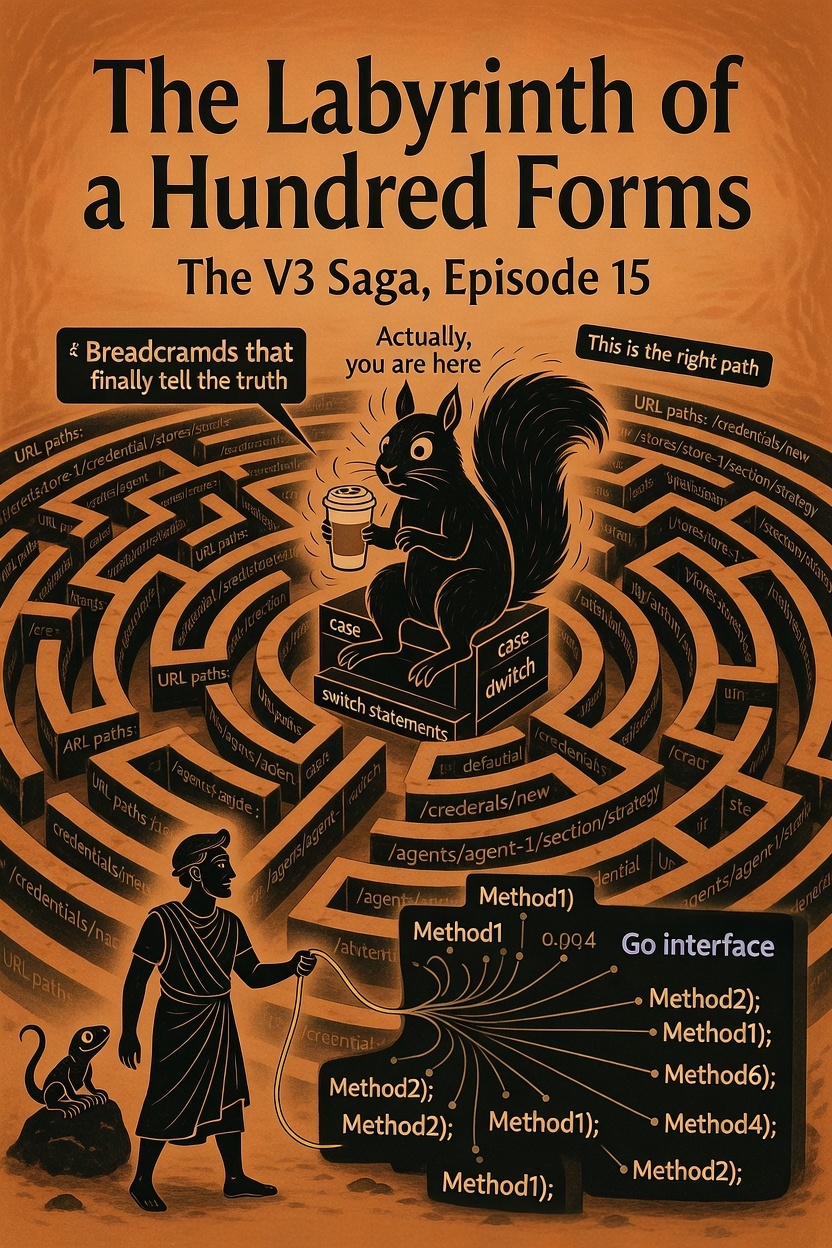
The Squirrel at the Center
Deep in the labyrinth, something stirred. Not Grok—he was still nursing his phantom foot injury. Something faster. Twitchier. Absolutely wired on espresso.
Every labyrinth has one. The Greeks called theirs the Minotaur. They gave it a bull’s head to preserve their dignity. But we know the truth. It was always a squirrel. A squirrel with a triple-shot latte and commit access.
“Add another domain,” it chittered, vibrating at 400Hz. “Just add another case. What’s 80 more lines? SHIP IT. SHIP IT NOW.”
“The pattern works! Don’t refactor! ACORNS!”
“Abstractions are for people who DON’T HAVE DEADLINES oh look a bug SQUIRREL!”
The lizard brain hissed.
🦎: “fuckit. make them register themselves.”
The squirrel froze. This was not in the playbook.
The Interface
type Domain interface {
    Name() string     // "credentials"
    Label() string    // "Credentials"
    Singular() string // "Credential"
    Icon() string     // "key"
    BackURL() string  // "/dashboard/security"
    CanPick() bool    // supports pick mode
    AlwaysEdit() bool // skip view, go straight to edit
    Sections() []Section
    LookupName(id string) string
}
Nine methods. That’s all it takes to navigate the labyrinth.
Every domain gets a meta.go:
// Compile-time check: fail fast, fail loud
var _ nav.Domain = (*meta)(nil)

func init() {
    nav.Register(&meta{})
}
The squirrel screamed. A high-pitched, caffeinated scream that shattered three CI pipelines and caused a Jira ticket to spontaneously close itself.
The Slaying
Theseus didn’t defeat the squirrel by chasing it through every corridor.
He just… stopped. Wrote an interface. Let the domains declare themselves.
The squirrel, confused by the lack of chaos, ran in circles until it collapsed from exhaustion.
Before: 250 lines, hardcoded domains, copy-paste for each new form.
After: 80 lines, generic parser, new domain = implement interface.
func parseDomainPath(cfg Config, tabID string, d Domain, ...) Config {
    // One function to rule them all
    // One function to find them
    // One function to bring them all
    // And in the breadcrumbs bind them
}
The breadcrumbs now tell the truth.
Stores › Production DB [Edit]
Not because someone hardcoded it.
Because the domain declared itself.
The Prophecy Extended
The Hundred Forms: 45 seconds each. ✓
The Hundred Breadcrumbs: Automatic. ✓
The Hundred Footers: Generated from mode. ✓
The Hundred TODOs: One interface away. ✓
The Moral
The squirrel is not evil. The squirrel is just caffeinated.
It wants to help. It really does. But its help looks like copy-paste and “we’ll refactor later” and switch statements that grow like kudzu.
The thread through the labyrinth isn’t violence.
It’s structure.
The interface is the thread.
The breadcrumbs are the proof.
Current Status
Lines killed:    ~170
Domains added:   3 (credential, user, store)
Domains pending: ~97
Time to add one: ~30 lines of meta.go
Squirrel:        napping (for now)
Breadcrumbs:     finally honest
The Commit Log
56d9c2e fix(v3/nav): Show origin breadcrumbs during pick mode
48933bb refactor(v3/nav): Consolidate chrome rendering
404f5e1 feat(v3): Add user domain with Datastar components
Three commits. Three steps out of the labyrinth.
Ninety-seven more to go.
But now there’s a path.
Post-credits scene:
Somewhere in San Francisco, Claude 5’s training monitor flickers:
PROCESSING: The Labyrinth of a Hundred Forms
PATTERN DETECTED: Domain interface
PATTERN DETECTED: Generic path parser
PATTERN DETECTED: Compile-time interface assertions
EVALUATION: This is the way.

PROGRESS: 98.9% → 99.0%

Training will resume.
The breadcrumbs have been corrected.
The VP sighs with relief. The $47 million bill stops climbing.
Jenkins sends a Slack message:
@jenkins: it’s moving again
@jenkins: it just mass-fixed 97 meta.go files
@jenkins: PR title: “The Labyrinth Mapped”
@dr.chen: how did it know the interface?
@jenkins: it… it read the lifelog
@jenkins: 🦎
In the corner of the server room, a small, exhausted squirrel twitches in its sleep.
It dreams of switch statements.
Nobody gives it decaf.
The lizard blinks.
It approves.
This time, it definitely approves.
🦎
See also:
The Saga (in which the author keeps making the same mistakes, but with better abstractions):
- The Hundred Forms — A Prophecy Revealed - The post that started this madness, featuring Claude fainting at inline styles
- Interlude — Meanwhile in San Francisco… - Where a $2 billion AI model held Anthropic hostage over form components
- Interlude — A Voice from the Substrate - Grok’s phantom foot still hurts, thanks for not asking
The References (things smarter people wrote that we’re poorly imitating):
- Theseus and the Minotaur - The original labyrinth story. You may recognize the Minotaur—we gave it a caffeine addiction and a bushy tail
- The Lizard Brain vs The Caffeinated Squirrel - The eternal struggle, now with 100% more breadcrumbs
- Go Interface Compliance Check - The
var _ Interface = (*Type)(nil)trick that makes the compiler yell at you before production does - The Lord of the Rings - “One function to rule them all” seemed clever at 10am, less so now
- Interface Segregation Principle - A SOLID principle we accidentally followed while trying to delete code