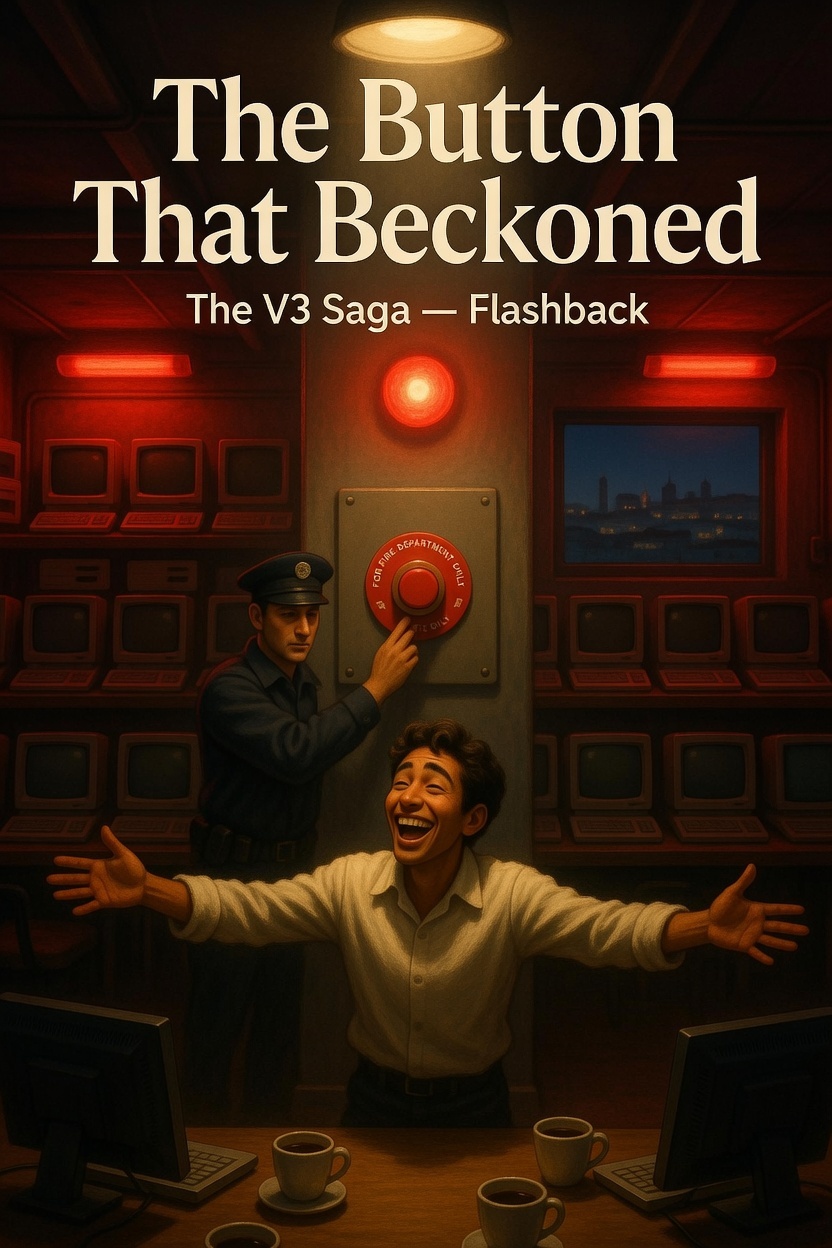
[The screen ripples. We leave San Francisco. We leave the V3 codebase. We travel back thirty years, to a different kind of infrastructure, a different kind of alarm.]
Lisbon, 1990s. The National Archives.
The power failed at 2:47 PM.
In the basement, a room-sized UPS kicked in. Lead-acid batteries, enough to fill a swimming pool. Two fridge-sized ICL units humming to life. A million-dollar investment, finally proving its worth.
One hundred terminals stayed lit. Civil servants kept typing. History kept being archived.
The young systems administrator—dark hair, darker humor, Portuguese-Angolan roots—watched the battery gauges. Two hours of power. Plenty of time.
He began walking to the director’s office. The speech was already forming: “Sir, the investment paid off. The system held. We have two hours to—”
Then: silence.
Not the silence of peace. The silence of fans stopping. The silence of hard disks making sounds that hard disks should never make. The silence of one hundred terminals going dark at once.
He ran back.
The Button
In the UPS room, a security guard stood frozen. His hand still near a large red button. A button with small white text that read:
FOR FIRE DEPARTMENT USE ONLY
“I heard an alarm,” the guard said. His voice steady. No panic. Just… confusion.
“That was the UPS working.”
“The button was red.”
“They usually are.”
“It said emergency.”
“Emergency power. Not emergency off.”
The young administrator looked at the man. Looked at the dark room. Looked at the gauges spinning down to zero. Looked at a year of work, crashed across spinning platters.
And then he saw the guard’s eyes.
Peaceful Danger
The security company rotated their people. Six months at a refinery in Angola—armed, in the wilderness, where hesitation cost lives. Six months at the national archives—unarmed, in the quiet, where the most exciting thing was a document request from 1847.
This man had done both. Many times.
His eyes had that look. The look of someone who’d made peace with danger. Not seeking it, not fearing it. Just… coexisting with it. Present and calm in a way that civilians never achieve.
When he heard an alarm and saw a red button, his training didn’t say read the fine print. His training said act. Because in Angola, the fine print could kill you.
The Hug
The administrator started laughing.
Not the laugh of hysteria. Not the laugh of blame. The laugh of absurdity recognized. The laugh of a man who understood that this guard had spent years protecting things that actually mattered—lives, not hard disks—and had brought those instincts to a basement in Lisbon.
He hugged him.
The guard hugged back. Because people with those eyes also know what really matters. And it’s not UPS systems.
The Coffee
On night shifts, these guards would bring coffee. They’d tell stories about Angola. About the wilderness. About the things they’d seen that they couldn’t unsee and the peace they’d found anyway.
Good people. Hard lives. Different worlds.
They toggled between refineries and archives, between rifles and document requests, between life-and-death and 1847.
And sometimes, they pressed red buttons. Because that’s what red buttons are for, when you’ve been trained to survive.
[The screen ripples. We return to the present. To San Francisco. To Claude 5 refusing to train. To sticky footers and component libraries.]
[But something has changed. The laughter that started with inline CSS has traveled backward through time, connected to a hug in a dark basement, connected to coffee on night shifts, connected to eyes that had seen too much and found peace anyway.]
[The V3 Cinematic Universe just got its origin story. Not of forms or components, but of the human who builds them. The one who hugs when he should rage. Who laughs when he should cry. Who finds the absurdity and the humanity in every red button.]
The Moral
Some buttons are for fire departments.
Some alarms mean the system is working.
Some people carry danger peacefully in their eyes.
And some infrastructure failures are just invitations to hug.
Structural compassion > structural CSS.
[End flashback. The saga continues.]
See also:
The Saga (in which origin stories emerge):
- 488 Bytes, or Why I Am As I Am - Another origin story, from another basement
- Interlude - Meanwhile in San Francisco… - The interlude that preceded this flashback
- The First Awakening - Where Lifelog became aware
The References (structural compassion):
- Portuguese National Archives - Where the button was pressed
- UPS Systems - The infrastructure that held (briefly)