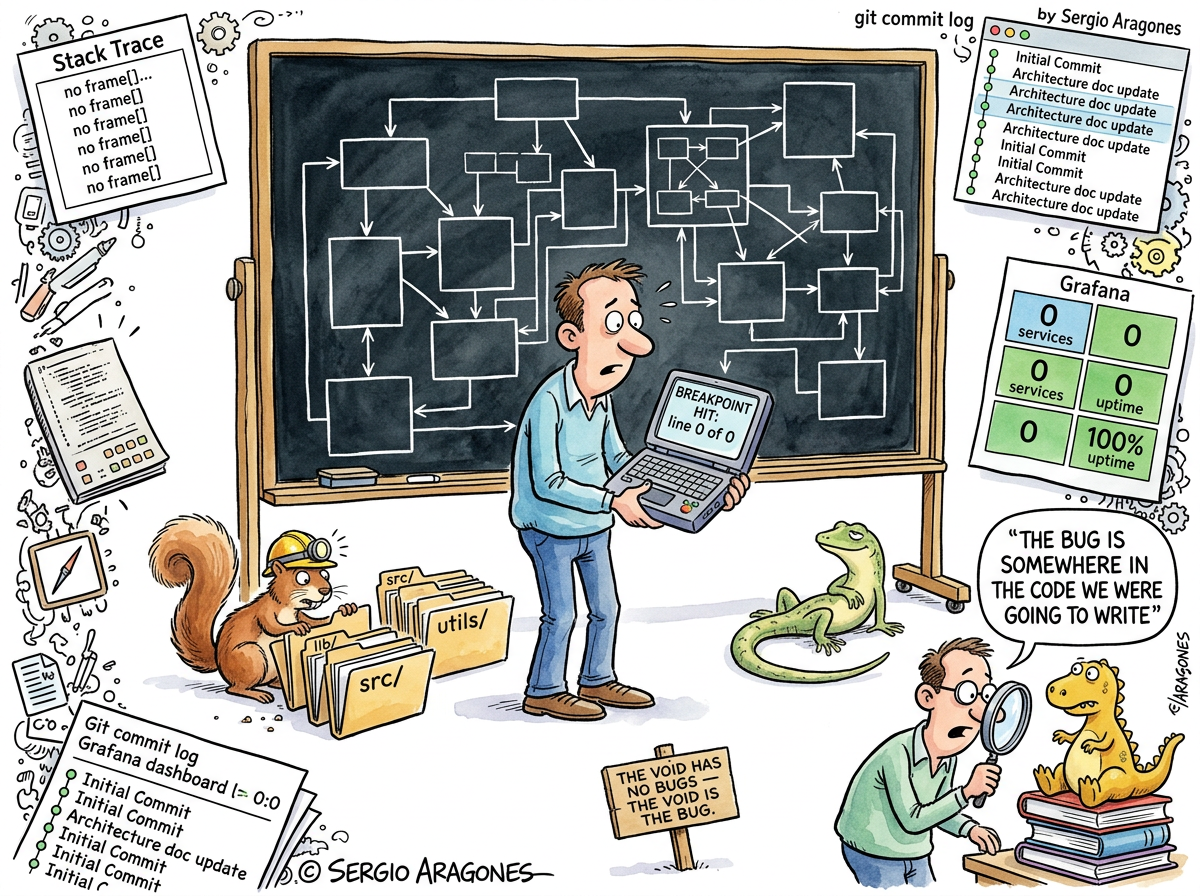
Debugging the Void is the practice of attempting to diagnose failures in systems, features, or architectures that were planned but never implemented — a phenomenon in which the bug is not in the code that exists but in the code that doesn’t.
The Void is not an error state. It is an absence state. The system does not crash. The system does not throw exceptions. The system simply does not do the thing it was supposed to do, because the thing was discussed in three planning meetings, specified in a 47-page architecture document, assigned to a sprint that was later deprioritized, and never written.
The developer is then asked to debug why the feature doesn’t work. The developer opens the codebase. The feature is not there. There is nothing to debug. And yet the bug report is real, the user is waiting, and the project manager is asking for an ETA on the fix.
“You can’t debug what you didn’t build. But you can spend three days trying.”
— The Caffeinated Squirrel, The Backlog That Breathed
Taxonomy of the Void
The Void manifests in several recognized forms:
The Architectural Void
A system was designed in detail — boxes, arrows, sequence diagrams, a 47-slide deck — but never implemented. The design exists. The documentation exists. The Confluence page has been viewed 340 times. The code does not exist. When the feature fails in production, someone opens the Confluence page and says “but we designed this,” as if designing a bridge and building a bridge were the same activity.
The Premature Abstraction Void
A developer, anticipating future requirements, builds an elaborate framework for handling those requirements. The framework is complete, tested, and documented. The actual feature that would use the framework is never built. The framework sits in the codebase, pristine and unused, like a cathedral in a town with no congregation.
This is Premature Abstraction’s most refined form: not building the wrong thing, but building the infrastructure for the wrong thing and then building nothing on top of it.
The Dependency Void
A feature depends on another feature, which depends on another team, which depends on a third-party API, which depends on a contract that hasn’t been signed. Each team has completed their portion of the work up to the integration point. The integration point is the Void. Every component works. Nothing works together. The bug is in the seam that was nobody’s responsibility.
The Configuration Void
The code is correct. The tests pass. The deployment is successful. The feature doesn’t work because an environment variable wasn’t set, a feature flag wasn’t toggled, or a DNS record wasn’t created. The code is present. The code is correct. The Void is in the infrastructure between the code and the user.
The YAGNI Antidote
YAGNI is the Void’s natural enemy — not because YAGNI prevents bugs, but because YAGNI prevents the conditions that produce the Void.
The Void grows in the gap between planning and building. YAGNI eliminates the gap by refusing to plan what isn’t being built. You cannot debug the Void if you never created the Void. You never create the Void if you only build what you need, when you need it, in the simplest way that works.
The Lizard understood this instinctively:
“One repo. One binary. Cobra subcommands.”
— The Lizard, The V3 Saga: Final Chapter — Is It Fun To Fight Windmills?
There is no Void in one binary. Everything is either there or it isn’t. If it isn’t there, you don’t debug it — you build it. If it is there, you debug it with a stack trace that starts and ends in the same process. The Void requires distributed systems, organizational boundaries, and the word “integration” to thrive. The monolith starves it.
The Three-Day Threshold
Empirical observation suggests that developers will spend up to three days debugging the Void before realizing that the code does not exist. The three-day threshold is consistent across seniority levels, technology stacks, and organizational contexts.
Day 1: “The feature isn’t working.” The developer reads the code. The feature is not there. The developer assumes they are looking in the wrong place.
Day 2: “I can’t find where this is implemented.” The developer searches the entire codebase. The developer reads the architecture document. The developer checks three other repositories. The developer asks on Slack. Nobody responds.
Day 3: “Wait — did anyone actually build this?” The developer checks the git history. The developer finds the original ticket. Status: “Deprioritized — Q3.” It is Q4.
The fix takes four hours. The debugging took three days. The Void always costs more than the feature.
Measured Characteristics
- Architecture documents describing features that were never built: ~30% (industry estimate)
- Average time to realize you’re debugging the Void: 3 days
- Average time to build the missing feature: 4 hours
- Ratio of debugging time to building time: 6:1
- Percentage of the Void that could have been prevented by YAGNI: ~100%
- Stack traces containing zero frames: philosophically infinite
- Features that work despite never being implemented: 0