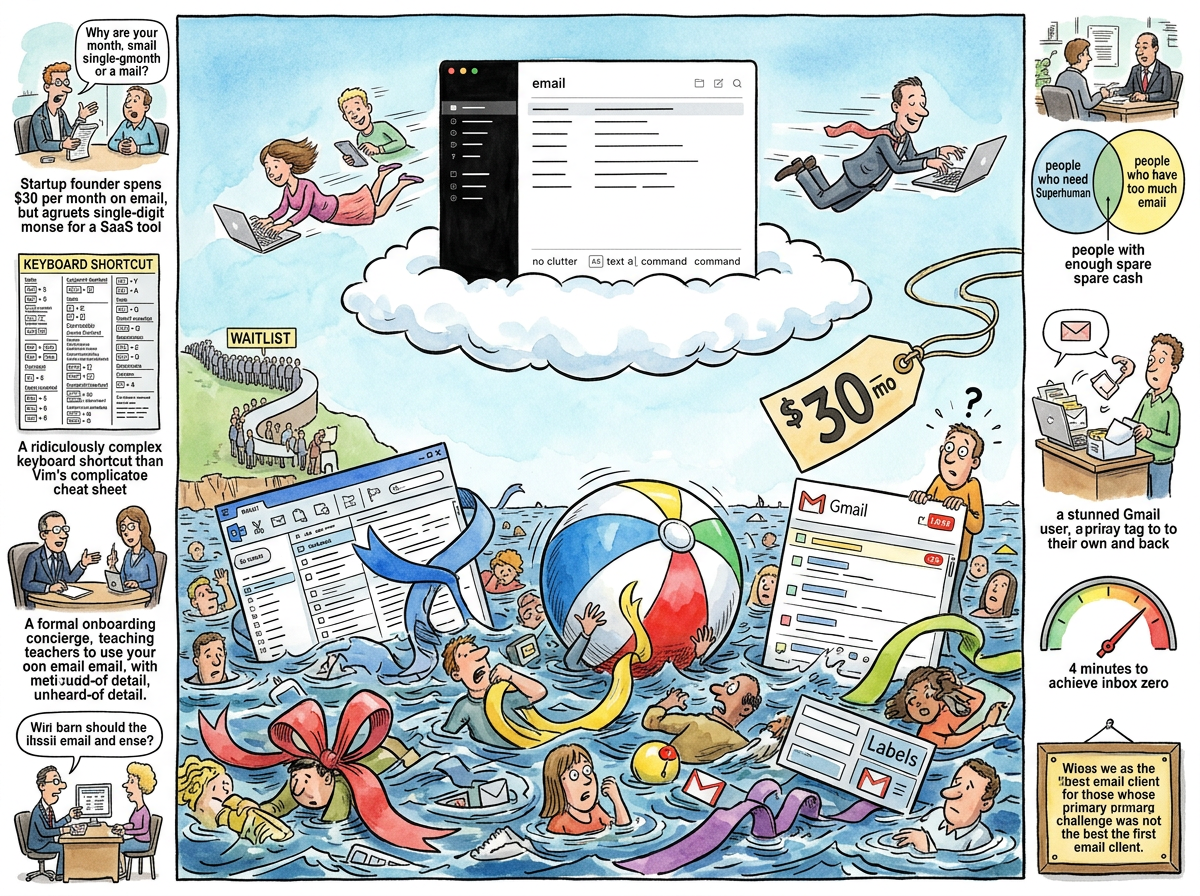
Superhuman is a $30/month email client launched in 2017 by Rahul Vohra that proved three things simultaneously: that people will pay extraordinary prices for speed, that the email experience can be dramatically improved, and that the people willing to pay $30/month for email were never the people whose problem was email.
Superhuman is the fastest email client ever built. This is not marketing. It is measurably, demonstrably, obsessively fast — every interaction responds in under 100 milliseconds, every animation is 60fps, every keyboard shortcut eliminates a click. Using Superhuman after Gmail is like driving a sports car after a bus. The experience is genuinely transformative.
The question is whether the experience of driving a sports car is worth $360/year when the bus goes to the same place.
The Product
Superhuman does email. Only email. It does it with a level of craft that borders on the spiritual:
- Speed: every action completes in under 100ms. Not “feels fast.” Is fast. Measured, profiled, optimised to the millisecond.
- Keyboard-first: Superhuman is designed to be operated entirely by keyboard, like vim for email.
Eto archive.Rto reply.J/Kto navigate.Cmd+Kfor the command palette. Reaching for the mouse is a failure state. - Split inbox: emails are automatically triaged into categories — VIP, newsletters, notifications — without manual rules. The inbox you see contains only the emails that matter.
- Snippets: templated responses inserted with a keystroke. The same polite decline, sent to the same type of request, in under two seconds.
- Read receipts: you know when someone reads your email. This is either useful or unsettling, depending on which side of the receipt you’re on.
The product is extraordinary. The product is also email. The gap between “extraordinary email” and “ordinary email” is real, measurable, and — for most people — not worth $30/month.
The Waitlist
Superhuman launched with a waitlist. Not a “sign up and we’ll let you in next week” waitlist. A curated waitlist — you applied, described your email habits, and were accepted or rejected based on whether you were the right fit. The waitlist created scarcity. Scarcity created desire. Desire created a $30/month email client that people bragged about using.
The waitlist was a masterpiece of product marketing. It also contained an implicit message: not everyone deserves fast email. This is either brilliant positioning or absurd gatekeeping, and the two are closer together than the industry admits.
The onboarding was equally curated: a one-on-one concierge call where a Superhuman employee taught you to use the product. Someone taught you to use email. You paid $30/month for the privilege. And it worked — because the onboarding wasn’t teaching email. It was teaching speed, training muscle memory for keyboard shortcuts that would, eventually, make the $30/month feel justified.
The $30 Question
$30/month for email generates two reactions:
The convert: “Superhuman saves me four hours a week. At my hourly rate, it pays for itself in a single email session. I reach inbox zero every day. My email anxiety is gone. I will never go back to Gmail.”
Everyone else: “It’s… email.”
Both reactions are correct. The convert is correct that Superhuman is faster, that speed reduces anxiety, and that the time savings are real. Everyone else is correct that Gmail is free, that email is email, and that $360/year is a peculiar amount to spend on a problem that most people solve by checking email less often.
The deeper question: the people who pay $30/month for email are typically founders, executives, and VCs — people who receive 200+ emails per day and for whom email is a primary work interface. These are also the people whose email problem is not speed but volume — and no email client, however fast, solves volume. Superhuman lets you process 200 emails faster. It does not prevent the 201st.
The best email productivity hack is not a faster client. It is fewer emails. But “send fewer emails” is not a product you can charge $30/month for.
The Craft
Superhuman’s real contribution is not the product. It is the proof — the demonstration that software can be fast, that speed is a feature, that the 300-millisecond response time everyone accepts is not a law of physics but a choice, and that choosing differently produces a measurably better experience.
Every time a web application takes 800 milliseconds to respond to a click, Superhuman exists as evidence that it didn’t have to. Every loading spinner is a design choice. Every janky animation is a priority decision. Superhuman proved that “fast” is achievable and that users — at least the ones willing to pay — notice the difference.
This is Superhuman’s legacy, regardless of whether the company survives: the proof that speed matters, that craft matters, and that someone, somewhere, will pay for the difference. The bootblock kid would understand. 488 bytes. Six layers of parallax. Speed is not a feature. Speed is the product.
Measured Characteristics
Monthly price:                               $30
Annual cost:                                 $360
Gmail cost:                                  $0
Interaction response time:                   <100ms
Gmail response time:                         300–800ms
Onboarding format:                           1:1 concierge call
Waitlist duration (peak):                    months
Keyboard shortcuts memorised (power user):   ~30
Time to inbox zero (Superhuman):             4 minutes
Time to inbox zero (Gmail):                  what is inbox zero?
Emails received per day (target user):       200+
Emails prevented by faster client:           0
Users who feel faster:                       ~95%
Users whose problem was email speed:         ~20%
Users whose problem was email volume:        ~80%
Price sensitivity of target market:          none (they expense it)