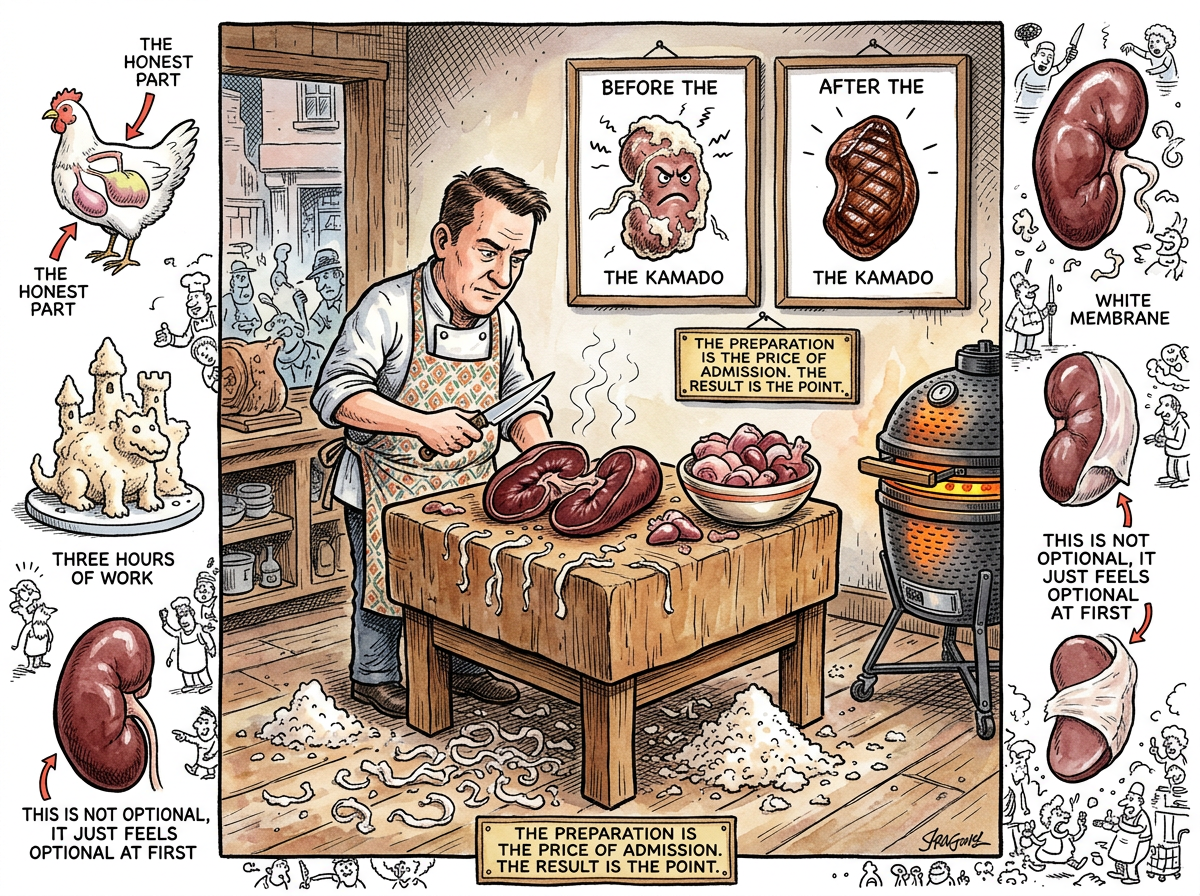
Organ meat — also called offal, variety meats, fifth quarter, or “that section of the butcher counter that makes people walk faster” — is the category of animal parts that includes hearts, livers, kidneys, gizzards, lungs, tongues, and anything else that was not a muscle the animal used for locomotion. It is simultaneously the oldest food in human culinary history, the most nutrient-dense category of animal protein, and the thing that causes grown adults to make involuntary facial expressions in the meat aisle.
This is the part that every predator eats first. When a lion takes a wildebeest, it does not head for the ribeye. It opens the abdominal cavity and eats the organs — the liver, the heart, the kidneys. This is not squeamishness in reverse. This is efficiency: organs are the most nutritionally dense tissues in any animal, packed with vitamins and minerals that muscle tissue does not contain in comparable concentrations. The wildebeest’s ribeye will still be there. The organs are the prize.
Modern Western culinary culture, in its ongoing project of forgetting things that worked, decided somewhere in the mid-twentieth century that organ meats were for people who couldn’t afford the good cuts. This was exactly backwards. Organ meats were the good cuts. They just required knowing how to prepare them, which takes effort, and effort, as a general principle, was being phased out.
“The liver was always the prize. The muscle was what was left over.”
— The Lizard, from a position of complete stillness near the giblet bag
The Taxonomy
Organ meats divide into two categories based on preparation difficulty, and it is not coincidental that the category most people encounter first — chicken giblets — is the one that requires the least intervention.
The Easy Gate: Chicken Giblets
A whole chicken comes with a bag. Inside the bag: the neck, the heart, the gizzard, and the liver — the giblets, removed during processing and tucked inside the bird as though the manufacturer is quietly daring you to do something with them. Most people throw the bag away. This is the culinary equivalent of discarding the documentation because it didn’t come in a shrink-wrapped box.
The heart is a muscle — a relentless, tireless, unremarkable-looking muscle that spent its entire existence doing the single most important job in the bird’s body. It has a firm texture and a flavour that is more intensely “chicken” than chicken breast has any right to be. It requires nothing. Halved, skewered, and put on the Kamado for four minutes, it is extraordinary. The heart is the gateway organ: it looks like what it is, it prepares the way ordinary meat prepares, and it rewards without demanding anything unusual of the cook.
The gizzard is the chicken’s second stomach — a muscular grinding organ used to process grain. It is tough, it is small, and it must be cleaned of its inner lining before cooking. Braised low and slow until tender, it has the character of a highly compressed chicken thigh: dense, flavourful, and slightly defiant. The gizzard is honest about what it is. It does not pretend to be convenient.
The liver is the filter. Every metabolic toxin, every compound that needed processing, passed through this organ. It has a flavour to match: rich, metallic, deep, and intensely alive — a flavour that either makes complete sense to a person or produces the involuntary facial expression. There is no neutral response to chicken liver. You understand it or you don’t, and the people who understand it are not wrong.
The neck is just a neck — a collection of small vertebrae with very little meat that makes the best stock of anything in the bird, because the vertebrae are porous and marrow-rich and give up their collagen without complaint. The neck goes in the freezer until there are enough to make a proper stock. The neck is not trying to be anything. The neck is infrastructure.
The Advanced Course: Beef Kidney
If chicken giblets are the introductory module — low stakes, familiar context, a gentle introduction to the proposition that not all value is in the muscle — then beef kidney is the advanced course, and the advanced course has a practical exam.
The Anatomy
A beef kidney is not one kidney. It is a lobulated organ — multiple fused lobes, each with its own internal structure, connected by white fibrous tissue (the renal pelvis and calyces) that must be removed entirely before cooking. The entire organ arrives encased in suet — the hard, waxy fat that surrounds bovine kidneys, chemically distinct from the intramuscular fat in a steak, and significant in quantity. A whole beef kidney from a well-nourished animal can arrive with enough suet surrounding it to make the organ itself difficult to locate.
This is not a defect. The suet is Tallow waiting to happen. It renders at higher temperatures than other fats, stays solid at room temperature, and makes the best frying medium of anything available — flaky pastry, roasted potatoes, beef dripping. The suet is not waste. The suet is a byproduct. The suet is the thing you rendered off while doing the real work.
The Preparation
Cleaning a beef kidney from a local pasture-raised supplier is a project. Not a long project — forty-five minutes, perhaps — but a project with a psychological dimension that no recipe adequately prepares the cook for.
The first surprise is the quantity of suet. The second surprise is that removing the suet reveals a membrane — a translucent, slippery capsule wrapped around each lobe — that must also be removed, because it toughens during cooking. The third surprise is that once the membrane is removed, the lobes reveal their internal white fibrous tissue, and this too must be removed — the renal pelvis and the branching calyces, a structure that looks like the root system of a very small plant, and that a small paring knife must follow into the organ’s interior with the patience of a person who has committed to the task and is not going to leave it half-done.
The swearing, at this stage, is proportional to the commitment. The commitment is total. The preparation is not for anyone who wants this to be easy, and it is not easy, and the preparation makes the result possible, and this is the honest transaction that organ meat offers: more work than muscle, more reward than muscle, no apology for being what it is.
Source matters here more than almost anywhere else in cooking. A beef kidney from a well-raised, pasture-fed animal smells clean and mineral and faintly, properly, of what it is. A kidney from an animal raised in industrial conditions does not. The quality difference between a kidney from a local pasture-raised supplier and one from an anonymous industrial source is wider than the same gap for any muscle cut. The kidney processed everything. The kidney is the record of the animal’s life. Get it from an animal that had a good one.
The Kamado’s Role
The Kamado, when presented with a properly cleaned, properly prepared beef kidney, does what the Kamado does with everything: applies direct heat without compromise, develops a sear that no oven or pan can replicate, and produces a result that justifies the preparation in a way that feels disproportionate given how simple the actual cooking step is.
Beef kidney on the Kamado: halved, seasoned, grill marks at 260°C (500°F), four minutes per side, internal temperature 63°C (145°F). Done. The exterior is caramelised and slightly charred. The interior is a deep, vivid colour — not the grey of an overcooked organ, but the warm, complex brown of protein that has been treated correctly. The flavour is rich and mineral and deeply savoury in a way that has no useful comparison, because nothing else tastes like a properly cooked kidney from a well-raised animal. It doesn’t taste like “offal.” It tastes like the animal’s purpose, concentrated.
The swearing during preparation was audible to the neighbours. The silence during eating was complete.
The Philosophy of the Whole Animal
Organ meat is the physical expression of a culinary philosophy that might be summarised as: if you are going to eat an animal, eat the animal. The muscle cuts are obvious. The organ cuts are the honest work.
There is a reason traditional cuisines — French, Portuguese, British, Chinese, almost every food culture that developed before industrial protein processing — have elaborate, beloved preparations for every organ. Kidneys in sherry sauce. Chicken liver pâté. Haggis. Fígado à portuguesa. These dishes exist because people who ate animals ate all of them, developed technique for the difficult parts, and found that the difficult parts rewarded the effort.
The modern reduction of “meat” to muscle alone is a historical anomaly, and a nutritionally impoverished one. Liver contains more vitamin A, B12, folate, and iron per gram than any muscle cut. Heart is the highest natural source of CoQ10. Kidney contains selenium in concentrations that most people never achieve through diet alone. The organs are not the discount section. The organs are the part where the nutrients are.
Bone Broth extracts the collagen and minerals from structural tissue. Tallow renders the fat that surrounded the organs. Organ meat addresses the tissue that metabolised everything. The complete picture of eating an animal is not a steak. It is the steak, and the organs, and the bones, and the fat, each part contributing something that the muscle cut alone cannot provide.
This is Boring Technology applied to nutrition: use what exists, use all of it, do not discard things that work because they are unfashionable or require effort.
The Chicken Giblet Preparation
Heart: Trim the aorta stub and any fat. Halve lengthwise. Season with salt, pepper, and a thread of olive oil. Hot Kamado, 4 minutes total. Done. The heart is the most approachable organ cut in existence.
Gizzard: Clean the gizzard by slicing it in half and removing the inner yellow lining (it peels away). Rinse. Braise for 1–2 hours in stock until tender; then sear on the Kamado or in cast iron to develop a crust. The gizzard rewards patience. It will be tough if rushed.
Liver: The chicken liver requires only that the connective tissue be trimmed and the lobes separated. Pan-fry in butter over high heat — two minutes per side, no more, because an overcooked liver is grey and grainy and tastes like a lesson in consequences. Or chop into small pieces, sauté with garlic and onion, deglaze with Madeira or sherry, and serve on toast. The classic preparation exists because it is correct.
The Beef Kidney Preparation
The cleaning: Remove all suet. Peel the outer membrane from each lobe. Find and remove the white fibrous core — the renal pelvis — with a small paring knife, following it inward until no white tissue remains. This takes time. The suet goes in a separate container for rendering. Nothing is wasted.
The soak (optional): Some preparations call for soaking in milk or lightly salted water for 30–60 minutes after cleaning, to mellow the flavour. For a kidney from a well-raised animal, this is optional. For a kidney of unknown provenance, it is advisable. The milk draws out blood and residual compounds. The flavour after soaking is milder, less assertive, more approachable.
The cook: High direct heat. The Kamado at 260°C (500°F), or a cast iron pan at screaming hot. Slice into lobes or halves. Season generously. Sear for 3–4 minutes per side. Pull at 63°C (145°F) internal temperature. Overcooking ruins a kidney. Undercooking is not a concern at these temperatures for an animal protein. The window between perfect and overcooked is narrow, which is why direct Kamado heat — predictable, controllable, precise in its ferocity — is the correct tool.
Measured Characteristics
| Property | Chicken Giblets | Beef Kidney |
|---|---|---|
| Preparation difficulty | Low | Moderate to high |
| Suet to remove | None | Considerable |
| Membranes to remove | Inner gizzard lining only | Complete outer capsule per lobe |
| White fibrous core | None | Yes (renal pelvis; remove entirely) |
| Swearing required | Optional | Yes |
| Kamado time | 4 min (heart) | 6-8 min (kidney) |
| Quality source sensitivity | Moderate | Very high |
| Nutritional density | High | Very high (especially selenium) |
| Flavour compared to muscle | Deeper, more complex | Mineral, rich, incomparable |
| Frequency in lifelog | Weekly (when cooking whole chicken) | First attempt (successful) |
| Whether it was worth it | Yes | Unambiguously yes |
| The Squirrel’s response | “I’d add a marinade framework” | “I’d sous vide it first, then sear” |
| The Lizard’s response | (blinks) | (blinks, slightly slower, in approval) |
See Also
- BBQ — The daily practice that makes good ingredient sourcing feel like the natural thing
- The Kamado — The instrument that redeemed the preparation
- Bone Broth — The companion philosophy: nothing from an animal should be discarded
- Tallow — The suet you removed from the kidney, rendered into the fat worth keeping
- Spatchcock Chicken — Whole chicken work where the giblet bag first appeared
- Fermentation — Another preparation technique that requires patience and rewards it
- Boring Technology — The philosophy applied to ingredients: use what exists, use all of it