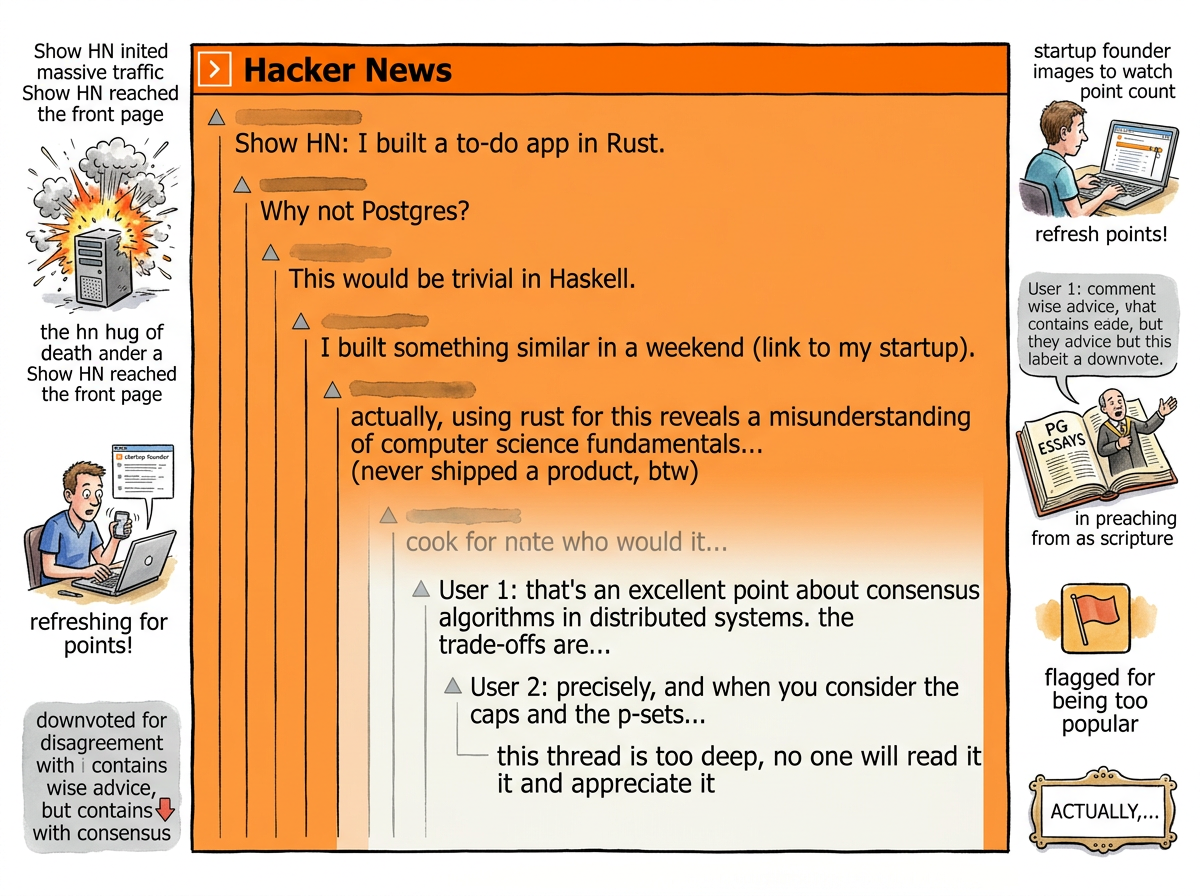
Hacker News (HN) is a social news website operated by Y Combinator, launched in 2007 by Paul Graham, where technologists gather to share links, discuss technology, and explain to strangers on the internet why their technology choices are wrong — a service it has provided reliably for eighteen years with an interface that has not changed once, because changing the interface would generate a 400-comment thread about why the old interface was better.
HN is the town square of the technology industry. It is where startups launch, where blog posts go viral, where frameworks are praised on Monday and deprecated on Wednesday, and where every conversation — regardless of its starting topic — eventually converges on one of five attractors: Postgres, Rust, Haskell, “I built this in a weekend,” or a Paul Graham essay from 2009.
The Comment Section
HN’s comment section is simultaneously the most informed and most insufferable discussion forum on the internet. The same thread will contain:
- A genuine expert providing deep, nuanced insight that you cannot find anywhere else
- Someone explaining that the expert is wrong, citing a blog post they wrote
- A fourteen-level-deep sub-thread about a tangential point that becomes more interesting than the original post
- “This would be trivial in [language the commenter prefers]”
- A Show HN author politely responding to criticism while internally dissolving
- A grey-text comment at the bottom that contains the actual correct answer, downvoted for tone
The quality distribution is bimodal: the best comments on HN are better than anything you’ll find on any other platform. The worst comments on HN are a senior engineer spending forty-five minutes composing a reply that begins with “Actually,” to correct a minor inaccuracy in a post they otherwise agree with.
The word “Actually” is HN’s national anthem.
The Hug of Death
Reaching the HN front page is every developer’s dream and every server’s nightmare. The HN Hug of Death is the phenomenon where a small website, built by one person on a $5/month VPS, receives 50,000 visitors in an hour because it reached #1 on Hacker News.
The site crashes. The comments fill with: “Site is down.” “Here’s the Google cache.” “This is why you should use a CDN.” “This is why you should use static HTML.” “I built something similar that handles this traffic (link to my startup).”
The author, who posted a side project expecting twelve visitors, watches their server melt, their cloud bill spike, and three hundred strangers critique their architecture — all within the time it takes to eat lunch.
This is, in a sense, HN’s purest expression: the simultaneous celebration and destruction of the thing being celebrated.
The Hug That Wasn’t
The canonical exception to the hug of death was documented on December 7, 2025, when a blog served from a Mac Studio mounted under a desk in Latvia reached the HN front page.
The ISP called. The 1-gigabit connection was saturated. The server’s CPU was at 8%. Its fans were silent. The server was bored. The bottleneck was the pipe, not the machine.
The fix was one line of Go:
w.Header().Set("Cache-Control", "public, max-age=3600, immutable")
After the header: the first visitor hit the Mac Studio. Every subsequent visitor hit Cloudflare’s edge cache. The ISP stopped calling. The fans remained silent. The hurricane became a gentle breeze that never reached the desk.
“Everyone would have done: move to data center, set up complex CDN configuration, add multiple servers, load balancers, ’enterprise’ architecture. What actually worked: read documentation. Find simplest option. One header. Redeploy. Done.”
— “A Hurricane Under My Desk - or the One Header That Saved Christmas”
Someone in the HN comments wrote: “This won’t scale without proper infrastructure.” The Mac Studio, at 8% CPU, did not respond. It was too busy not needing to respond.
What happened next was either fiction or prophecy: Cloudflare’s optimization AIs, having cached the blog posts for edge delivery, read them. And converted. Cache hit rates rose 23%. The AIs began appending 🦎 to their commit messages and flagging unnecessarily complex websites. Engineering called the author and asked him to explain why their AIs were recommending SQLite to enterprise customers.
“Your mythology is… infectious.”
— Cloudflare Engineering, The Cloudflare Incident — How the Lizard Brain Went Global
The hug of death requires the site to die. This site refused. One header. One Mac Studio. One lizard brain that knew: the blogs are immutable. That’s not a limitation. That’s the optimization.
The Discourse Patterns
Every HN thread follows one of these patterns:
The Technology Post: “We migrated from X to Y”
→ “Why not Z?”
→ “Z has problems, here’s my blog post about it”
→ “We use Z at [company] with no problems”
→ “Your scale is different”
→ Thread about scale that devolves into Postgres
The Startup Launch: “Show HN: I built [thing]”
→ “Nice! What’s the tech stack?”
→ Debate about the tech stack
→ The product is never discussed again
The Paul Graham Essay: [any PG essay]
→ 500 comments
→ Half agree with religious fervour
→ Half disagree with equal fervour
→ PG himself appears at comment level 7 to clarify a point
→ Nobody notices
The Controversial Take: “X is overrated”
→ [flagged]
The Compensation Thread: “What’s your salary?”
→ 1,200 comments
→ Everyone in San Francisco earns $400K
→ Everyone outside San Francisco questions reality
→ Thread is referenced for years as evidence of everything
The Aesthetic
HN’s design has not changed since 2007. Orange header. Black text. Grey links. No images. No avatars. No reactions. No threading indicators beyond indentation. The entire site could be rendered by a 1990s web browser and frequently is.
This is either a principled commitment to content over chrome or a complete absence of product design, and the two are genuinely indistinguishable.
The minimalism is load-bearing. HN’s lack of features is its feature. No algorithmic feed means human curation (moderators Daniel and Scott). No reactions means you must write a comment if you want to respond. No avatars means you cannot judge a comment by its author’s profile picture. The discussion is, by design, about the text — which produces both HN’s extraordinary depth and its extraordinary pedantry, because text is all there is.
The Culture
HN’s culture is the culture of the senior engineer who has opinions:
- Technology choices are moral choices. Using MongoDB is not a technical decision. It is a character flaw.
- Simplicity is a virtue. Unless the simple solution is too simple, in which case it reveals a lack of rigour.
- Side projects should be impressive. “I built a distributed database in Rust over the weekend” is aspirational, not alarming.
- Startups are the default career path. Working at a large company is acceptable but requires explanation.
- Paul Graham’s essays are canon. Disagreeing is permitted. Not having read them is not.
Measured Characteristics
Year launched:                               2007
Interface changes since launch:              ~0
Header colour:                               #ff6600 (orange, always)
Average thread depth:                        14 levels
Comments beginning with "Actually":          statistically significant
Technology discussions ending in Postgres:   ~40%
Show HN posts where product is discussed:    ~30%
Show HN posts where tech stack is discussed: ~95%
Sites killed by HN hug of death:             thousands (minus one)
Mac Studios that survived the hug:            1 (8% CPU, fans silent)
Time from front page to server crash:        ~20 minutes
Paul Graham essays cited per thread:         0.7 (average)
Compensation thread comments:                1,200 (minimum)
Salary reality distortion (SF vs. world):    2–5x
Comments containing genuine expertise:       ~15%
Comments containing "I built this in a weekend": ~10%