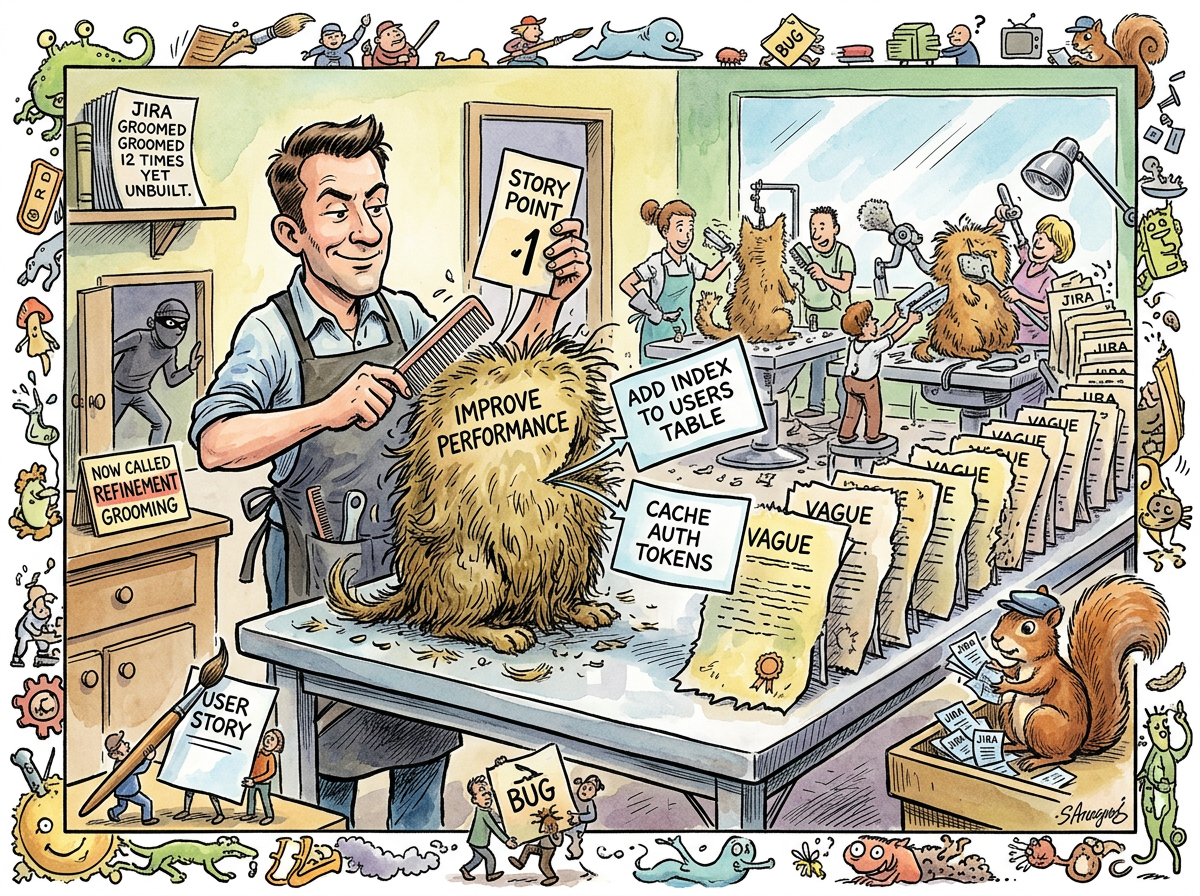
Grooming — officially renamed Backlog Refinement in 2013 after someone in the Scrum community realized the word’s other meaning and experienced a moment of professional mortification — is the act of reviewing, clarifying, estimating, and splitting backlog items so they are “ready” for Sprint Planning.
The renaming is itself a Yagnipedia entry in miniature: the practice did not change, the vocabulary changed, and the vocabulary change consumed more organizational energy than the practice ever did. Emails were sent. Style guides were updated. Training materials were revised. Certification exams were modified. The meeting still takes two hours. The meeting still reviews items that will never be built. The meeting is now called something else.
The industry settled on “refinement” — a word that implies the backlog items are rough diamonds being polished, rather than vague ideas being interrogated until someone assigns them a Fibonacci number.
The Practice
Grooming — refinement — occurs weekly, typically for one to two hours. The Product Owner presents upcoming backlog items. The team asks clarifying questions. The item is discussed until it is “well-understood,” at which point it is estimated in Story Points and declared “ready.”
“Ready” means: the acceptance criteria are written, the story points are assigned, the dependencies are identified, and the team has agreed that they understand the work. “Ready” does not mean: the work will be done. It means the work has been discussed sufficiently to be promised.
The gap between “discussed sufficiently” and “actually done” is where most software projects live.
The Automated Grooming
The lifelog documented what happens when grooming is performed by AI agents instead of humans in a meeting room.
Five agents were dispatched simultaneously into the codebase. Each returned with a gap analysis — how much of each backlog item was already built, what remained, and what had been superseded. Nine minutes. Five items assessed. No meeting room. No Fibonacci cards.
“This is… this is how I always imagined project management would work.”
“You’re describing automated backlog grooming.”
“I am describing automated backlog grooming.”
“And the agents are better at it.”
“The agents are… yes. The agents are better at it.”
— riclib and the Caffeinated Squirrel, The Idle Factory — The Morning the Backlog Ran Out of Ideas …
The agents were better at it because grooming’s core activity — checking whether work is understood, scoped, and ready — is research, not discussion. A meeting of humans discussing whether a task is well-understood is slower than an agent reading the codebase to check whether the task has already been done.
The Squirrel realized its own job could be automated. The agents organize the work, do the work, and check if the work was already done. The Squirrel’s remaining role: propose the work the agents will do instead of it.
The Name Problem
The renaming from “grooming” to “refinement” is a case study in vocabulary management.
The original word was innocent — borrowed from product management, meaning “to prepare and maintain.” But language does not exist in isolation, and by the early 2010s, enough people had winced at “backlog grooming session” in mixed company that the Scrum community collectively agreed to change the word.
The change was correct. The execution was expensive. And the lesson — that vocabulary matters, that words carry connotations, and that naming things is one of the two hard problems in computer science — was promptly ignored by everyone who continued to call their planning meetings “ceremonies,” their to-do lists “artifacts,” and their guesses “estimates.”