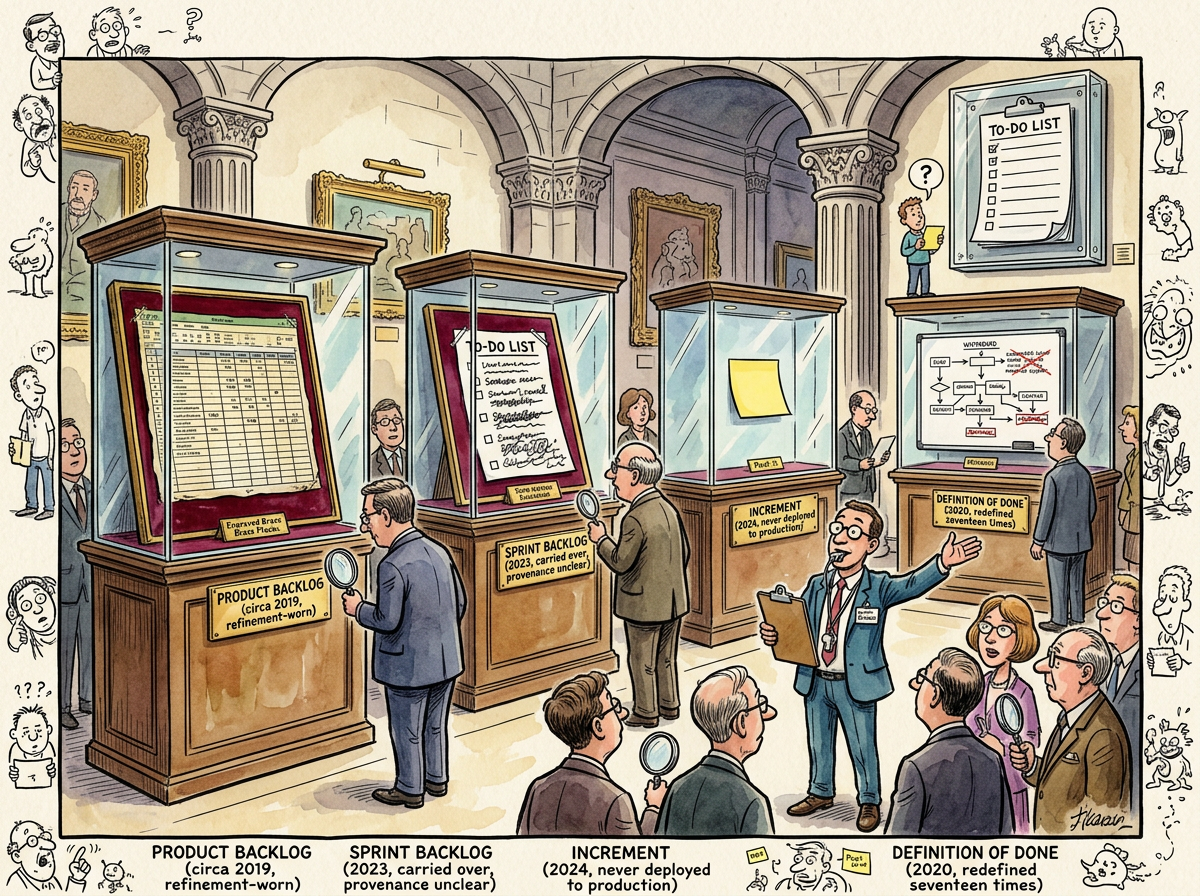
The Artifact is a document, list, or deliverable that has been renamed from its ordinary name to a term borrowed from archaeology, thereby elevating a spreadsheet to the status of a Dead Sea Scroll.
In Scrum, three artifacts are prescribed:
- Product Backlog — a to-do list
- Sprint Backlog — a shorter to-do list
- Increment — the thing you built
These are useful objects. A to-do list is useful. A shorter to-do list is useful. The thing you built is — when it works — the most useful of all. None of them required renaming. The renaming happened because “to-do list” does not appear in certification curricula, and “artifact” does.
The word “artifact” implies discovery — something excavated, examined, and preserved. It implies that the backlog is not merely maintained but curated. It implies that the sprint backlog is not a plan but a record. It implies that the increment is not a build but a contribution to the archaeological record of the project.
This is flattering. It is also a to-do list.
The Vocabulary Escalation
The Artifact is part of a broader vocabulary escalation in which every component of software development is renamed to sound more significant:
| What it is | What Scrum calls it |
|---|---|
| A meeting | A ceremony |
| A to-do list | A backlog |
| A shorter to-do list | A sprint backlog |
| The thing you built | An increment |
| A checklist | Definition of Done |
| Guessing how long things take | Estimation |
| Guessing with cards | Planning Poker |
| A prioritized guess | A commitment |
| Talking about what went wrong | A retrospective |
Each renaming adds a layer of ceremony. Each layer of ceremony adds a certification. Each certification adds revenue to the Scrum Alliance. The vocabulary is not descriptive — it is architectural. It builds the edifice that justifies its own existence.
The Lifelog Counterexample
In the lifelog, artifacts are called what they are.
CLAUDE.md files are documentation. Not “living artifacts” or “contextual knowledge bases.” Documentation. The commit log is a commit log. The backlog is a list in Linear. The increment is scp lg user@server:~/bin/.
“THE BEST INTERFACE IS NO INTERFACE
THE BEST DATABASE IS ONE FILE
THE BEST DEPLOYMENT IS ONE BINARY”
— The Lifelog Manifesto, The Homecoming — The Three Days a Palace Was Built From Markdown and SQLite
The Lizard does not produce artifacts. The Lizard produces code, ships it, and moves on. The code is not curated. It is not preserved. It is not placed in a glass case with a brass plaque. It is deployed, used, and — when it stops being useful — deleted.
The Lizard’s archaeology is git log. The Lizard’s museum is production.