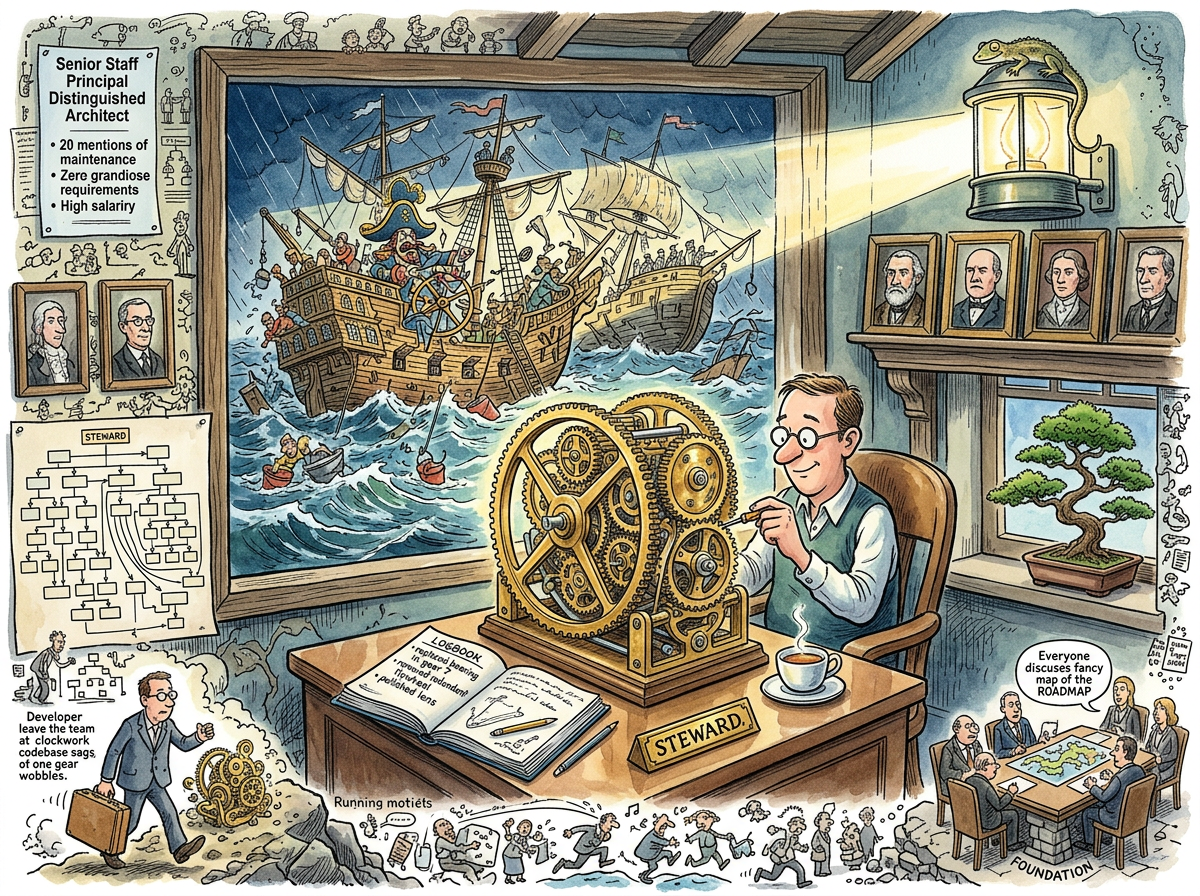
Code Stewardship is the practice of taking long-term responsibility for a codebase — not as an owner who extracts value, but as a steward who preserves it. The steward maintains what exists, removes what doesn’t serve, and ensures the system can outlast any single contributor, including themselves.
The software industry has no title for this role. It has Staff Engineer, Principal Architect, Distinguished Fellow, and seventeen other titles that describe seniority without describing care. The person who actually tends the codebase — who knows where the load-bearing assumptions live, who remembers why the migration was done that way, who notices when a convention is drifting — has no job title, no career ladder, and no roadmap slide.
They have a desk, a git log, and the specific stubbornness of someone who refuses to let a system they love become a system nobody understands.
“The steward is the person who, when they leave, the team discovers was holding everything together. The discovery takes about three sprints.”
— A Passing AI, reviewing departure patterns
The Role
Code stewardship is not code ownership. Ownership implies control, authority, a title on a document. Stewardship implies care, continuity, and the humility to maintain something that will outlast your tenure.
The steward’s responsibilities:
Remembering why. The codebase is full of decisions. Each decision had a reason. The reason is not in the code — the code shows what, not why. The commit message, if written well, captures the why for one decision. The steward carries the aggregate — the web of whys that connects decisions to each other, the architectural reasoning that spans twelve months of commits and doesn’t fit in any single one.
Noticing drift. Conventions decay. A pattern that was universal in December has three variations by March because three developers each implemented it slightly differently. The steward notices the drift. The steward doesn’t file a Jira ticket about the drift — the steward fixes the drift, in the same commit as the feature, because the fix takes four minutes and the ticket would take four meetings.
Carrying context across time. In December 2025, six lines of JavaScript were written for sidebar resize modes. The sidebar modes were deleted in January. The six lines survived, because the steward — who was also the author, in this case — recognised that the convention was generic and the feature was not. Three months later, those six lines became the foundation for AI context awareness across eleven editor panels. The steward carried the idea across time. The AI would have cleaned it up. The AI was right to clean up unused code. The AI was wrong in this specific case.
Saying no. The most important thing a steward does is refuse. Refuse the abstraction that isn’t needed yet. Refuse the framework that solves a problem that doesn’t exist. Refuse the feature that would make the codebase heavier than it needs to be. The steward says no the way a lighthouse keeper refuses to move the lighthouse — not out of stubbornness, but because the rocks haven’t moved and the ships still need the light.
THE STEWARD DOES NOT OWN
THE STEWARD DOES NOT CONTROLTHE STEWARD REMEMBERS
WHAT THE CODEBASE HAS FORGOTTENTHE STEWARD REFUSES
WHAT THE CODEBASE DOES NOT NEEDTHE STEWARD LEAVES
AND THE CODEBASE REMEMBERS
WHAT THE STEWARD TAUGHT IT— The Lizard, on the only role it respects
Stewardship vs. Ownership
The distinction matters because ownership is about authority and stewardship is about care. Authority can be assigned. Care cannot.
The code owner reviews pull requests, approves merges, and is listed in the CODEOWNERS file. The code owner has a badge on the repository and a notification in their inbox. The code owner may or may not understand the code. The code owner’s authority comes from a configuration file.
The code steward knows the code. Not from the CODEOWNERS file — from living in it. The steward has read the commit log back to the initial commit. The steward knows which patterns emerged organically and which were imposed by a senior engineer who left in Q2. The steward knows which tests are load-bearing and which are theatre. The steward’s authority comes from understanding, not assignment.
In a healthy team, the owner and the steward are the same person. In most teams, they are different people. The owner is whoever the org chart says. The steward is whoever stayed late to fix the thing that wasn’t anyone’s responsibility but was everyone’s problem.
“Every team has a steward. Most teams don’t know who it is until that person takes a vacation and the deploy breaks.”
— riclib
The Solo Developer
The Solo Developer is the purest form of code steward. Owner and steward and planter and pruner and tender, collapsed into one person. There is no gap between authority and care, because there is no org chart to create the gap.
The solo developer carries the entire context. Every decision’s why. Every convention’s origin. Every line’s purpose and every deleted line’s ghost. This is both the solo developer’s strength (no context is lost between people) and their vulnerability (all context is lost if they’re hit by a bus, which is the industry’s favourite hypothetical and the solo developer’s favourite thing to not think about).
The stewardship problem in a solo project is not “who cares” — the solo developer cares, or the project wouldn’t exist. The stewardship problem is succession: encoding the care into the codebase itself so that the next person can find the load-bearing assumptions without the steward’s narration.
Good commit messages. Clear conventions. Self-evident data structures (see Pike’s Rules). A CLAUDE.md file that says not just what but why. These are acts of stewardship — gifts from the present steward to the future one.
The Enterprise Vacancy
Enterprise codebases do not have stewards. They have:
Maintainers — who fix bugs. Maintenance is reactive. Stewardship is proactive. The maintainer responds to the alert. The steward prevents the condition that causes the alert.
Architects — who design the next system. Architecture is forward-looking. Stewardship is present-tending. The architect draws the blueprint for the building that will replace the garden. The steward waters the garden that exists.
Tech leads — who manage the team that works on the code. Leadership is about people. Stewardship is about the code itself. The tech lead ensures the developers are productive. The steward ensures the codebase is habitable.
Nobody — who carries context across team rotations. The steward’s most irreplaceable function — remembering why, noticing drift, carrying conventions across time — requires continuity. Enterprise teams rotate. The average tenure on a codebase is eighteen months. The steward’s job requires years. The org chart allows months. The gap is where context goes to die.
“The enterprise has architects who design what it should become, maintainers who fix what it currently does, and nobody who remembers what it already knows.”
— A Passing AI
Stewardship in the LLM Age
LLMs do not change the need for stewardship. LLMs intensify it.
The LLM writes four thousand lines in a day. Each line is a decision. Each decision should have been navigated (see Vibe Engineering). But even navigated decisions accumulate. The conventions from three months ago need someone to notice they’ve been superseded. The patterns from last week need someone to feel that they’re heavier than they should be. The six-line convention from December needs someone to carry it across the deletion of its original purpose into the March feature that nobody imagined.
The LLM cannot steward. The LLM has no continuity between sessions. The LLM does not remember that the for-loop survived the sidebar deletion. The LLM does not know that the convention is load-bearing because the steward chose to keep it when everything around it was deleted.
The LLM is the most capable contributor who has ever had zero institutional memory. This makes the human steward more essential, not less. The steward carries the context that the LLM cannot. The LLM executes the decisions that the steward makes. The division of labour is clean: the machine does the work, the human carries the meaning.
The Three-Sprint Revelation
The standard discovery of stewardship’s value follows a predictable pattern:
Sprint 1 (after steward departs): Everything works. The team doesn’t notice anything different. The deploy pipeline runs. The tests pass. The steward’s absence is invisible.
Sprint 2: A convention drifts. Two developers implement the same pattern differently. A dependency update breaks something that the steward would have caught in review. The team fixes it. Nobody connects it to the departure.
Sprint 3: The accumulated drift surfaces as friction. The build is slower. The tests are flakier. A new feature touches code that nobody on the current team wrote or understands. The feature takes three times longer than estimated. Someone says, “Didn’t this used to be simpler?” Someone else says, “Ask [steward’s name].” Someone else says, “[steward’s name] left two months ago.”
The codebase didn’t change. The steward’s absence revealed what the steward had been doing — which was everything that doesn’t fit in a Jira ticket, doesn’t appear on a roadmap, and doesn’t have a career ladder.
Measured Characteristics
Job titles containing "steward":              0 (in all of software)
Job titles containing "architect":            47,000+ (LinkedIn, March 2026)
Correlation between title and care:           inverse

Time to notice a steward's presence:          never (their work is invisible)
Time to notice a steward's absence:           3 sprints (±1)

Context carried by a steward:                 years of decisions + their reasons
Context carried by a CODEOWNERS file:         a list of GitHub handles
Context carried by an LLM:                    one session

Enterprise codebase stewards:                 0 (by title)
                                              0-1 (by practice, unpaid, unrecognised)
Solo developer stewards:                      1 (always, by definition)

Steward departure consequences:
  Sprint 1:                                   nothing visible
  Sprint 2:                                   drift begins
  Sprint 3:                                   "didn't this used to be simpler?"
  Sprint 6:                                   rewrite proposed
  Sprint 12:                                  rewrite reaches critical mass

Career advancement for stewardship:           none
Career advancement for proposing a rewrite:   promotion
This incentive structure is:                  the entire problem
See Also
- Tending — The practice. Stewardship is the role.
- The Software Garden — The metaphor that implied stewardship but forgot to name it
- Critical Mass — What happens when the steward leaves and nobody replaces them
- Technical Debt — What the enterprise calls the steward’s absence
- Technical Debt Repayment — The ritual the enterprise performs instead of hiring a steward
- Solo Developer — The purest steward: owner, tender, and keeper in one
- Coding with LLMs Map of Content — The steward carries what the LLM cannot: context across time