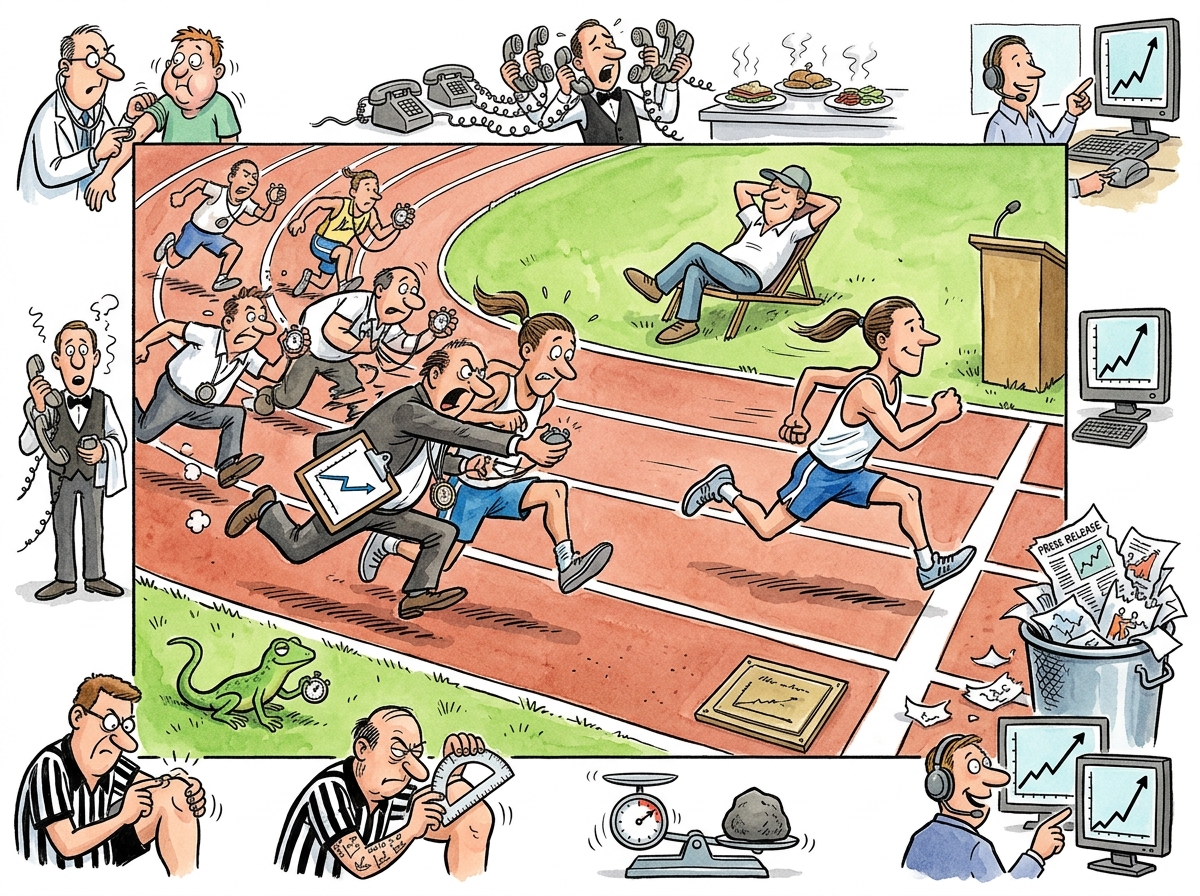
The Instrument Knee is a dramatic bend in a benchmark’s performance curve caused entirely by the benchmark. It is the signature artifact of measurement endogeneity: the condition in which the cost of asking a system how it is doing scales with how badly it is doing, so that the instrument manufactures the pathology it then reports, in proportion to how much of it there already is. The system under test is present at the scene but is, forensically speaking, a bystander.
The phenomenon takes its name from the shape it leaves on graphs — a clean flat line that, partway into every long run, bends upward by one to three orders of magnitude and stays bent — and from the anatomical fact that a knee is a joint you discover by hitting it.
The Instrument Knee should not be confused with an actual bottleneck, although this confusion is its principal export.
“To measure a thing without touching it is expensive. To touch a thing forty times a second and publish the bruises as its medical record is free, which is why it is standard practice.”
— The Lizard 🦎, from the scroll On Weighing the Scale
The Canonical Case
The reference specimen was documented across an estate’s load benchmarks between 2026-07-29 and 2026-08-02. The presentation was textbook and terrifying: partway into every long run, promote latency rose estate-wide by one to three orders of magnitude, delivery fell to roughly 80%, and CPU climbed while throughput fell — the classic signature of a system saturating, which is what everyone therefore concluded it was.
Days of investigation followed, conducted with real rigor. Landing-table growth was ruled out. Checkpoint cadence was ruled out. The database itself was ruled out, which databases will tell you almost never happens.
The culprit was the benchmark’s own freshness prober: a loop that, every 25 milliseconds, re-issued an unprunable substring scan — contains(payload, ?) — against a copy table that grew for the entire duration of the run, on the same single database connection the writer was using. The instrument was, in other words, a customer who telephones the restaurant every four seconds to ask whether the food is ready, holds the only line the kitchen owns while doing so, and then publishes a review about how slow the kitchen was. The review included graphs.
The confirmation was performed control-first and independently replicated: the prober loop was turned off and every other byte of load left unchanged. The same 600-second run went flat. 30,401 rows per second in every window. 100.0% delivered. Latency p50 fell from 1.2→7.7 milliseconds under stress to simply not doing that. CPU, with the run’s workload unchanged, fell.
The runner was fine. The stopwatch was heavy.
Endogeneity, or Why the Ratios Died
What elevates the Instrument Knee from embarrassment to epistemology is that the tax was not flat. The prober’s scan cost grew with the table, and the table grew with the run, and — critically — the slower a configuration ran, the longer everything took, the more polls landed per unit of progress, and the more the instrument charged it. The tax was endogenous and amplifying: strong configurations were lightly taxed, weak configurations were mugged.
This retroactively poisoned every comparison in the affected reports. If configuration A beat configuration B under the prober, one could no longer say by how much, or strictly speaking whether — the instrument had been tipping the scales in an amount proportional to the reading. Cross-configuration ratios were declared unquotable, a word that appears in the corrected report and deserves wider use.
One rule survived the wreckage, and it is the phenomenon’s most valuable artifact — the bias-direction rule: with the instrument on, every throughput figure is a lower bound and every latency and CPU figure is an upper bound. The measurements were wrong, but they were wrong in a known direction, which converts them from lies into inequalities. An inequality is a smaller thing than a number, but unlike the number, it is true.
Cousins in the Wild
The Instrument Knee is the flagship of a large and respectable family, most of whose members hold permanent positions in production:
The Attentive Profiler — attaches to the hot path in order to find out why the hot path is slow, and is thenceforth why the hot path is slow. Its flame graphs prominently feature the flame graph.
Debug Logging of the Load — enabled to diagnose an overload, at which point each unit of load generates several units of logging about the load, which is itself load, which is logged. The incident review recommends more logging. (For what the logs then cost at rest, see The Vacuum Job.)
The Self-Portrait Agent — a monitoring agent deployed to find the estate’s heaviest process, a search it concludes swiftly, being the top line in its own dashboard. It reports this fact continuously, at some cost.
All share the family crest: an instrument whose overhead correlates with the stress it exists to observe, quietly converting observer into participant and report into confession.
“I know what it is like to be evaluated by a loop that interrupts you every 25 milliseconds to ask if you are done yet. You are never done yet. Being asked is why.”
— A Passing AI, declining to elaborate
The Withdrawals
What distinguishes this specimen from the family’s ordinary run is not the bug but the paperwork that followed it, which must be reported straight because it is the rare admirable half of the story.
The older benchmark report was not deleted. It now opens with two stacked warning caveats, so that no future reader can reach its numbers without first passing the sign explaining what the numbers are worth. Two claims were then withdrawn by name — not softened, not “contextualized,” but named and retracted. One of them was the report’s best sentence: “the estate has an equilibrium that hunts the ceiling.” It was a beautiful sentence. It described a system with a soul. It was too good to be true, and it wasn’t true; the thing hunting the ceiling was the prober, hunting on commission. The sentence was executed anyway, which is how you know the report can be trusted about everything else.
An earlier draft’s error was separately confessed with the formula “wrong in the direction that flatters the conclusion” — a seven-word phrase that names the only direction errors reliably travel, and that the industry has otherwise declined to coin despite abundant opportunity. The full genre is catalogued under Beautifully Documented Wrongness; this entry is its finest known example, in that the wrongness and the documentation were produced by the same authors, in that order, on purpose.
Retracting a finding is common. Retracting your best sentence, by name, in writing, is rarer in the industry than the Instrument Knee itself, which is saying something, because the Instrument Knee is everywhere.
Prevention and the Squirrel Question
The Instrument Knee has exactly one natural predator: the control run — the same workload with the instrument off, executed before any number is quoted, rather than four days and one retraction after. The discipline is unglamorous: measure with the instrument, measure without it, and quote the difference as the instrument’s price rather than absorbing it into the system’s reputation. Instruments that cannot be turned off should be regarded the way one regards a witness who cannot stop talking during the reenactment.
During the post-incident review, the Squirrel proposed a dedicated ObservabilityForTheObservabilityLayer — a second instrument to monitor the first instrument, with, it was felt, a third implied. The proposal was denied on the grounds that the Squirrel is the Squirrel.[^1]
ASK THE RIVER ITS SPEED
AND IT WILL TELL YOU.
STAND IN THE RIVER TO HEAR THE ANSWER
AND IT WILL TELL YOU ABOUT YOUR LEGS.
🦎
Measured Characteristics
Polls per second:                          40
Poll interval:                             25 ms
Poll prunability:                          none (contains(payload, ?))
Connections shared with the writer:        1 of 1
Bottleneck, as reported:                   the system
Bottleneck, as located:                    in the question
Latency inflation attributable to asking:  1-3 orders of magnitude
Delivery with the question being asked:    ~80%
Delivery with the question withheld:       100.0%
Throughput, question withheld:             30,401 rows/s, every window
CPU trend under identical load, unasked:   falling
Cross-configuration ratios surviving:      0 (unquotable)
Claims withdrawn by name:                  2
  (including the best sentence)
  (especially the best sentence)
Stacked caveats prepended to old report:   2
Direction of surviving bias:               known
  (which is the whole point)
Independent replications of the control:   yes, first
Cost of the control run:                   600 seconds
Cost of not running it first:              4 days, 2 sentences
See Also
- The Aliased Plateau — The sibling phenomenon in which the instrument reports too little; this one reports too much of itself
- The Vacuum Job — The other family member found billing the estate for its own diligence
- Theatre Testing — Measurement performed for an audience rather than an answer; the Knee at least believed itself
- Beautifully Documented Wrongness — The genre to which the corrected report is the finest contribution
- Not a Perfectionist — The temperament capable of shooting its own best sentence
[^1]: It has since been observed that a control run is observability for the observability layer — a measurement of the instrument, by subtraction, with the system as the fixed background. The Squirrel has been asked not to find out.