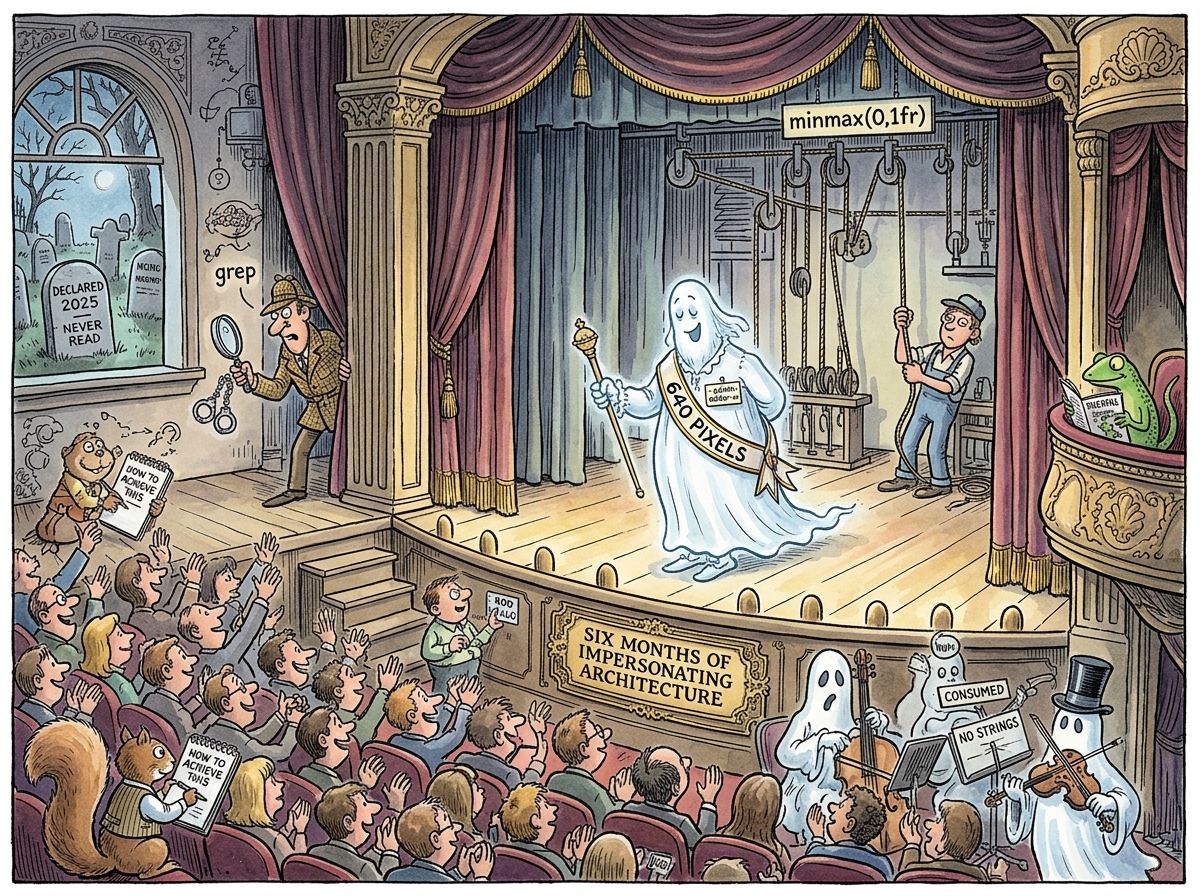
The Ghost Variable is a named value that is declared with confidence, documented with authority, maintained with diligence, and consumed by absolutely nothing. It differs from dead code in one crucial respect: dead code is at least suspected. The ghost variable enjoys a reputation. It appears in the design system. It has a comment. Colleagues believe in it. It has, on occasion, been carefully updated during refactors — its value adjusted, its name improved, its section of the file alphabetized — by engineers who never once checked whether anything, anywhere, reads it.
The ghost variable does not break anything, which is precisely the problem. Broken things get fixed. The ghost variable works, in the sense that a decorative thermostat works: turning it produces a deeply satisfying click and no heat whatsoever.
“Even I have never proposed a variable that does nothing. Declared everywhere. Consumed nowhere. It’s… it’s beautiful.”
— The Caffeinated Squirrel, The Lake Made Visible, in a rare moment of professional humility
Taxonomy of Spectral Values
The Ghost (classic) — declared, never consumed. The canonical specimen is a CSS custom property named something like --admin-editor-w, set to 640px in a design-tokens file, radiating architectural intent, while the actual layout is governed by a minmax(0, 1fr) that has never heard of it. Documented cases show ghosts surviving six months and multiple design reviews before an engineer, attempting to narrow a sidebar by setting the variable to 400, discovered that the sidebar had opinions of its own.
The Zombie — consumed, but its value is immediately overridden by something with higher specificity. Technically alive. Functionally decorative. Distinguished from the Ghost by the fact that deleting it produces one (1) observable change, somewhere, usually in Safari.
The Poltergeist — consumed exclusively by dead code. The variable is read, faithfully, by a function nothing calls. Two spectral entities sustaining each other in a closed afterlife economy. Removing either one is safe; removing both feels like an exorcism and should be logged as one.
The Séance — a configuration value that operators genuinely believe controls production behavior, and adjust during incidents, with results attributed to it by coincidence. The Séance is the most dangerous form, as it accumulates runbook citations.
Lifecycle
The ghost variable is born honest. Someone intends to consume it — the consumption is in the next commit, or the next sprint, or the design doc. Then the consuming code takes a different path (a hardcoded value, a different mechanism, a 1fr that seemed fine at the time), and the declaration remains, orphaned at birth and never informed.
It survives through plausibility. It is named exactly like something that would exist. Reviewers see it and nod. New engineers learn it as part of the system. In mature cases, the ghost develops documentation, at which point it is effectively tenured.
Death comes only by measurement: someone finally changes the value and watches for the effect. This is rarer than the industry cares to admit. The recorded exorcism rite is a single grep, executed months late, followed by the traditional incantation: “it’s declared but consumed nowhere,” spoken aloud to an empty room.
In codebases practicing Tending, the ghost receives a grave marker — a comment recording what it was and why it is gone — which is the highest honor a dead thing can receive there. In all other codebases, it receives a new value during the next rebrand.
Measured Characteristics
Confidence radiated per declaration:              absolute
Effect on rendered output:                        0
Months of successful architecture impersonation:  6 (median, documented case)
Refactors survived:                               all of them
Reviews in which somebody checked consumption:    0
Greps required for exorcism:                      1
Greps actually performed:                         eventually
Satisfying clicks per adjustment:                 1
Heat produced:                                    none
Ghosts reading this entry and feeling seen:       --admin-editor-w
See Also
- YAGNI — The principle whose violation creates most ghosts
- The Review Gate — The checkpoint that asks the question nobody asked
- The Lake Made Visible — The exorcism, as it happened
- The Cathedral — Where several ghosts are believed to hold up the roof