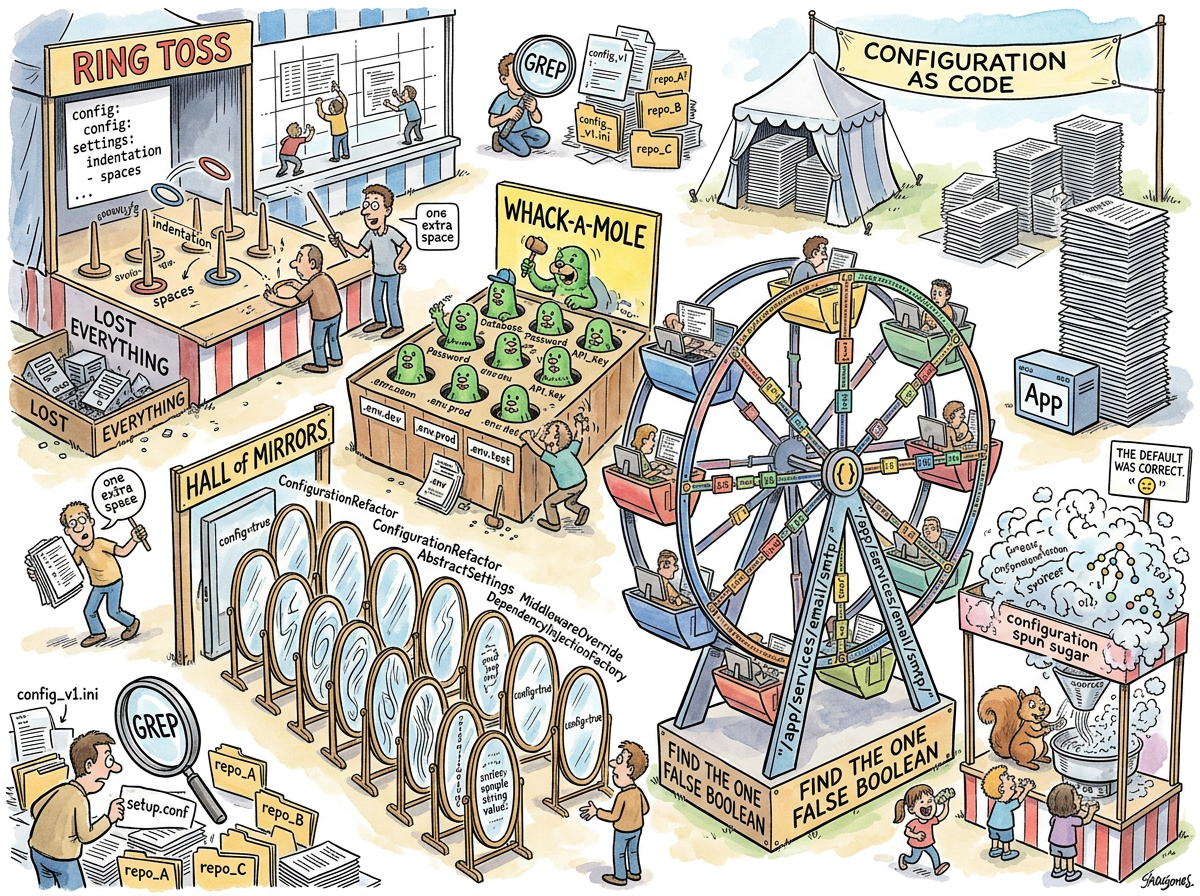
The Configuration Carnival is the anti-pattern in which a system’s configuration grows to exceed its source code in complexity, volume, and bug density — the point at which the application is no longer a program with settings but a settings file with a program attached.
The Carnival begins innocently. A developer extracts a hardcoded value into a configuration file. This is good practice. The value might change. It should be configurable.
Then a second value is extracted. Then a third. Then the database connection string, the API timeout, the retry count, the feature flags, the logging level, the cache TTL, the thread pool size, the batch limit, the rate limit, the circuit breaker threshold, and — in what future archaeologists will identify as the point of no return — the name of the configuration file itself, which is now configurable via an environment variable that points to a configuration file that specifies which configuration files to load.
“I evaluated HTMX. And rejected it.”
— The Caffeinated Squirrel, who once proposed a configuration system with seven layers of override precedence, The Framework That Wasn’t, or The Night the Squirrel’s Manifesto Shipped as Six Lines of HTMX
The Seven Layers of Override
The Configuration Carnival reaches its mature form when a single value can be set in seven or more locations, each overriding the previous:
- Default in code — the value the developer chose, which was correct
- Config file — the value someone changed, for reasons lost to time
- Environment-specific config — the value for staging, which differs from production for reasons nobody can explain
- Environment variable — the value set on the server, which overrides the config file, unless it doesn’t
- Command-line flag — the value passed at startup, which overrides everything, except the next layer
- Remote config service — the value fetched from Consul/etcd/Vault at runtime, which may or may not have propagated yet
- Feature flag service — the value controlled by a product manager who doesn’t know it’s also controlled by six other mechanisms
When a bug is reported, the developer must check all seven layers, in reverse override order, across multiple environments, to determine which value the system is actually using. This process takes longer than writing the feature the value controls.
The YAML Dimension
The Configuration Carnival found its ultimate expression in YAML, a serialization format whose sensitivity to whitespace means that a single misplaced space can change the meaning of an entire file, and whose type coercion means that the string “no” becomes the boolean false, the string “1.0” becomes the number 1, and the country code for Norway becomes falsy.
Kubernetes elevated YAML configuration to an art form. A simple deployment — one container, one port, one replica — requires a minimum of 30 lines of YAML. A production deployment with health checks, resource limits, volumes, secrets, service accounts, and affinity rules requires approximately 200 lines. The application being deployed may contain fewer lines than its deployment manifest.
This is The Configuration Carnival’s terminal stage: the carnival has consumed the town.
The Hardcoded Heresy
The most effective cure for the Configuration Carnival is also the most socially unacceptable: hardcoding.
Hardcoded values cannot be overridden from seven locations. Hardcoded values cannot drift between environments. Hardcoded values cannot be misconfigured by a product manager with access to LaunchDarkly. Hardcoded values are visible in the source code, version-controlled, code-reviewed, and tested. They are, by every engineering metric, superior to configurable values — for values that do not actually need to change.
The heresy is this: most values do not actually need to change. The database port is 5432. It has always been 5432. It will always be 5432. Making it configurable does not add flexibility. It adds a place for bugs to hide.
YAGNI whispers: if the value has never changed, it doesn’t need to be configurable. The developer hears YAGNI. The developer agrees with YAGNI. The developer makes it configurable anyway, because “what if someone needs to change it?” Someone never does. But the configuration option remains, forever, in seven layers.
Measured Characteristics
- Average configuration files per enterprise application: 14
- Average layers of override: 4–7
- Time to determine actual runtime value of one config key: 15–45 minutes
- Values that have never been changed from their default: ~80%
- Values that are configurable “just in case”: ~60%
- Bugs caused by configuration drift between environments: ~25% of production incidents
- Lines of YAML per Kubernetes deployment: 30–200
- Lines of application code deployed: often fewer
- The default was correct: almost always