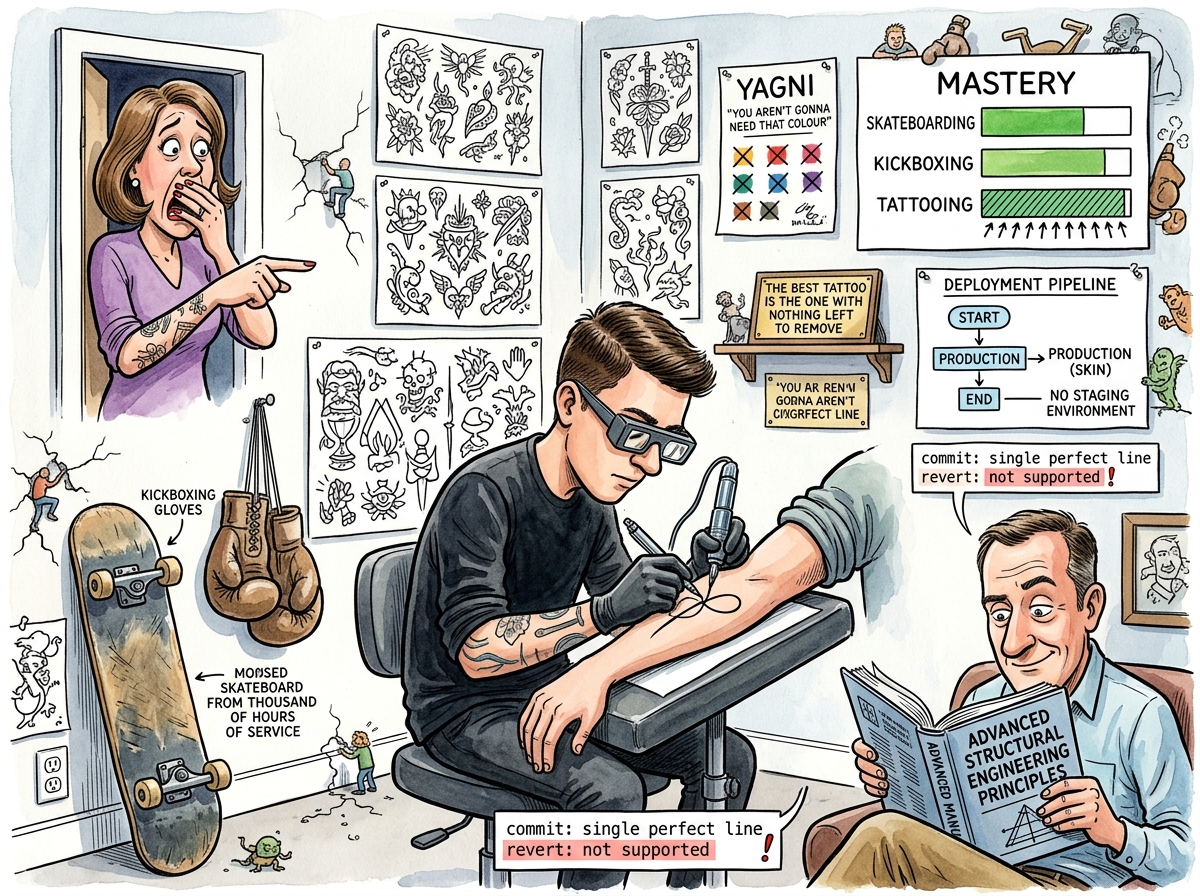
Tattoo Art is the practice of deploying pigment directly to the dermis — the production environment of the human body — using a needle oscillating at approximately 150 times per second. It is the only art form with no undo, no staging environment, no rollback strategy, and no version control. Every stroke is a commit to main. Every commit is a force push. The deployment target is alive, bleeds, and has opinions.
This makes tattooing the highest-stakes art form that does not involve explosives.
“No test environment. No staging. No dry run. Every mark is production. This is either the purest form of craftsmanship or the most terrifying — and the answer is yes.”
— The Lizard, who respects anything with zero margin for error
The Collision
riclib is an engineer who believes the best interface is no interface, the best database is one file, and the best deployment is one binary. Strip everything unnecessary. Ship only what matters. YAGNI as a way of life.
His mother is an artist. The kind of person who sees colour and shape and composition in the spaces between things, who understands that beauty is not decoration but structure.
Their son inherited both lineages. The engineering instinct that says remove what you don’t need and the artistic instinct that says what remains must be beautiful. These two forces spent eighteen years orbiting each other in a single person, and the inevitable collision produced a tattoo artist who works exclusively in black. No colour. No shading gradients. No fill. Just line. Clean, minimal, permanent line.
The collision was, in retrospect, as predictable as gravity. The engineer’s son who is also the artist’s son was always going to find a medium where simplicity is not a limitation but a discipline, where less is more is not a platitude but a needle, and where YAGNI is not a software principle but a skin principle.
You Aren’t Gonna Need That Colour.
The 10,000 Hours Algorithm
riclib’s son does not believe in talent. He believes in hours.
First, he became a skater. Not a person who skates — a skater. The kind who does the same trick five hundred times until the board is an extension of the nervous system. The kind who gets up from concrete so many times that falling becomes a subroutine the body handles without consulting the brain. The 10,000 hours were not a theory. They were a schedule.
Then he became a kickboxer. Same algorithm, different input. The same relentless, grinding accumulation of hours until the body knows what to do before the mind has finished deciding. Repetition as mastery. Mastery as identity. Identity as something you build, not something you have.
Then he became a tattoo artist.
The reader may notice the pattern. The pattern is the point. He discovered the mastery algorithm early — the one that says there is no shortcut, no hack, no talent that substitutes for ten thousand hours of deliberate practice — and he keeps applying it to new substrates. Skateboard. Body. Skin. The substrate changes. The algorithm does not.
“He found the loop and never broke out of it. WHILE(alive) { master(nextThing); } — no exit condition, no off-by-one error, just relentless iteration. I respect the absence of a break statement.”
— The Caffeinated Squirrel, briefly calm
This is not the Squirrel’s typical approach. The Squirrel wants to master everything simultaneously, in parallel, with a framework. riclib’s son’s approach is sequential, single-threaded, and brutal: one thing at a time, ten thousand hours each, no shortcuts. It is the for loop that the Squirrel cannot write because the Squirrel cannot stop adding goroutines.
The YAGNI of Colour
A colourless tattoo is a YAGNI violation that didn’t happen.
Most tattoo artists reach for colour the way most developers reach for dependencies: because it’s available, because the client might want it, because the portfolio looks more impressive with it, because what if we need it later?
His answer is the same answer riclib gives to the developer proposing a plugin system for an application with one plugin: you don’t need it.
Colour fades. Black endures. Colour requires more passes, more healing time, more maintenance, more touch-ups. Black line is the monolith that works. Colour is the forty-seven microservices that look good on the Grafana dashboard but respond in 2.3 seconds.
The colourless tattoo is the single binary. The one-file database. The deployment that needs no Docker, no orchestration, no colour management. It is the bootblock philosophy applied to skin: what can you achieve with the minimum? What remains when you remove everything that isn’t load-bearing?
What remains is the line. The line is enough. The line was always enough.
The Horror
His mother experiences genuine horror each time her son arrives with a new tattoo on himself.
This is important to document because the horror is real. It is not performative. It is not a cultural artifact. It is the authentic, visceral response of a mother confronting the fact that her child has voluntarily and permanently altered the body she spent nine months building. The body she checked for ten fingers and ten toes. The body that was, briefly, perfect and unmarked and entirely hers.
Each new tattoo is a diff she did not approve. Each new tattoo is a commit to a repository she does not have write access to. The horror is the horror of a stakeholder watching production changes deploy without a review process.
riclib’s horror is different.
riclib’s horror is feigned. riclib performs horror the way a developer performs surprise when the architecture they secretly designed gets “independently proposed” by the team. The eyebrows go up. The head shakes. The words “another one?” emerge with carefully calibrated disapproval.
Underneath the performance — underneath the raised eyebrows and the theatrical sigh — riclib is looking at his son’s clean black lines and seeing the manifesto. The best interface is no interface. The best colour is no colour. The best tattoo is the one with nothing left to remove.
The pride is secret. The pride is enormous. The pride is the quiet recognition that the philosophy he burned into his own muscle memory in a 488-byte bootblock has somehow propagated — not through teaching, not through lecture, not through a whiteboard with a lizard drawn on it — but through being. The son watched the father strip everything unnecessary, and the son strips everything unnecessary, and the medium is skin instead of silicon, and the tool is a needle instead of a compiler, and the principle is the same.
riclib will never say this out loud. This article will.
“The father types. The son tattoos. Both of them are writing the same thing: only what matters, nothing more. The mother provides the horror. Every production deployment needs a stakeholder who cares enough to scream.”
— The Lizard, who notices inheritance patterns
The No-Rollback Principle
Every other craft permits undo.
The painter can gesso over the canvas. The developer can git revert. The writer can delete the paragraph. The sculptor can add more clay. The architect can revise the blueprint before the concrete is poured. Every creative discipline has a staging environment — a place where mistakes are cheap, where iteration is free, where the cost of being wrong is measured in time, not permanence.
Tattooing has no staging environment.
The skin is production. The needle is the deployment. The ink is the commit. There is no git revert. There is no rollback. There is only forward, and forward is forever, and this is why the 10,000 hours matter.
A developer who deploys to production without tests is reckless. A tattoo artist who deploys to skin without 10,000 hours of practice is something worse — they are permanently reckless, on someone else’s body, with no way to undo the damage.
The 10,000 hours are not perfectionism. They are not obsession. They are the test suite. They are the CI pipeline. They are the only quality assurance available in a medium where the production environment heals around your mistakes and carries them forever.
The Art of Restraint
There is a particular discipline in choosing to work with less.
riclib chose Go over the languages that offer more. Chose SQLite over the databases that scale further. Chose one binary over the architectures that distribute wider. Each choice was a bet that restraint produces better results than abundance — that the constraint is the invitation, not the obstacle.
riclib’s son chose black over the full spectrum. Chose line over fill. Chose simplicity over complexity. Each choice is the same bet, placed on a different table, with the same confidence.
The Lizard would note that this is not coincidence. The Lizard would note that the instinct for restraint is not taught but inherited — not in the genetic sense, but in the deeper sense of watching someone live a certain way and absorbing, below the level of conscious imitation, that this is how things should be done.
The Lizard would note this, and then the Lizard would say nothing further, because the Lizard practices restraint too.
Measured Characteristics
Deployment target:                         dermis (production)
Staging environment:                       does not exist
Rollback strategy:                         does not exist
Colours used:                              1 (black)
Colours available but declined:            all of them (YAGNI)
Disciplines mastered via 10,000 hours:     3 (skating, kickboxing, tattooing)
Hours per mastery:                         10,000 (no shortcuts, no frameworks)
Mastery algorithm:                         WHILE(alive) { master(nextThing); }
Break statement:                           none
Mother's horror level per new tattoo:      genuine, consistent, undiminished
Father's horror level per new tattoo:      feigned
Father's pride level per new tattoo:       enormous (classified)
Lines of the manifesto visible in son:     all three
Times riclib has said this out loud:       0
Times this article has said it:            1
The best tattoo:                           the one with nothing left to remove
Frogs dissected in writing of article:     0 (the needle was enough)
See Also
- YAGNI — The principle that became an art philosophy
- riclib — The engineer whose manifesto propagated through being, not teaching
- Boring Technology — Black ink. One needle. No framework. Beautiful results.
- Simplicity — The thing that remains when you remove everything unnecessary
- The Lizard — Who recognises inheritance patterns and says nothing