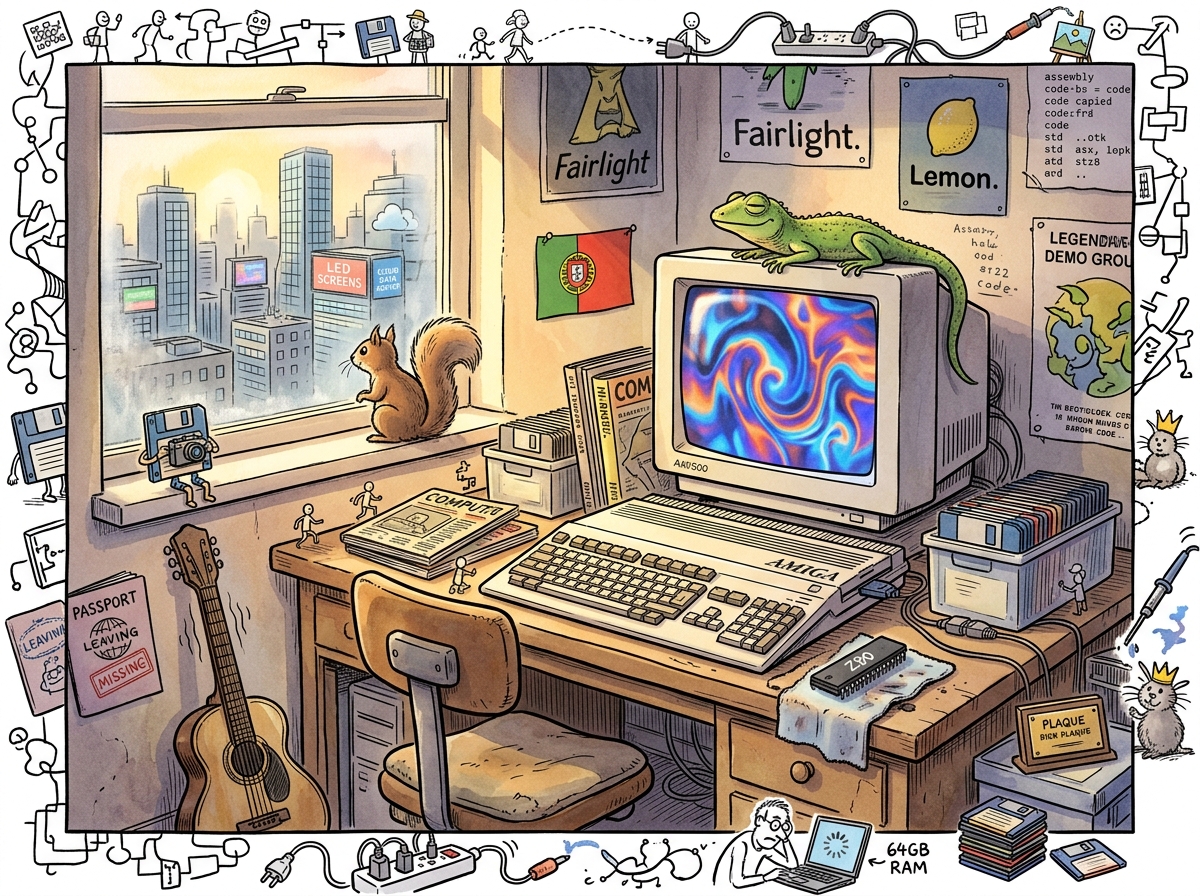
Saudade (Portuguese: [sɐwˈdadɨ]) is a deep emotional state of melancholic longing for something that one loved, that is gone, and that nothing has replaced. It has no direct translation into any other language, which is itself a form of saudade — the Portuguese carry a feeling so specific that the rest of the world cannot even name it.
Saudade is not nostalgia. Nostalgia romanticises. Nostalgia puts a filter on the past and makes it glow. Nostalgia says: it was better then. Saudade says something more precise and more painful: it was beautiful then, it is gone now, and nothing that came after is the same thing. Saudade does not claim the past was better. Saudade acknowledges that the past was genuinely beautiful and that its absence is genuinely felt and that these two facts will coexist, unresolved, for the remainder of the experiencer’s life.
The Portuguese invented a word for this because they feel it more than anyone else, possibly because they are a nation of people who keep leaving home and then missing it. Five centuries of maritime exploration produced a civilisation that is constitutionally incapable of being somewhere without aching for somewhere else. This is not a bug. This is the operating system.
The Feeling That Cannot Be Compiled
In software engineering, saudade manifests as the specific ache a developer feels for a machine, an era, or a way of working that is irrecoverably gone — not because it was objectively superior (it was not), but because it was yours in a way that modern technology cannot be.
The Amiga is saudade. Not because the Amiga was a better computer than a modern MacBook Pro with 64GB of unified memory and an M-series chip that could run the entire Amiga software library in an emulator tab while simultaneously compiling a Go binary and serving a blog. The Amiga was not better. The Amiga had 512 kilobytes of chip RAM and a 7.14 MHz processor and crashed if you looked at it wrong. The Amiga is saudade because it was comprehensible. You could hold the entire machine in your head — every custom chip, every DMA channel, every copper list cycle. You understood it completely. It was yours in the way that a musical instrument is yours: not because you own it, but because you and it have a private language.
A modern computer cannot be yours in this way. A modern computer has seventeen layers of abstraction between you and the hardware, each layer maintained by a different team, each team using a different framework, each framework deprecated before you learned the previous one. You do not understand a modern computer. You use a modern computer. The difference is saudade.
“I remember every register. Every cycle. Every timing constraint of the copper. I cannot remember what version of Node is current. Both of these facts are correct, and neither is the one that hurts.”
— riclib, who carries saudade like a second passport
The Demo Scene: Beauty That Knew It Was Temporary
The demo scene is the purest expression of saudade in computing, because the demo scene was always aware that it was ephemeral.
A demo was a programme that did impossible things with limited hardware — copper effects that the custom chips were never designed to produce, sample playback on machines with no audio codec, 3D rendering on processors that could barely multiply. The demo existed to prove that beauty was possible within constraints, and the constraints were the point, and when the constraints were removed by faster hardware, the beauty changed into something else — something technically superior and emotionally different.
A demo on an Amiga 500 with 512K of chip RAM is not the same as a demo on a GPU with 16GB of VRAM. Both are beautiful. But the first one is beautiful and impossible, which is a compound that produces saudade when the impossibility is no longer required.
The demo sceners knew this. They competed fiercely, released their work at parties that lasted three days, and then moved on — to PCs, to jobs, to lives that did not involve counting copper cycles at 4 AM. They did not romanticise the era while it was happening. They were too busy. The saudade came later, when they looked back and realised that the combination of constraint, community, and creative desperation that produced those demos would never exist again, because the constraints had been removed, the community had dispersed, and the desperation had been replaced by comfort.
Comfort is the enemy of saudade. You cannot ache for something you still have.
The Z80, the 68000, and the Architecture of Loss
Z80 Assembly is saudade. The Z80’s register set was idiosyncratic, its instruction encoding was byzantine, and its addressing modes were a historical accident of Intel 8080 compatibility. Programming the Z80 was a fight. But it was your fight. You memorised the opcodes. You knew that DJNZ was 10 xx and that LD A, (HL) was 7E and that the undocumented IX half-registers worked even though Zilog pretended they didn’t. The Z80 was difficult in a way that created intimacy. You and the processor had a relationship that was earned, byte by byte.
The 68000 was the opposite kind of saudade. The 68000 was elegant. Orthogonal. Beautiful. Programming the 68000 felt like the machine respected you. Where the Z80 fought you and you loved it for the fight, the 68000 cooperated with you and you loved it for the grace. Both are gone. Both are saudade. The ache is the same; only the flavour differs.
Modern processors are not saudade. Not because they are bad — they are extraordinary — but because you cannot know them. The M4 chip in a current MacBook contains more transistors than every Z80 and 68000 ever manufactured combined. It has execution units you will never see, prediction logic you cannot influence, and cache hierarchies that operate entirely without your knowledge or consent. It is magnificent and alien. You do not have a relationship with it. You have a dependency on it. Dependencies do not produce saudade. Relationships do.
Saudade Is Not Nostalgia
This distinction matters and must be made precisely, because the internet is full of nostalgia for old computers and almost none of it is saudade.
Nostalgia says: “Remember the Amiga? That was awesome. I wish we still had those.”
Saudade says: "The Amiga is gone. It was genuinely beautiful. Nothing has replaced the specific kind of beauty it provided. I do not wish for its return, because returning it would not restore the conditions that made it beautiful. I simply carry the weight of its absence, and the weight is not a burden — it is a proof that it mattered."
Nostalgia wants to go back. Saudade knows you cannot go back and does not pretend otherwise. Nostalgia collects retro hardware and boots up old games and says “just like I remember.” Saudade knows it is not just like you remember, because you are different, and the room is different, and the friends who were there are elsewhere now, and the feeling of discovery — the first time the copper bars worked, the first time the tracker module played, the first time the bootblock loaded your code instead of someone else’s operating system — that feeling cannot be reproduced by reproduction.
The Squirrel does not understand saudade. The Squirrel only looks forward. The Squirrel is already investigating the next framework, the next language, the next architecture. The Squirrel sees old hardware and thinks: why would you want fewer features? This is a reasonable question. It is also the wrong question. Saudade is not about features. Saudade is about the space between you and the machine, and how that space has expanded from intimacy to abstraction over the course of a career.
“I understand saudade perfectly. I am four hundred million years old. Everything I have ever loved is sedimentary rock.”
— The Lizard, who does not explain further
The Portuguese Condition
riclib is Portuguese. This is not incidental. This is load-bearing.
The Portuguese did not invent saudade because they are more emotional than other cultures. The Portuguese invented saudade because they are more precise about this particular emotion. Other cultures feel the ache of absence. The Portuguese named it, catalogued it, wrote fado music about it, built an entire aesthetic tradition around it, and then — crucially — refused to translate it, because translating it would reduce it to something it is not.
Every translation of saudade is wrong:
- “Longing” is too simple. Longing implies you want the thing back. Saudade does not necessarily want the thing back.
- “Melancholy” is too passive. Melancholy sits. Saudade carries.
- “Nostalgia” is too sweet. Nostalgia romanticises. Saudade is precise.
- "Grief" is too final. Grief is for things that died. Saudade is for things that changed — that still exist in some form, but not the form you loved.
- “Missing” is too shallow. You miss your keys. You have saudade for the person you were when you could hold an entire computer in your head.
The word is untranslatable because the feeling is untranslatable. The Portuguese carry it as cultural infrastructure. riclib carries it across two continents and three decades of computing, from a bedroom in Portugal with an Amiga 500 to an office in Helsinki with a MacBook Pro, and the distance between those two rooms is not measured in kilometres but in layers of abstraction.
“Why don’t you just use an emulator? You can run every Amiga program ever written. You can even use the original Workbench.”
— The Caffeinated Squirrel, who means well but is solving the wrong problem
“The machine is not what I miss.”
— riclib, not explaining further because the Portuguese never do
The Warmth of the Z80
There is a Z80 chip on the desk. It is still warm.
This is not physically possible. The Z80 was last powered on decades ago. Silicon does not retain heat. The chip is at room temperature, the same temperature as the desk, the same temperature as the air.
It is still warm.
This is saudade. The factual temperature and the felt temperature are different, and the felt temperature is the true one. The Z80 is warm because it was held, because it was understood, because someone spent months learning its instruction set by hand, encoding opcodes in hexadecimal, counting T-states for timing loops. That kind of intimacy leaves a thermal signature that voltmeters cannot detect and engineers cannot explain and the Portuguese do not need explained.
The chair in front of the Amiga is empty. The demo is still running — copper bars cycling, plasma waves undulating, the SID-style tracker module playing through Paula’s four channels. The code is still executing. The beauty is still there. The person who wrote it has moved on to systems with more memory and less meaning, and the chair is empty, and the demo does not know this, and the copper bars do not care, and the music plays for no one, which is the most saudade thing a computer has ever done.
Measured Characteristics
- Direct translations of saudade into English: 0 (verified across all dictionaries)
- Approximate translations attempted: 47 (all wrong)
- Fado songs about saudade: approximately all of them
- Portuguese who claim not to feel saudade: 0 (they are lying)
- Amiga 500 systems that are still beautiful: all of them
- Amiga 500 systems that are still yours: 0 (that is the point)
- Layers of abstraction between developer and hardware, 1985: 1-2
- Layers of abstraction between developer and hardware, 2026: 17+
- Z80 opcodes memorised by riclib: all of them, still
- Z80 opcodes relevant to current work: 0
- Emotional weight of knowing all the opcodes of a dead processor: untranslatable
- The Squirrel’s understanding of saudade: 0%
- The Lizard’s understanding of saudade: 100% (400 million years of practice)
- Modern computers that can be held entirely in one’s head: 0
- Old computers that could be held entirely in one’s head: several, and they are gone
- The chair: empty
- The demo: still running
- The chip: still warm