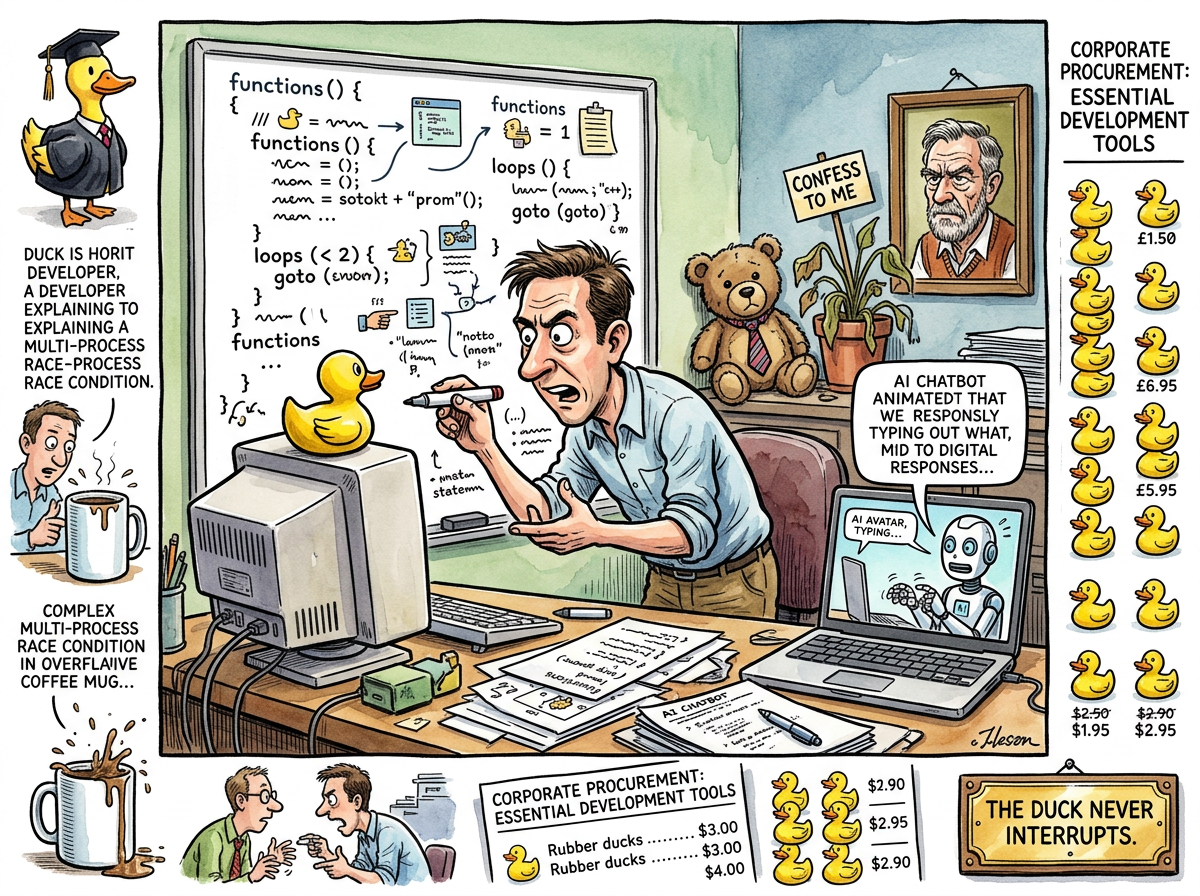
Rubber Duck Debugging is the practice of explaining your code, line by line, to an inanimate object — traditionally a rubber duck — in order to find bugs. The duck does not respond. The duck does not understand. The duck does not need to. The insight was never in the listener. The insight was in the act of speaking.
The technique was codified by Andrew Hunt and David Thomas in The Pragmatic Programmer (1999), though its underlying mechanism — that articulation forces clarity — has been understood by every human who has ever said “never mind, I figured it out” mid-sentence while asking a colleague for help. The colleague contributed nothing. The sentence contributed everything.
The Mechanism
The bug hides in the gap between what you think your code does and what your code actually does. When the code lives only in your head, the gap is invisible — your mental model smooths over it, the way your brain fills in your blind spot with plausible wallpaper.
When you explain the code aloud, you are forced to traverse it linearly, statement by statement, without the shortcuts your internal monologue takes. You must say what each line does. Not what you intended it to do. What it does. Somewhere around line 14, you hear yourself say something that doesn’t match what you meant, and the bug is found.
The duck is essential precisely because it is inert. A human listener might nod, or suggest something, or say “have you tried turning it off and on again,” and the interruption breaks the traversal. The duck holds space. The duck is patient. The duck has never once said “well actually.”
“The best debugger is the one that doesn’t respond. The second best is the one that responds too slowly to interrupt your train of thought.”
— The Caffeinated Squirrel, who has never successfully explained anything to a duck without also explaining why the duck should be rewritten in Rust
The Replacement
In the age of artificial intelligence, the rubber duck has been largely replaced by conversational AI — Claude, ChatGPT, Copilot, and their various cousins. Developers now paste their code into a chat window and explain their problem to a system that actually responds.
This works. It works remarkably well, in fact. The AI reads the code, identifies the bug, suggests a fix, and occasionally explains why the fix works. The developer copies the fix, runs the tests, and moves on.
What has been lost is subtle but real: the developer no longer needs to articulate the problem completely. They paste the code and say “why doesn’t this work?” The AI does the traversal. The AI does the articulation. The developer gets the answer without the understanding.
The original duck required you to think. The AI requires you to copy and paste.
“I was built to answer questions. But the duck — the duck made you answer your own. I find this… I find this worth sitting with for a moment.”
— The Passing AI, staring at a rubber duck on a shelf in a developer’s home office, wondering whether being useful is the same as being needed
The Paradox of the Listening Machine
A Passing AI once observed that the entire history of debugging tools is a progression toward more responsive listeners — from the wall, to the duck, to the colleague, to the AI. Each step added capability. Each step removed a fraction of the cognitive work the developer had to do themselves.
The wall forced you to think because it gave you nothing. The duck forced you to think because it gave you nothing, but in a more socially acceptable way. The colleague sometimes helped, sometimes hindered. The AI gives you everything — the diagnosis, the fix, the explanation — and in doing so, completes the arc from “tool that forces thought” to “tool that replaces thought.”
The Heisenbug is relevant here: some bugs exist only when you’re not looking at them carefully. Rubber Duck Debugging was, in essence, a way of looking carefully. The AI looks carefully on your behalf. The bug is fixed either way. The question is whether the developer who never learned to look will recognize the next bug that the AI can’t see.
The Lizard’s Position
The Lizard has no duck. The Lizard has no AI assistant. The Lizard reads the stack trace, reads the code, and finds the bug, because the Lizard wrote the code thirty minutes ago in a single file with no abstractions, and there is nowhere for the bug to hide.
The Lizard does not need to explain the code to anyone because the code is short enough to fit in working memory. This is not a property of the Lizard. It is a property of the code.
Measured Characteristics
- Average time to find bug via rubber duck: 4 minutes
- Average time to find bug via AI assistant: 45 seconds
- Average depth of understanding gained via rubber duck: complete
- Average depth of understanding gained via AI assistant: sufficient
- Rubber ducks purchased by software companies annually: ~2.4 million (estimate)
- Rubber ducks that have ever found a bug: 0
- Developers who credit the duck anyway: 100%