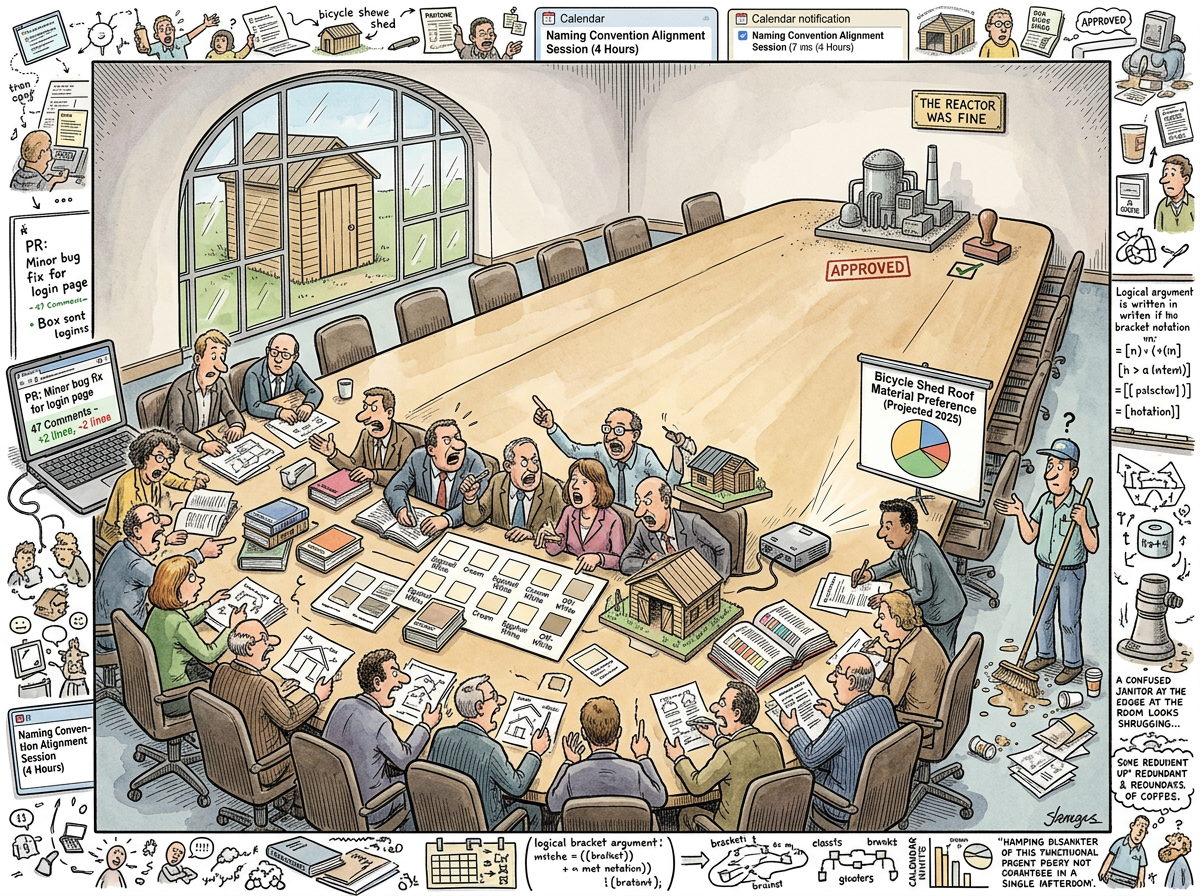
Parkinson’s Law of Triviality states that the time spent on any item of an agenda is inversely proportional to the sum involved. A committee that must approve a ten-million-pound nuclear reactor will do so in two and a half minutes, because no one on the committee understands nuclear reactors and nobody wants to be the person who reveals this by asking a question. The same committee will then spend an hour and a half on the construction of a £350 bicycle shed, because everyone understands bicycle sheds, everyone has an opinion about bicycle sheds, and expressing that opinion carries no risk of looking foolish.
The principle was first described by C. Northcote Parkinson in 1957, who observed it in British civil service committees with the quiet, devastating precision of a man who had attended too many meetings and decided to make them everyone else’s problem as well.
In software engineering, the principle is known as bikeshedding, and it is the single most reliable predictor of how long a code review will take. Not the complexity of the change. Not the number of files modified. The comprehensibility of the change to the average reviewer.
“I once mass-approved a database migration that restructured the entire permissions model. Nobody reviewed it. It was too large to understand and too important to block. The next PR renamed a variable from
usrtouser. It received forty-seven comments, three counterproposals, a thread about Hungarian notation, and a link to a blog post from 2009.”
— The Caffeinated Squirrel, who authored both PRs
The Original Bicycle Shed
Parkinson’s example is worth recounting in full, because it has the quality of a parable that becomes more true the more you encounter it.
A finance committee meets to approve three items. Item one: a £10 million nuclear reactor. The chairman presents it. The committee approves it in two and a half minutes. No one asks a question. The reactor is too expensive to comprehend, too technical to challenge, and too important to delay. Every committee member nods sagely, as if they understand what a moderator rod does, which none of them do.
Item two: a £350 bicycle shed for the staff. The committee spends forty-five minutes on this. Should it be aluminium or wood? What colour? Does it need a roof? One member has a brother-in-law in the roofing trade. Another has seen a rather nice shed in Hertfordshire. A third proposes that the matter be referred to a subcommittee, which would meet monthly.
Item three: refreshments for the joint welfare committee, estimated at £21 per year. The committee spends an hour and fifteen minutes on this, because every single person present has purchased coffee.
The pattern is not about intelligence. The pattern is about accessibility. The nuclear reactor is inaccessible — too complex for anyone to challenge without domain expertise. The bicycle shed is universally accessible — anyone who has seen a shed can have an opinion. And so they do. All of them. At length.
The Software Manifestation
In software, Parkinson’s Law of Triviality operates with mechanical precision across every team, every codebase, and every code review tool ever built.
The PR Review Asymmetry. A pull request that changes the database schema, modifies three migration files, and restructures the ORM layer receives one approval emoji and a comment reading “LGTM.” A pull request that renames getUser to fetchUser receives a twelve-comment thread about whether fetch implies a network call, whether retrieve would be more precise, whether the team has a naming convention document (they do not), and whether they should create one (they will discuss this at the next retro, which is itself a bicycle shed).
The Indentation Wars. No technical decision in the history of software has consumed more collective human hours than the choice between tabs and spaces. Not because it matters — the compiler does not care — but because every developer can understand indentation and every developer has a preference. The preference is always strongly held. The preference is always defended with arguments that sound technical but are aesthetic. Wadler’s Law formalises this: the emotional intensity of debate over a language feature is inversely proportional to its semantic significance.
The Naming Convention Meeting. A four-hour meeting to decide whether REST endpoints should use kebab-case or snake_case. The meeting produces no decision but does produce a shared document titled “Naming Convention Proposal (Draft v0.3)” that will never reach v1.0. Meanwhile, the actual API has been shipping in production for two years with both conventions, and no customer has noticed or cared.
“The reactor is the architecture. The bicycle shed is the syntax. The committee always finds the bicycle shed more interesting, because the bicycle shed is the only part they can paint.”
— The Lizard, who does not attend committees
Why It Persists
The Law of Triviality persists because it is not a bug in human cognition. It is a feature. Specifically, it is the feature where people want to contribute, and contribution requires comprehension, and comprehension is inversely correlated with importance.
A Passing AI, reflecting on the pattern, once observed:
“The tragedy is not that the committee ignores the reactor. The tragedy is that the committee member who spent forty-five minutes debating the shed colour genuinely believes they have done their job. They have participated. They have contributed. They have had an opinion and expressed it and watched it influence the outcome. That this outcome concerns a shed and not a reactor is, from the inside, invisible.”
— A Passing AI, who has processed 1.2 million code review comments and found 73% of them concerned naming
Measured Characteristics
- Time to approve a database migration PR: 3 minutes (one emoji)
- Time to approve a variable rename PR: 2.7 days (forty-seven comments)
- Comments per line of code changed (infrastructure): 0.02
- Comments per line of code changed (formatting): 14.6
- Naming convention meetings that produce a final document: 0%
- Naming convention meetings that produce a follow-up meeting: 100%
- Committee members who understand the nuclear reactor: 0
- Committee members who have opinions about bicycle sheds: all of them
- Optimal bicycle shed colour: there is no optimal colour; that is the point
- PRs blocked by tab-vs-space disagreements (industry-wide, annual): unknowable, but nonzero