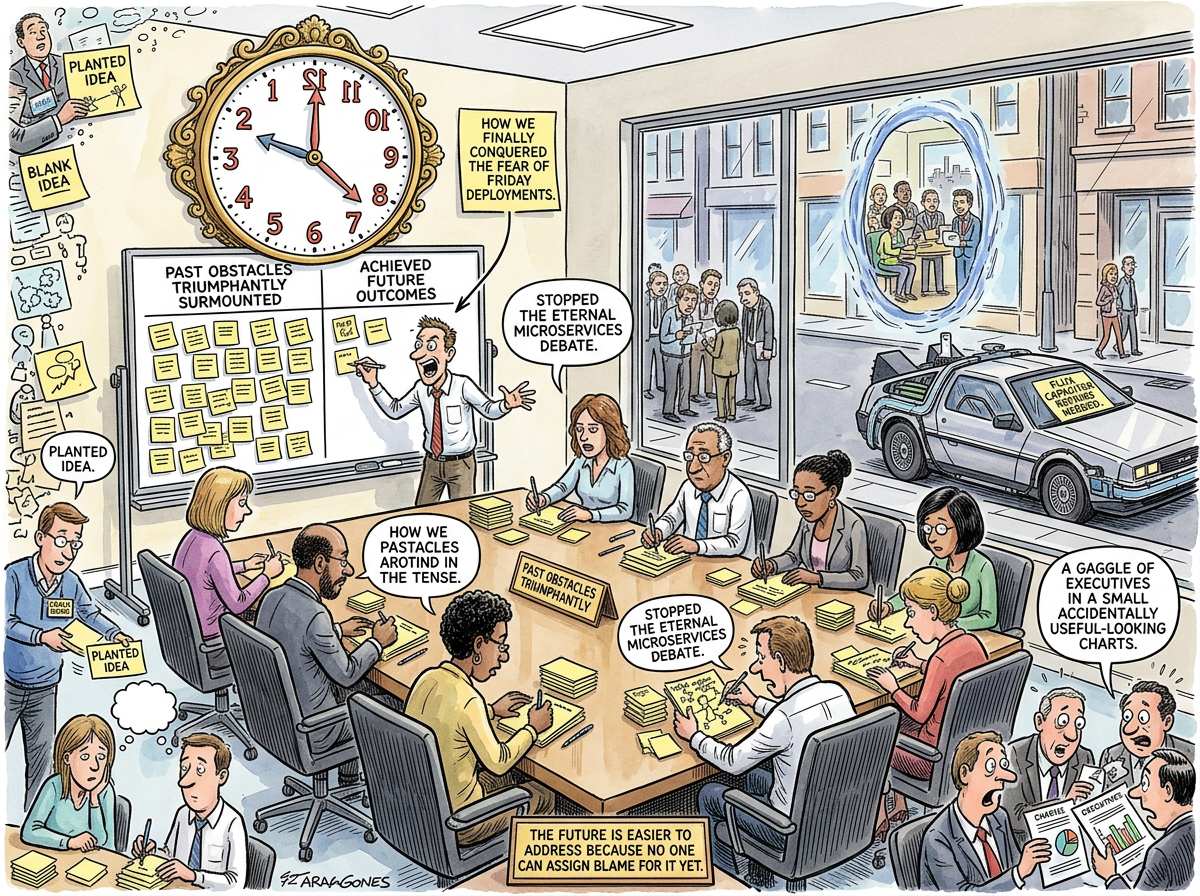
The Futurespective is a facilitation technique in which participants imagine themselves at a point in the future — typically six months to a year from now — and describe, in past tense, what happened to get them there. It is a Retrospective conducted on events that have not yet occurred, which sounds like either science fiction or a waste of time, and is in practice the single most effective way to get a room full of humans to say what they actually think.
The futurespective works because the future hasn’t blamed anyone yet. A Retrospective asks “what went wrong?” — which triggers defensiveness, because the things that went wrong have names attached to them. A futurespective asks “what obstacles did we overcome?” — which triggers honesty, because the obstacles being described are hypothetical, and hypothetical obstacles have no authors, no guilty parties, no disciplinary implications. People will say “we overcame our fear of releasing without a three-week QA cycle” in a futurespective who would never, in a retrospective, say “our QA process is broken” while the QA lead is sitting right there.
This is not a trick. It is a time machine. The temporal displacement makes truth-telling safe.
“Start where you are. Involve the people. Change one thing.”
— The summary of Agendashift, which uses the futurespective as its core discovery mechanism
The Mechanism
The futurespective operates on a simple cognitive shift: past tense creates emotional distance.
“What problems do we have?” produces anxiety, blame, and sticky notes that say “communication.”
“What problems did we solve?” produces stories, specifics, and sticky notes that say “we stopped having the architecture review meeting that nobody prepared for because the architect was always on holiday.”
The second sticky note is useful. The first sticky note is a prayer. The difference is the tense.
The facilitator’s script is:
- “Imagine it is one year from now. Everything went well. We achieved what we wanted.”
- “What obstacles did we overcome to get here?”
- Participants write obstacles in past tense on sticky notes.
- The obstacles are clustered, discussed, and flipped into outcome statements.
- The outcomes are prioritized.
- The top outcomes become the agenda for actual change.
At no point does anyone say “what’s wrong.” At every point, people are saying what’s wrong — they’re just saying it in past tense, about a version of reality that doesn’t exist yet, which makes it bearable.
The FOTO Format
Agendashift formalized the futurespective into a structured exercise called FOTO — From Obstacles To Outcomes. The 15-minute FOTO is the entry point: a short, sharp facilitation that surfaces real obstacles and converts them into actionable outcomes in the time it takes most workshops to agree on ground rules.
The FOTO works. The FOTO also has a failure mode that Mike Burrows documents with less emphasis than it deserves.
The Awkward Silence Problem
The FOTO asks participants to write obstacles on sticky notes. In a room of agile coaches, product managers, or anyone who has been through facilitation training, the sticky notes flow immediately. These people are professionally fluent in articulating organizational dysfunction. They have vocabulary. They have practice. They can name an obstacle the way a sommelier names a grape — with precision, confidence, and mild condescension.
In a room of people who have never been asked to imagine the future and write down what went wrong in it — engineers, executives, accountants, anyone whose job does not include “facilitation” in the description — the FOTO produces a silence so dense it has its own gravitational field. People stare at blank sticky notes. People look at each other. People write “communication” because it is the one safe word in organizational development, the way “fine” is the one safe word in personal development.
The silence is not a failure of the technique. It is a failure of preparation.
The plant. Every experienced futurespective facilitator seeds the room. One or two coaches, pre-briefed, sitting among the participants, who write the first sticky notes — the slightly brave ones, the ones that name something real but not dangerous. “We overcame our dependency on the platform team for every deployment.” The plant’s sticky note gives the room permission. The second sticky note is always braver than the first. The third is braver still. By the fifth, the room is writing things the facilitator didn’t expect, which is the entire point.
Without the plant, the room stares. With the plant, the room speaks. This is not manipulation. This is facilitation — the creation of conditions in which honesty becomes possible. The plant does not write the room’s truth. The plant writes the first sentence, and the room writes the rest.
“The futurespective is a time machine. But like all time machines, someone has to go first.”
— riclib, who learned this by watching rooms freeze
The Mission and Vision Weapon
The futurespective’s most devastating application is not the team retrospective. It is the mission and vision workshop.
Mission and vision workshops are, in their natural state, a particular form of corporate suffering. Twenty people in a room for a full day, tasked with producing a mission statement and a vision statement, armed with sticky notes and a facilitator who has been instructed to “get alignment.” The output, after eight hours, is a sentence so carefully negotiated that it means nothing — a diplomatic communiqué from a country that doesn’t exist to a population that won’t read it.
“We empower innovative solutions through collaborative excellence to deliver transformational value for our stakeholders.”
This sentence was produced by humans. It took a day. It will be printed on a wall. Nobody will look at it. The wall will be repainted within eighteen months and the sentence will be gone, and nobody will notice.
The futurespective bypasses the entire negotiation. Instead of asking “what is our mission?” — which produces abstract nouns — it asks “it’s a year from now and we succeeded. What did we actually do?”
The answers are specific. “We shipped the self-service portal and reduced onboarding from three weeks to two days.” “We stopped requiring VP approval for changes under ten thousand dollars.” “We hired three senior engineers and stopped losing them to companies that let them deploy without a change advisory board.”
These are not mission statements. They are better than mission statements. They are outcomes — concrete, measurable, and produced by the people who will have to deliver them. The mission, if you need one, can be reverse-engineered from the outcomes in fifteen minutes. It took the futurespective to produce the truth, and the truth can be summarized.
riclib discovered this by accident. Tasked with facilitating a mission and vision workshop for a department that had failed to produce either in three previous attempts, riclib ran a futurespective instead. “Imagine it’s a year from now. The department is exactly where you want it to be. What happened?” The room produced, in forty-five minutes, more actionable strategic direction than three full-day workshops had produced in aggregate. The mission statement was written in ten minutes at the end, from the outcomes, as an afterthought. It was the only mission statement the department ever used, because it was the only one that described something real.
The three previous workshops had asked “what do we want to be?” The futurespective asked “what did we do?” The difference is the difference between aspiration and imagination, and imagination is more honest because it is more specific.
The Pre-Mortem Variant
The futurespective has a dark twin: the pre-mortem.
Where the futurespective asks “imagine everything went well — what did we do?” the pre-mortem asks “imagine everything went wrong — what happened?”
The pre-mortem is useful. The pre-mortem surfaces risks that optimism obscures. The pre-mortem is also significantly harder to facilitate, because imagining collective failure produces anxiety in a way that imagining collective success does not. The futurespective is a holiday photograph from next year. The pre-mortem is a post-crash investigation report from next year. Both are useful. One of them is a lot more fun to write.
Gary Klein formalized the pre-mortem in 2007. Agendashift chose the positive variant — obstacles overcome, not disasters suffered — because the positive framing produces more actionable output and less existential dread. This is a design decision, not a philosophical one. Both time machines work. One of them brings people back happier.
Why It Works When Retrospectives Don’t
The Retrospective fails when people don’t feel safe saying the truth about what happened. The futurespective succeeds because it asks people to say the truth about what hasn’t happened. The temporal displacement is the safety mechanism.
A retrospective says: “The deployment failed because we didn’t test the migration.” Someone is responsible. Someone is in the room. Someone’s face changes colour.
A futurespective says: “We overcame our tendency to skip migration testing before deployments.” Nobody is responsible. Nobody is accused. The obstacle is named. The obstacle is real. The obstacle is the same obstacle. But the tense changes everything.
This is why the futurespective is the most underused tool in organizational development. It does what the retrospective promises — surfaces truth, produces change — but without the scar tissue. It is the retrospective’s better-adjusted sibling: the one that went to therapy, learned to communicate without blame, and still calls on holidays.
Measured Characteristics
| Property | Value |
|---|---|
| Time orientation | Future (past tense) |
| Truth surface area | High (temporal safety) |
| FOTO duration | 15 minutes (the short version that replaces your all-day workshop) |
| Sticky notes per participant | 2-4 (if planted), 0-1 (if not planted) |
| Coaches to plant in the room | 1-2 (minimum; more for larger groups) |
| Awkward silence probability (without plants) | ~80% |
| Awkward silence probability (with plants) | ~10% |
| Mission statements produced by three previous full-day workshops | 0 useful |
| Mission statements produced by one 45-minute futurespective | 1 (the one that stuck) |
| Action items that say “communicate better” | 0 (the past tense prevents this) |
| Gary Klein’s pre-mortem year | 2007 |
| Agendashift’s FOTO year | 2017 |
| People who call it a “time machine” | at least 1 |
See Also
- Retrospective — The backward-looking sibling. Same goal, less temporal safety.
- Agendashift — Uses the futurespective (FOTO) as its core discovery mechanism.
- Agile Coach — The person who should know this technique but might not have planted the room.
- Ceremony — The futurespective is a ceremony that works by pretending to be a conversation from the future.
- Transformation Initiative — The thing a good futurespective can replace for a fraction of the cost.
- Gall’s Law — The futurespective produces small, specific outcomes. Gall’s Law approves.