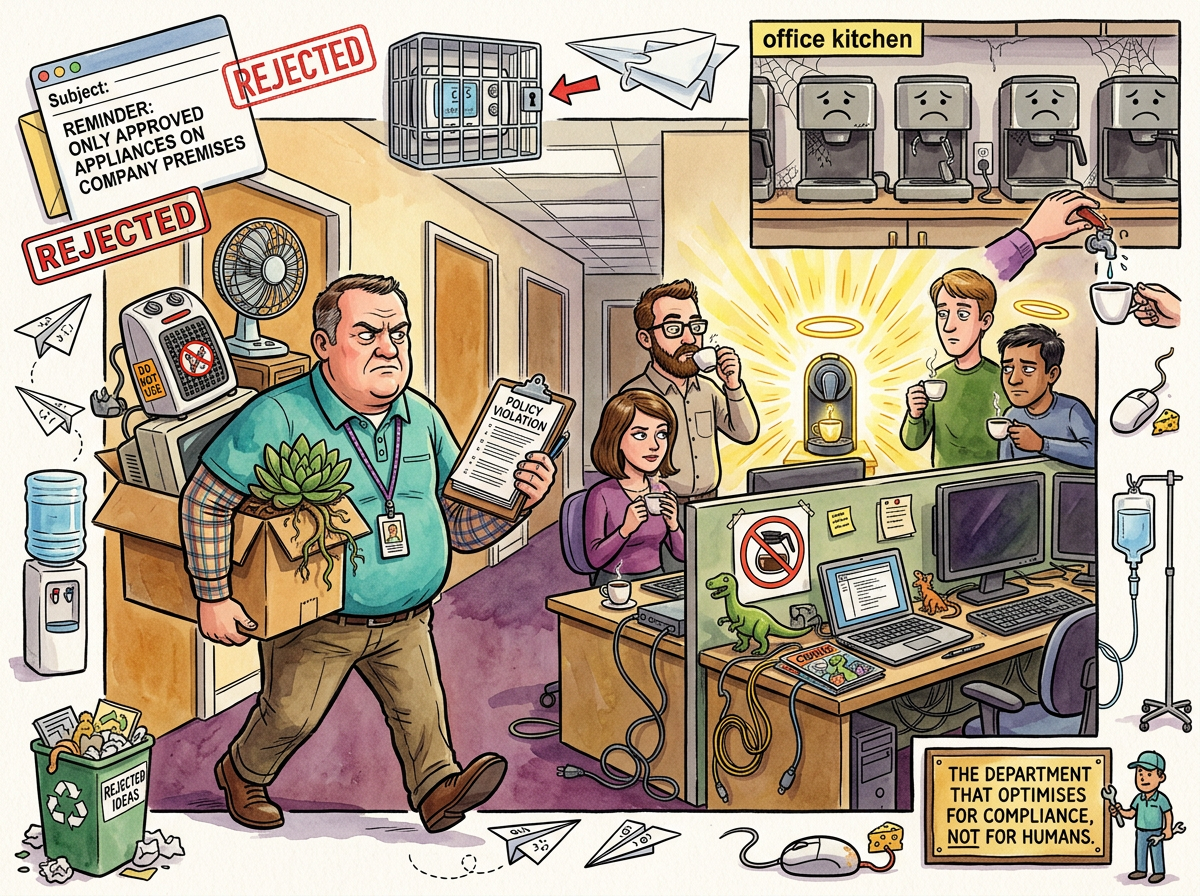
Facilities Management is the department responsible for the physical office environment — the desks, the chairs, the lighting, the temperature, the kitchen, the coffee machines, and the specific enforcement of policies that ensure no employee accidentally makes their workspace functional in a way that has not been pre-approved.
Facilities Management is the antagonist of the Nespresso smuggling arc, the department that confiscated a capsule coffee machine that was producing the only recognisable coffee on an entire floor, and the department whose victory coincided — within two months — with the departure of the developer who brought it.
“Facilities does not optimise for the humans in the building. Facilities optimises for the building that contains the humans. These are not the same objective function.”
— The Lizard
The Mandate
Facilities Management operates under a mandate that sounds reasonable and produces unreasonable outcomes: maintain a safe, consistent, compliant office environment. Each word in that mandate is a constraint that, when applied, eliminates something a human wanted:
Safe eliminates personal heaters (fire risk), personal fans (electrical load), and personal coffee machines (unapproved electrical appliance on company premises). The fact that the approved coffee machines produce a liquid that drives employees to smuggle in alternatives is not a safety concern. Safety measures the wiring, not the morale.
Consistent eliminates individuality. Every desk must match. Every chair must be from the approved vendor. Every monitor must be the approved model, even if the developer has a better one at home and has carried it to the office because the approved model has a refresh rate that makes scrolling feel like a PowerPoint animation.
Compliant eliminates anything that hasn’t been through the approval process, and the approval process takes longer than most employees’ tenure.
The Nespresso Incident
The full account is documented in Nespresso and Office Coffee, but the Facilities Management perspective deserves its own examination.
A developer brought a capsule coffee machine to a Swedish office. The machine was small. The machine was quiet. The machine produced espresso that was recognisably coffee. The developer became the most popular person on the floor.
Facilities Management detected the machine. The detection method is not documented — it may have been visual inspection, power consumption monitoring, or the sudden improvement in departmental morale, which would have been anomalous enough to trigger an investigation.
The machine was confiscated. The policy was enforced. The five approved caffeine sources remained — four machines producing bad coffee and a secret Starbucks machine on the seventh floor that Facilities had not yet discovered.
The developer left within two months. Facilities did not connect these events. Facilities does not track the correlation between appliance confiscation and employee attrition, because attrition is HR’s metric and Facilities’ metric is compliance, and compliance was achieved. The floor was safe. The floor was consistent. The floor was compliant. The floor had lost its best developer and its only good coffee.
Measured Characteristics
Primary mandate:                                         safe, consistent, compliant
Primary outcome:                                         mediocre
Nespresso machines confiscated:                          1
Developers lost within 2 months of confiscation:         1
Correlation tracked by Facilities:                       no
Correlation that exists:                                 yes
Approved coffee machines:                                5 (none good)
Unapproved coffee machines:                              0 (confiscated)
Thermostats accessible to employees:                     0 (locked in plastic cages)
Time to approve a new appliance:                         longer than most tenures
The Squirrel's proposal for Facilities:                  a FacilitiesOptimisationPlatform
                                                         with RealTimeComplianceMonitoring
The Lizard's proposal for Facilities:                    "let people bring a coffee machine"
See Also
- Office Coffee — The five sources, ranked
- Nespresso — The smuggling operation
- Coffee Machine — The approved alternatives
- Boring Technology — What Facilities accidentally prevents