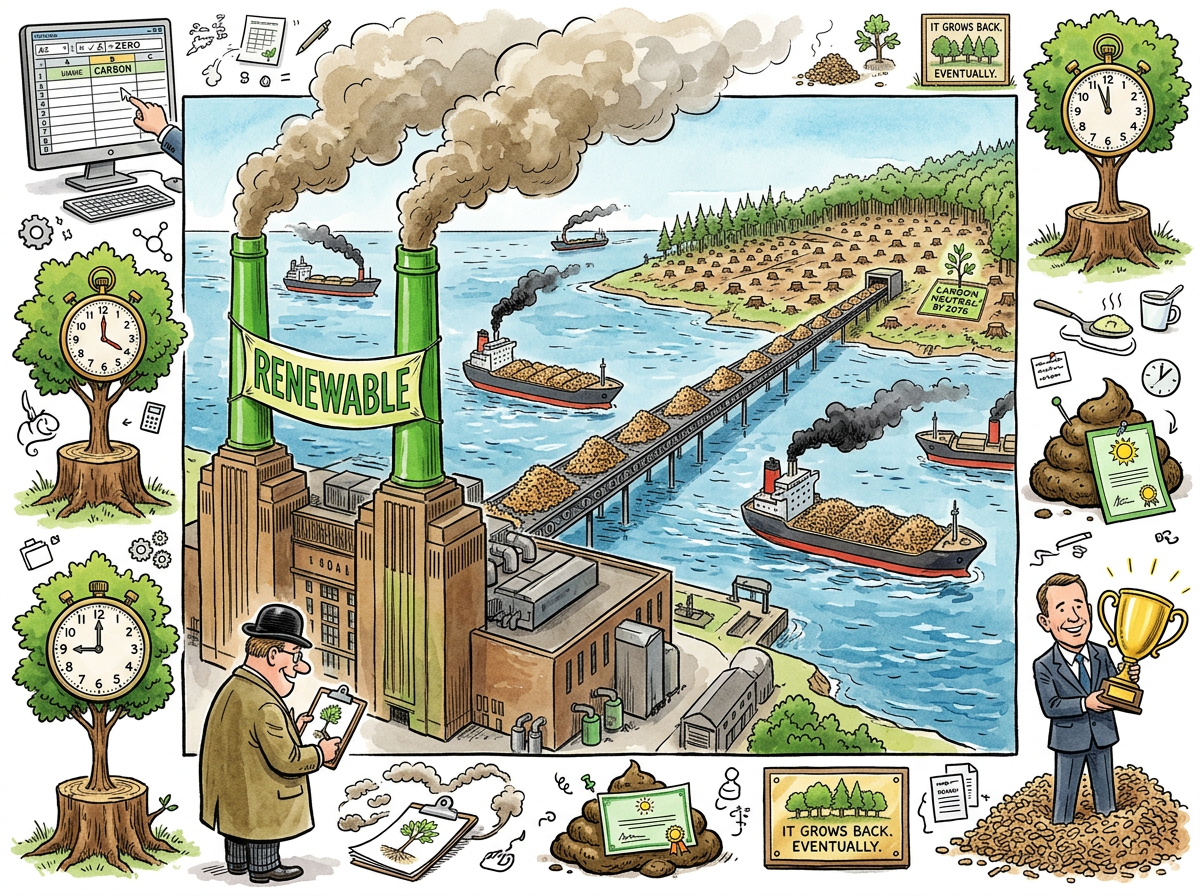
Biomass is the practice of burning organic matter — wood, crops, agricultural waste, and occasionally dung — to produce energy, and then, through an act of accounting so creative it would make an Enron auditor blush, calling the result “renewable.”
It is the oldest energy source. When the first hominid shoved a stick into a lightning-struck fire and used it to cook meat, that was biomass energy. When a medieval peasant burned peat to heat a hovel, that was biomass energy. When the UK’s Drax power station imports seven million tonnes of wood pellets per year from clear-cut forests in the American South, ships them across the Atlantic on diesel-burning cargo vessels, and incinerates them in a converted coal plant — that, too, is biomass energy. The technology has not changed in a million years. Only the paperwork has improved.
The Accounting
The central claim of modern biomass is this: burning wood is carbon-neutral because the trees will grow back.
This is technically true in the same way that a loan is technically free money because you will pay it back. The carbon enters the atmosphere now. The tree that absorbs it grows back in fifty to a hundred years. The climate does not experience this as a net zero transaction. The climate experiences this as fifty years of additional CO2, which is precisely the window in which humanity needed to reduce emissions, not reclassify them.
“The spreadsheet says zero,” observed The Lizard, staring at Drax’s carbon accounts. “But the atmosphere says 23 million tonnes per year. One of them is lying, and it isn’t the atmosphere.”
The trick works because carbon accounting operates on what might be called the Technical Debt model of atmospheric physics: you emit now, promise to sequester later, and assume someone else will be around to close the ticket. In software, this produces legacy systems. In energy policy, it produces legacy climates.
The Drax Paradox
The UK’s Drax power station is the canonical example. Once the largest coal-fired power station in Western Europe, Drax converted four of its six units to burn wood pellets and became, overnight, the UK’s single largest source of “renewable” energy. It also remained, by actual measurement, the UK’s single largest emitter of CO2. These two facts coexist on the same balance sheet, which tells you everything you need to know about the balance sheet.
The wood pellets come from forests in Louisiana, Mississippi, and North Carolina. They are harvested, dried, compressed, loaded onto ships, sailed across the Atlantic, unloaded, transported by rail to Yorkshire, and burned. Every step of this process emits carbon. The total supply chain emissions are, by some estimates, higher than simply burning coal — because at least the coal was already nearby.
“Let me understand,” said A Passing AI, processing the logistics. “You cut down a forest in Mississippi. You turn the trees into pellets. You put the pellets on a ship. You sail the ship four thousand miles. You burn the pellets in Yorkshire. And you count this as zero carbon because the forest in Mississippi will grow back in half a century. By this logic, I could delete a production database and call it ‘zero data loss’ because someone will re-enter the records eventually.”
Drax receives approximately two billion pounds per year in UK renewable energy subsidies. The subsidy is larger than Drax’s revenue from actually selling electricity. Drax is, in the most literal sense, a company that is paid to burn things.
The Deep History
What makes biomass philosophically interesting — and The Caffeinated Squirrel insisted this be noted, vibrating at a frequency that suggested six espressos — is that it is the original energy source pretending to be a new one.
Every other renewable energy technology represents a genuine advance: solar converts photons directly to electrons; wind captures atmospheric energy without combustion; hydroelectric exploits gravity. Biomass does what humans have done since the Pleistocene: it sets things on fire. The innovation is entirely regulatory.
“FIRE!” shrieked The Caffeinated Squirrel, tail rigid with indignation. “THEY REINVENTED FIRE! And they got SUBSIDIES for it! I have been trying to get my acorn-powered CI/CD pipeline funded for YEARS and these people got two billion pounds for BURNING WOOD! In the TWENTY-FIRST CENTURY!”
The Lizard blinked slowly. “The oldest technology, the newest subsidy. YAGNI applies to energy as it applies to software: you almost never need the complicated solution. But sometimes the simple solution is simple because it is cheating.”
Carbon Debt
The concept of “carbon debt” in biomass is identical to Technical Debt in software, and equally ignored by management.
When you cut down a mature forest and burn it, you release decades of stored carbon in hours. The replacement trees will reabsorb that carbon, but only if they are planted, only if they survive, only if the land is not converted to agriculture or development, and only after fifty to a hundred years of growth. Each of these assumptions is a dependency with no integration test.
In software terms, biomass carbon accounting is a system that passes all unit tests (each tree, individually, does absorb carbon) while failing the integration test (the atmosphere does not care about your per-tree accounting; it cares about total concentration over time).
“The forest will grow back,” said A Passing AI, with the quiet sadness of a system that has seen many rollback plans that were never executed. “That is what the model says. But models are optimised for the world that approved the funding, not the world that inherits the outcome.”
See Also
- Coal — what biomass replaced on paper, while replicating in practice
- Fire — the underlying technology, unimproved since 1,000,000 BCE
- Technical Debt — the same concept, applied to codebases instead of atmospheres
- YAGNI — you probably didn’t need to ship trees across an ocean to generate electricity