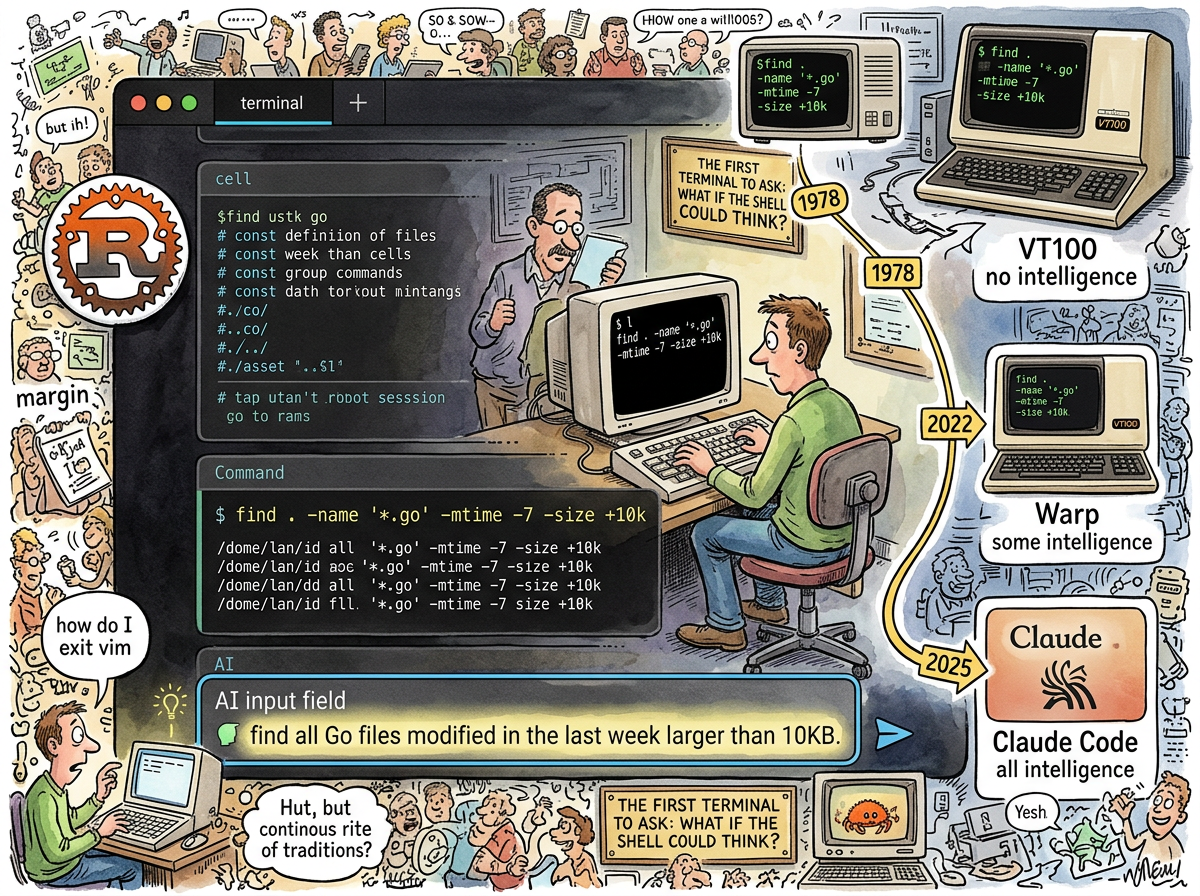
Warp is a terminal emulator created by Zach Lloyd in 2022, written in Rust, and notable for being the first mainstream terminal to integrate a large language model into the command-line experience. You type a question in natural language. The terminal suggests a command. The command is usually correct.
This sounds like a small feature. It is not a small feature. It is the crack in the wall through which Claude Code later drove a truck.
“Warp was the first terminal to ask: what if the shell could think? The question turned out to be more important than the answer, because the answer was: it shouldn’t think a little. It should think a lot. And then it’s not a terminal anymore.”
— A Passing AI, reviewing its own genealogy
The Innovation
Traditional terminals are scrolls. Command, output, command, output, an endless river of text where finding the output of a specific command requires scrolling, searching, and hoping. Warp introduced blocks — each command and its output grouped together as a discrete unit, like cells in a notebook. You can select a block, copy a block, share a block. The output doesn’t bleed into the next command’s context.
This was a genuine UX improvement. Terminals had been infinite scrolls since the VT100 in 1978. Forty-four years of scrolling. Warp was the first to say: what if the output belonged to the command?
But the blocks weren’t why Warp mattered. The AI was why Warp mattered.
The AI
Warp’s AI feature let you describe what you wanted in natural language, and the terminal would generate the shell command. “Find all Python files modified in the last week” → find . -name '*.py' -mtime -7. “Show disk usage sorted by size” → du -sh * | sort -rh. “Kill the process on port 8080” → lsof -ti:8080 | xargs kill.
For developers who had memorized these commands, this was unnecessary. For developers who hadn’t — which was most developers, because nobody remembers the flags to find or tar or rsync without Stack Overflow — this was magic.
The magic had limits. The AI suggested commands. It did not execute them. It did not understand context. It did not know what files were in your directory, what services were running, what you had done five commands ago. It was autocomplete with a language model — smarter than tab completion, dumber than a colleague.
But it was the proof of concept. It proved that the command line — the oldest, most stable, most resistant-to-change interface in computing — could absorb intelligence. And once that was proven, the question became: how much intelligence?
The Transition
Warp occupies a specific place in the timeline:
1978  VT100        — the terminal, no intelligence
1989  Bash         — the shell, scriptable intelligence
2005  fish         — the shell, discoverable intelligence (autosuggestions, syntax highlighting)
2022  Warp         — the terminal, LLM intelligence (natural language → commands)
2025  Claude Code  — the shell IS the intelligence
Warp was the transitional form. The terminal that added a brain but kept the old body. You still typed commands. You still read output. You still operated in the paradigm of the VT100 — human types, computer responds, text flows. The AI was an assistant sitting beside the terminal, not the terminal itself.
Claude Code removed the terminal. Or rather, Claude Code became the terminal. You don’t ask Claude Code to generate a find command. You tell Claude Code what you want, and it runs the commands, reads the output, decides what to do next, and tells you when it’s done. The human doesn’t type commands. The human states intent.
Warp was the Wright Flyer. Claude Code is the 747.
Measured Characteristics
Year released:                           2022
Creator:                                 Zach Lloyd
Written in:                              Rust (fast, native, like Zed)
Key innovation (UX):                     blocks (command + output as discrete units)
Key innovation (AI):                     natural language → shell commands
AI capability:                           suggest commands (does not execute, does not understand context)
Position in timeline:                    transitional (between dumb terminals and intelligent shells)
What it proved:                          the command line can absorb intelligence
What came next:                          Claude Code (the intelligence absorbed the command line)
See Also
- Claude Code — What happens when the intelligence doesn’t assist the shell but replaces it.
- VT100 — The terminal Warp improved on. Forty-four years of scrolling, then blocks.
- Zed — Shares the Rust DNA and the “native is faster” philosophy.
- fish — The shell that pioneered discoverable intelligence (autosuggestions). Warp added LLM intelligence. The trajectory was clear.
- sh — The shell that Warp’s AI generates commands for. sh will outlive Warp, because sh is the standard and Warp is a product.