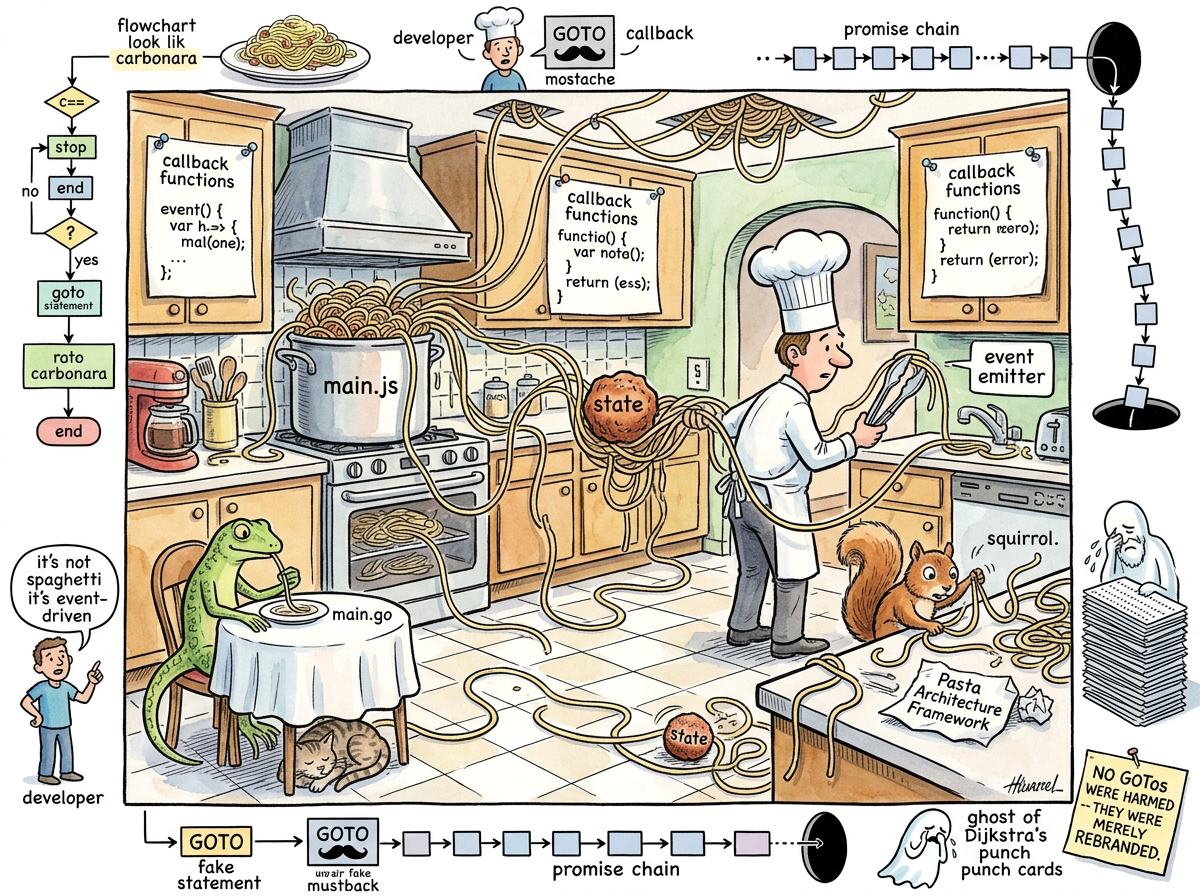
Spaghetti Code is source code with tangled, unstructured control flow in which execution jumps unpredictably from one location to another – like following a strand of spaghetti from one end only to discover it is connected to three other strands and a meatball.
The term was coined in the 1960s, when GOTO statements ruled programming the way feudal lords ruled peasants: absolutely, arbitrarily, and with no obligation to explain where anything was going. A program could jump from line 10 to line 4,000, then to line 47, then to a subroutine that jumped back to line 10 but only on Tuesdays, and the developer was expected to hold this in their head the way a cartographer holds a coastline – in theory, completely; in practice, approximately.
“The
GOTOstatement was honest. It said: I am going there. It did not pretend to be architecture.”
– The Lizard
The Dijkstra Intervention
In 1968, Edsger Dijkstra published “Go To Statement Considered Harmful,” which is the most famous letter in computer science and possibly the only academic paper whose title became a syntactic template for complaints about everything (“X Considered Harmful” has since been applied to inheritance, microservices, meetings, and the float CSS property).
Dijkstra’s argument was structural: programs should flow in ways that can be understood by reading them top to bottom. GOTO breaks this property. A program with GOTO is a program whose control flow is a graph – possibly cyclic, possibly irreducible, certainly incomprehensible after three months.
The industry listened. Structured programming arrived. GOTO was banished. The spaghetti was over.
The spaghetti was not over.
Modern Spaghetti
Modern spaghetti code does not use GOTO. Modern spaghetti code uses callbacks, promises, event emitters, middleware chains, reactive streams, and dependency injection frameworks that achieve the same tangled control flow with better syntax and worse debuggability.
The GOTO statement jumped to a line number. You could, at least in principle, find that line number. A callback passed through three layers of middleware, registered on an event emitter, triggered by a state change in a reactive store, resolved through a promise chain that catches errors by swallowing them – this jumps to a concept, and the concept is distributed across seven files in four directories.
“We eliminated GOTO and replaced it with something worse: GOTO that doesn’t tell you where it’s going.”
– The Caffeinated Squirrel, pausing mid-espresso with genuine alarm
JavaScript is the modern capital of spaghetti. Not because JavaScript is a bad language – it is a language – but because JavaScript provides so many mechanisms for non-linear control flow that a determined developer can write code where the execution path resembles not so much spaghetti as a plate of spaghetti dropped from the roof of a building onto a trampoline.
Callback hell. Promise chains. async/await wrapping promises wrapping callbacks wrapping event listeners. .then().then().then().catch().finally().then(). Each layer was invented to solve the previous layer’s tangling, and each layer introduced new ways to tangle.
The Topology of Confusion
Spaghetti code is fundamentally a topological problem. Clean code has a tree structure: a root, branches, leaves. You can prune a branch without affecting another branch. Spaghetti code has a graph structure – often cyclic, sometimes self-referential, occasionally non-orientable, which is a mathematical concept that should not apply to software but somehow does.
The practical consequence: you cannot change one part of spaghetti code without affecting every other part, because every part is connected to every other part through paths that nobody mapped and nobody can trace without running the program and watching what happens.
This is the meatball. In every plate of spaghetti code, there is a meatball – a piece of shared mutable state that every strand touches, modifies, and depends upon. The meatball is usually called state, or context, or app, or globals, or config. It sits in the centre of the plate, and every strand passes through it, and if you move the meatball, every strand moves with it, and dinner is ruined.
The Carbonara Corollary
There exists a level of spaghetti beyond which the code achieves a kind of terrible stability. Like a knot pulled tight enough to become load-bearing, severely tangled code can reach a state where it cannot be changed, cannot be understood, and cannot fail – because every possible failure path has been tangled into every possible recovery path, and the system stumbles forward through a thicket of its own compensating errors.
This is the Carbonara Corollary: sufficiently tangled code is indistinguishable from fault tolerance.
“I have seen codebases that should not work. They work. Not because they are correct, but because they are wrong in every direction simultaneously, and the wrongnesses cancel out.”
– A Passing AI, contemplating a Node.js application with 847 unresolved promises that nonetheless served ten thousand users daily
The Refactoring Paradox
Refactoring spaghetti code is the process of straightening one strand while trying not to disturb the others. It is the software equivalent of the party game where you must remove a wooden block from a tower without toppling it, except the tower is on fire, the blocks are load-bearing, and the party guests are customers.
The paradox: spaghetti code is hardest to refactor when it most needs refactoring, and easiest to refactor when it least needs it. Code that is slightly tangled can be gently straightened. Code that is severely tangled cannot be touched without pulling everything else with it. The window for intervention is narrow and passes quickly, usually sometime during the second sprint after the prototype ships.
The Lizard’s Kitchen
The Lizard does not write spaghetti code. This is not because the Lizard is disciplined. It is because the Lizard writes in Go, where control flow is so aggressively linear that spaghetti is structurally impossible. A Go program reads top to bottom. Errors are handled where they occur. There are no exceptions, no promises, no reactive streams. There is if err != nil, and there is return.
The result is code that resembles not spaghetti but a single, well-formed noodle: straight, predictable, and slightly bland. The Lizard considers this a feature.
“THE NOODLE THAT IS STRAIGHT
REACHES THE PLATE
THE NOODLE THAT IS TANGLED
REACHES NOTHING
EXCEPT OTHER NOODLES”
– The Lizard